1. What Is MgO Flooring?
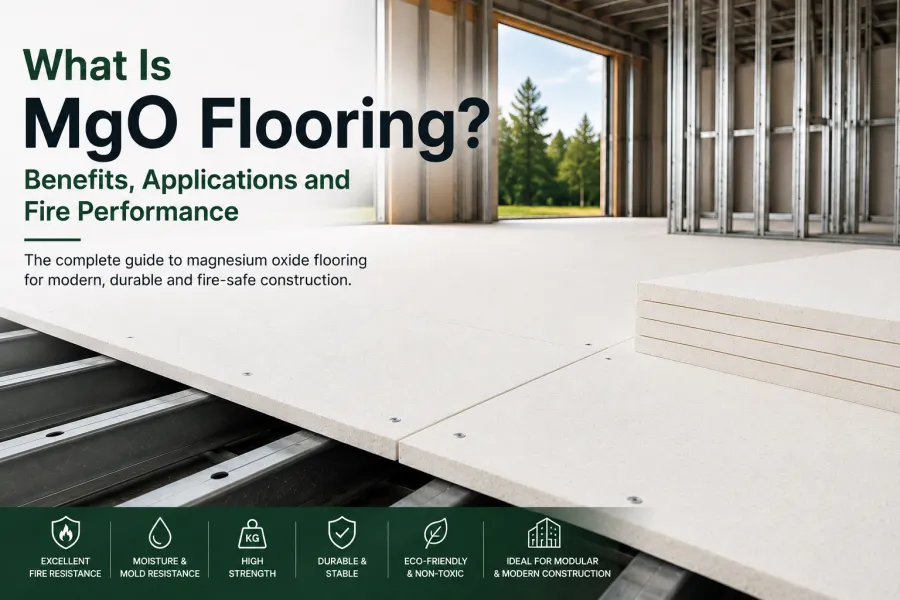
MgO flooring, also known as magnesium oxide flooring or MgO floor board, is a high-performance mineral-based flooring panel designed for subfloor and fire-rated floor systems. It is manufactured using magnesium oxide (MgO), magnesium chloride or magnesium sulfate binders, fiberglass mesh reinforcement, and lightweight mineral fillers.
Unlike standard MgO wall boards used for partitions and ceilings, MgO flooring is specifically engineered to handle structural floor loads, foot traffic, and long-term dimensional stability. It is commonly used as an alternative to plywood, OSB, and cement board in projects that require improved fire resistance, moisture resistance, and durability.
Modern MgO flooring panels are widely used in:
- Residential subfloor systems
- Commercial flooring assemblies
- Modular and prefabricated buildings
- Steel-frame construction
- Fire-rated floor systems
- Container houses and mobile units
As fire safety standards become stricter worldwide, MgO flooring is increasingly recognized as a safer and more durable flooring solution for modern construction.
2. How Is MgO Flooring Different from Standard MgO Boards?
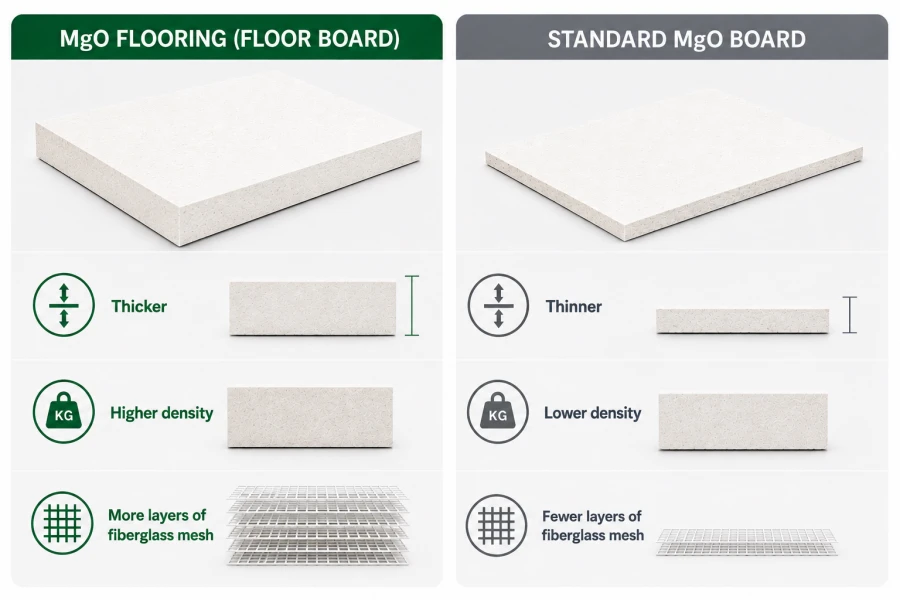
Although both products are made from magnesium oxide cement, flooring panels are structurally different from standard wall boards.
MgO flooring boards are typically:
- Thicker (usually 18–22 mm)
- Higher density (typically 1100–1400 kg/m³)
- Reinforced with multiple fiberglass mesh layers
- Designed for load-bearing applications
- Engineered for improved impact resistance and dimensional stability
By comparison, standard MgO wall boards are usually thinner and optimized for vertical applications rather than structural flooring systems.
2.1 Typical MgO Flooring Specifications
| Application | Recommended Thickness |
|---|---|
| Residential subfloor | 18 mm |
| Commercial flooring | 20 mm |
| Heavy-duty flooring | 22 mm+ |
The combination of thickness, density, and reinforcement allows MgO flooring to resist bending, cracking, and deformation under long-term use.
3. Fire Performance of MgO Flooring
3.1 Non-Combustible Flooring Material
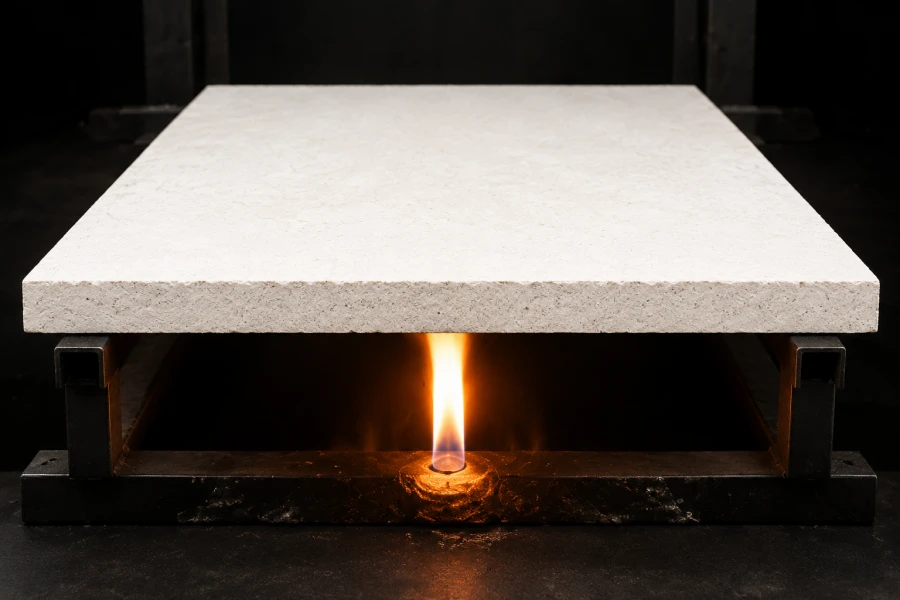
One of the biggest advantages of MgO flooring is its excellent fire resistance.
Unlike plywood or OSB subfloors, MgO flooring is non-combustible and does not contribute to flame spread during a fire. When exposed to high temperatures, the board maintains structural stability and produces minimal smoke.
Depending on the floor assembly and board thickness, MgO flooring systems may comply with fire standards such as:
- ASTM E119
- EN 13501-1
- UL fire-rated assemblies
This makes MgO flooring particularly suitable for:
- Hotels
- Schools
- Hospitals
- Apartments
- Modular buildings
- Commercial projects
3.2 Improved Fire Safety in Multi-Story Buildings
In multi-story construction, the subfloor system plays an important role in slowing fire spread between levels. Using MgO flooring can help improve evacuation time and reduce structural fire damage.
Because MgO flooring is mineral-based, it does not ignite like wood-based subfloors and does not release large amounts of toxic smoke during combustion.
4. Structural Strength and Load-Bearing Performance
4.1 Designed for Floor Loads
Floor systems experience continuous static and dynamic loads from:
- Foot traffic
- Furniture
- Equipment
- Rolling loads
- Structural movement
MgO flooring is engineered to provide the strength required for these conditions.
Typical performance advantages include:
- High compressive strength
- Excellent flexural strength
- Impact resistance
- Reduced surface cracking
- Long-term dimensional stability
Compared with traditional plywood or OSB, MgO flooring is less likely to warp, delaminate, or deform over time.
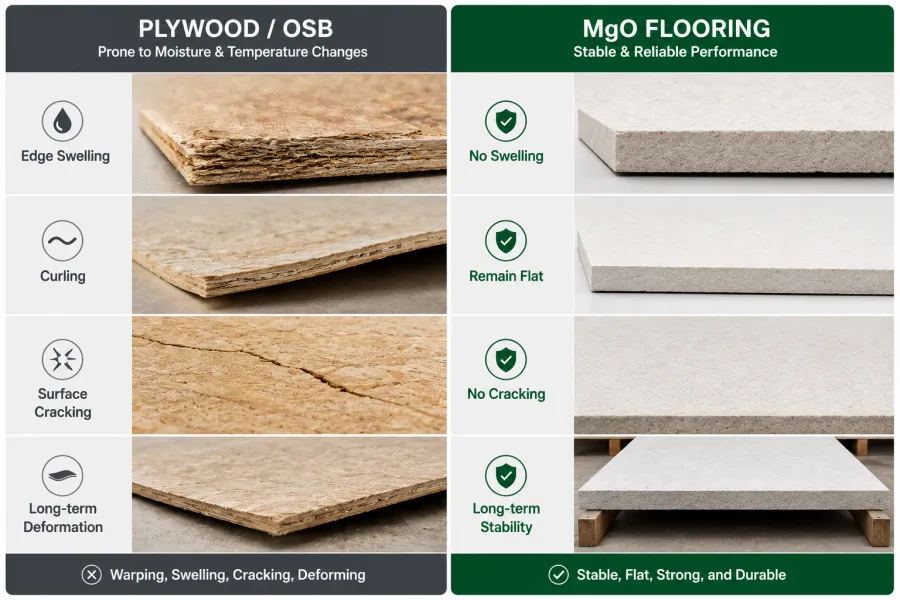
4.2 Stable Under Temperature and Humidity Changes
Traditional wood-based flooring materials can expand or shrink significantly when exposed to moisture or temperature fluctuations.
MgO flooring offers superior dimensional stability and resists:
- Edge swelling
- Curling
- Surface cracking
- Long-term deformation
This stability helps maintain a flat and secure flooring surface over many years of use.
5. Moisture Resistance and Mold Protection
5.1 Suitable for Humid Environments
MgO flooring is highly resistant to moisture and mold growth, making it suitable for environments where traditional wood subfloors may fail.
Common applications include:
- Bathrooms
- Kitchens
- Basements
- Utility rooms
- Coastal projects
- Humid climates
Unlike plywood or MDF panels, MgO flooring does not easily rot or support mold growth.
5.2 Important Limitation
Although MgO flooring is moisture-resistant, it is not intended for permanent water immersion or direct long-term weather exposure without proper protection.
Proper installation, waterproofing layers, edge sealing, and ventilation are still important for long-term performance.

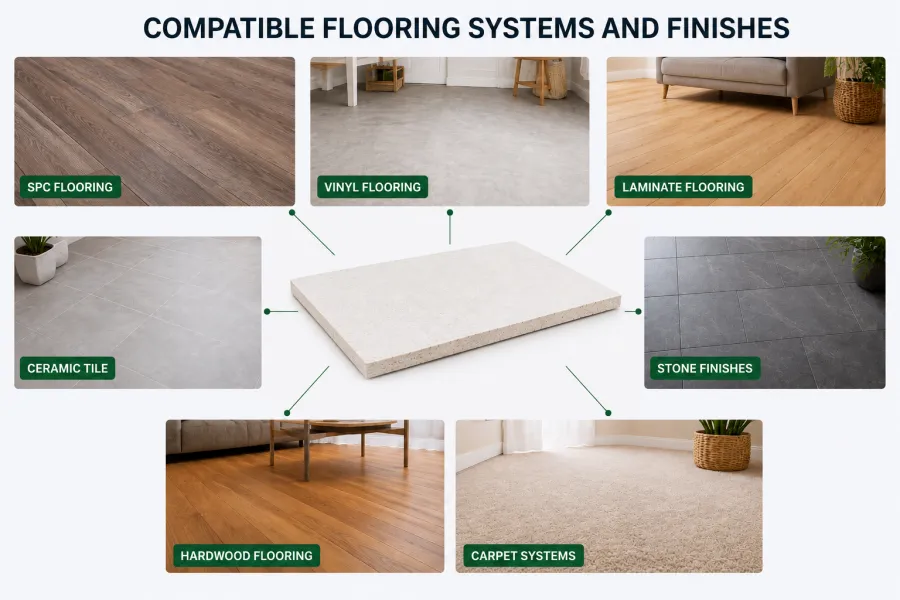
6. Compatible Flooring Systems and Finishes
MgO flooring is compatible with a wide range of modern flooring systems and finish materials.
It can be used under:
- SPC flooring
- Vinyl flooring
- Laminate flooring
- Ceramic tile
- Stone finishes
- Hardwood flooring
- Carpet systems
It also performs well in:
- Raised floor systems
- Steel-frame construction
- Modular building systems
- Underfloor heating systems
Because MgO flooring panels are relatively easy to cut and fasten, installation is often faster and cleaner compared with heavy cement boards.
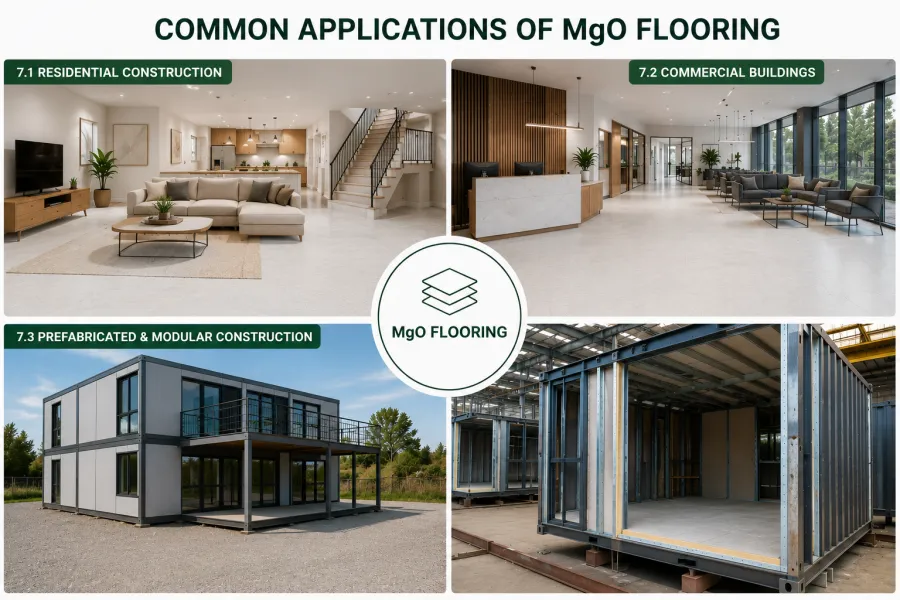
7. Common Applications of MgO Flooring
7.1 Residential Construction
In residential projects, MgO flooring is commonly used as a durable and fire-resistant subfloor solution.
Typical residential applications include:
- Apartments
- Villas
- Modular homes
- Tiny houses
- Container homes
Its dimensional stability helps reduce floor squeaking, uneven surfaces, and long-term movement.
7.2 Commercial Buildings
Commercial flooring systems require stronger materials capable of handling heavy traffic and stricter fire regulations.
MgO flooring is suitable for:
- Hotels
- Offices
- Retail spaces
- Schools
- Hospitals
- Public buildings
Its combination of fire resistance, structural strength, and moisture resistance makes it ideal for high-performance commercial projects.
7.3 Prefabricated and Modular Construction
MgO flooring is increasingly used in prefabricated and modular buildings because it offers:
- Lightweight handling
- Fast installation
- Fire-rated performance
- Compatibility with steel framing
- Long-term durability
For modular construction companies, MgO flooring can help simplify assembly while improving building safety.
8. MgO Flooring vs Traditional Subfloor Materials
| Feature | MgO Flooring | Plywood | OSB | Cement Board |
|---|---|---|---|---|
| Fire Resistance | Excellent | Low | Low | Excellent |
| Moisture Resistance | High | Low | Low | High |
| Mold Resistance | Excellent | Poor | Poor | Excellent |
| Dimensional Stability | High | Medium | Medium | High |
| Structural Strength | High | Medium | Medium | High |
| Weight | Moderate | Light | Medium | Heavy |
| Ease of Installation | Easy | Easy | Easy | Difficult |
| Environmental Safety | Non-toxic & Eco-friendly | Moderate | Moderate | Moderate |
Compared with traditional wood-based subfloors, MgO flooring provides a better balance between fire performance, durability, and moisture resistance.
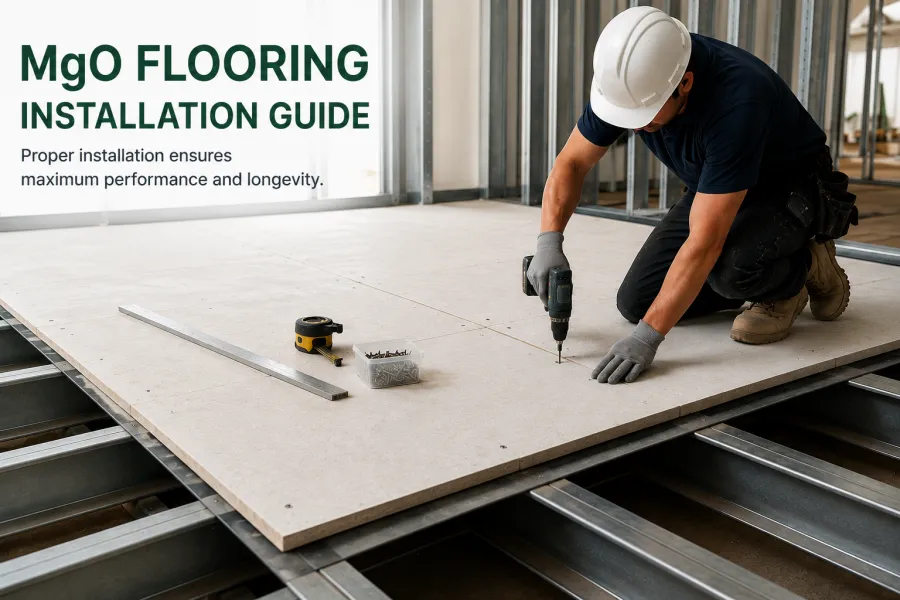
9. Installation Considerations for MgO Flooring
Proper installation is essential to maximize flooring performance.
9.1 Recommended Installation Practices
- Ensure the supporting structure is level and stable
- Leave small expansion gaps between panels
- Use appropriate screws and fastener spacing
- Seal joints in moisture-prone areas
- Store boards flat and dry before installation
MgO flooring can usually be cut using standard woodworking tools, although carbide-tipped blades are recommended for cleaner edges.
9.2 Avoid Common Installation Mistakes
Potential problems can occur if:
- Boards are exposed to standing water for extended periods
- Improper fasteners are used
- Subfloors are uneven
- Low-quality boards are selected
Choosing a reliable manufacturer and following installation guidelines are critical for long-term performance.
10. Pros and Limitations of MgO Flooring
10.1 Main Advantages
- Excellent fire resistance
- Moisture and mold resistance
- High structural strength
- Long-term dimensional stability
- Compatible with modern flooring systems
- Environmentally friendly and non-toxic
10.2 Potential Limitations
- Higher upfront cost than plywood or OSB
- Product quality varies by manufacturer
- Proper installation is important
- Not intended for permanent exterior exposure without protection
Understanding both the strengths and limitations of MgO flooring helps builders make better project decisions.
11. Is MgO Flooring Right for Your Project?
MgO flooring is an advanced subfloor solution designed for projects that prioritize:
- Fire safety
- Structural durability
- Moisture resistance
- Long-term stability
- Modern modular construction
Compared with traditional plywood or OSB systems, MgO flooring provides improved fire performance and durability while supporting modern building requirements.
For residential, commercial, modular, and fire-rated applications, MgO flooring offers a safer and more reliable alternative to conventional flooring materials.
12. Explore Our MgO Flooring Solutions
We provide high-performance MgO flooring panels suitable for:
- Residential subfloors
- Commercial flooring systems
- Modular construction
- Fire-rated assemblies
- Steel-frame buildings
Contact our team today for:
- Technical specifications
- Samples
- Pricing
- Installation recommendations
- OEM and custom solutions
Discover how MgO flooring can improve safety, durability, and long-term performance in your next construction project.
Latest Posts