
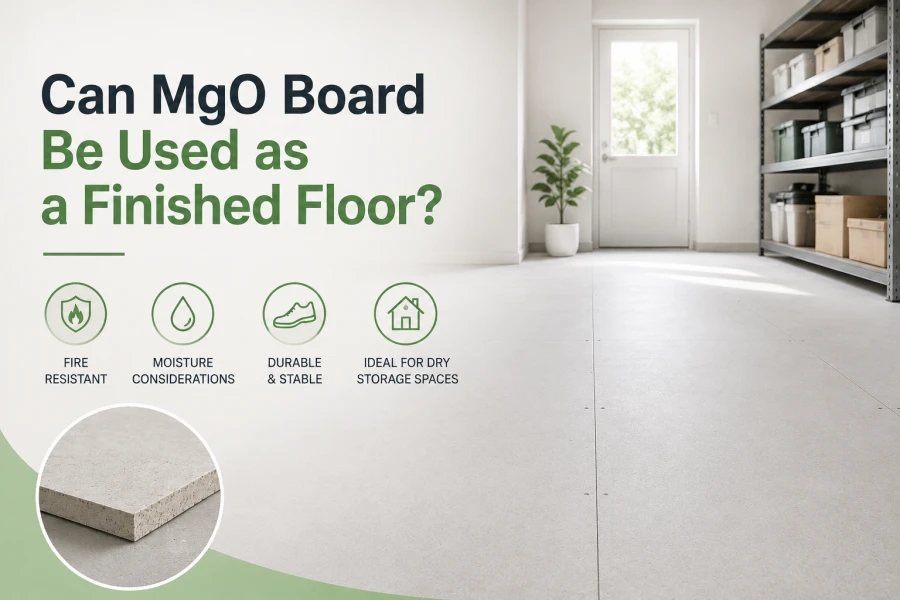
Magnesium oxide board, often called MgO board, is widely used in modern construction because of its fire resistance, dimensional stability, and durability. In flooring systems, it is commonly used as a subfloor, underlayment, or structural board beneath other floor coverings.
But many customers ask a practical question:
Can MgO board be used directly as a finished floor without any additional floor covering?
The answer is: yes, but only in limited conditions.
MgO board can be left exposed in some dry, low-traffic indoor areas such as storage rooms, utility spaces, temporary buildings, or equipment rooms. However, it is generally not designed to replace finished flooring materials such as vinyl, tile, laminate, epoxy, or carpet.
In this article, we will explain when MgO board can be used as an exposed floor, what limitations you should consider, and how to improve its performance if no floor covering is installed.
1. What Is MgO Board Normally Used For?
Magnesium oxide board is a versatile building panel used in walls, ceilings, partitions, fire-rated systems, and flooring assemblies.
👉 See all mgo board applications
In flooring applications, MgO board is usually not used as the final walking surface. Instead, it is commonly installed as a floor substrate or underlayment.
MgO Board as a Subfloor or Underlayment
In most projects, MgO board is installed underneath another flooring material.
Common applications include:
- Subfloor panels
- Tile backing boards
- Vinyl flooring base
- Laminate flooring underlayment
- Fire-resistant floor assemblies
- Modular building floor systems
In these systems, the MgO board provides strength, fire resistance, and dimensional stability, while the upper floor covering provides appearance, wear resistance, and easier maintenance.
Why Floor Coverings Are Usually Installed on Top
Although MgO board has many advantages, it is still primarily a building substrate.
Finished flooring materials are usually installed above MgO board because they provide:
- Better decorative appearance
- Improved surface wear resistance
- Easier cleaning
- Better moisture protection
- More comfortable walking surfaces
- Longer service life in daily use
For example, vinyl flooring provides a water-resistant and easy-to-clean surface. Tiles provide excellent abrasion resistance. Epoxy coatings create a hard and sealed surface. These materials are designed to be walked on directly for many years.
MgO board, by contrast, is usually designed to support these materials rather than replace them.
2. Can MgO Board Be Used Directly as Flooring?
The Short Answer
Yes, MgO board can be used directly as flooring in some dry and low-traffic indoor spaces.
However, it should be understood as a practical or temporary solution, not as a premium finished flooring system.
MgO board can work as an exposed surface when the project does not require a decorative finish, heavy abrasion resistance, or long-term moisture exposure resistance.
For example, if the space is only used for storage and people do not walk on it frequently, exposed MgO board may be acceptable.
But for residential living areas, kitchens, bathrooms, commercial interiors, or wet environments, it is better to install a proper floor covering or protective coating on top.
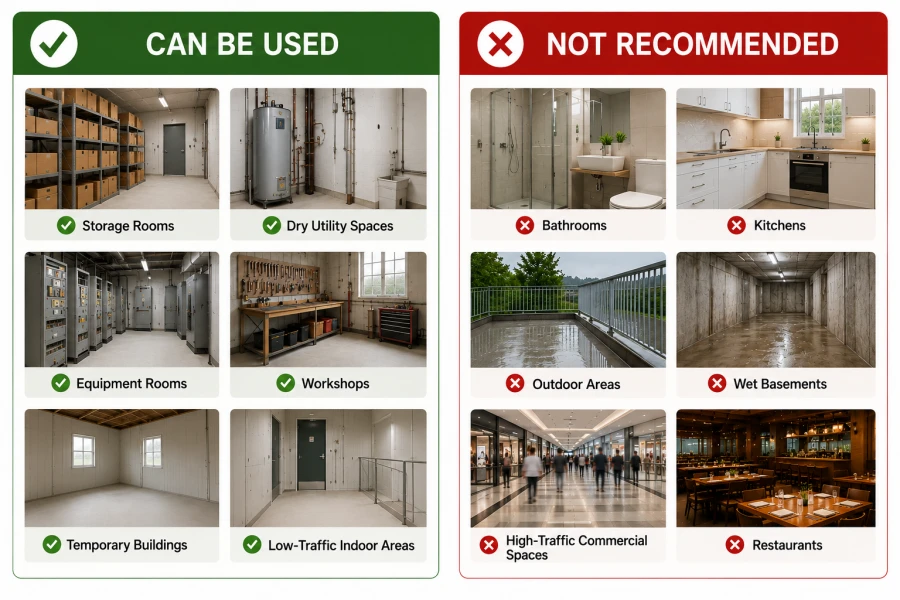
When It May Be Acceptable
Exposed MgO board may be considered in:
- Storage rooms
- Dry utility spaces
- Equipment rooms
- Workshops
- Temporary buildings
- Low-traffic indoor areas
- Areas where appearance is not a priority
In these spaces, the main requirement may be fire resistance, strength, or cost control rather than decorative appearance.
When It Is Not Recommended
Using bare MgO board as the final floor surface is generally not recommended in:
- Bathrooms
- Kitchens
- Outdoor areas
- Wet basements
- High-traffic commercial spaces
- Retail stores
- Restaurants
- Areas exposed to standing water
- Spaces requiring a decorative floor finish
In these conditions, the board may be exposed to frequent moisture, abrasion, cleaning chemicals, or heavy foot traffic. Over time, this can reduce the service life of the board.
3. Advantages of Using MgO Board as an Exposed Floor
Although MgO board is not usually promoted as a finished flooring material, it does offer several benefits when used in suitable environments.
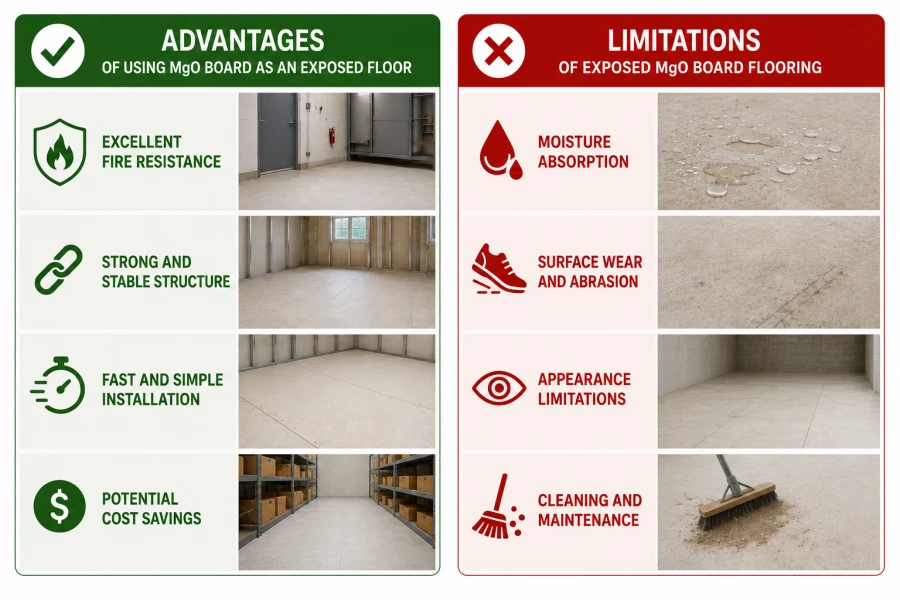
Excellent Fire Resistance
One of the biggest advantages of MgO board is its fire resistance.
Unlike many wood-based panels, MgO board is made from inorganic mineral materials. This gives it excellent fire-resistant properties and makes it suitable for projects where fire safety is important.
For storage rooms, equipment areas, and modular buildings, this can be a useful advantage.
Strong and Stable Structure
MgO board has good dimensional stability. It is less likely to warp, swell, or deform compared with some wood-based panels when used in appropriate indoor conditions.
This stability makes it a reliable substrate for flooring systems and can also make it suitable for exposed use in dry, controlled environments.
Fast and Simple Installation
MgO boards are supplied in large sheets, which allows for fast installation.
Compared with installing multiple layers of traditional materials, using MgO board directly may reduce installation steps in simple storage or temporary spaces.
This can be useful when the project requires quick construction.
Potential Cost Savings
Leaving MgO board exposed can reduce the cost of additional flooring materials.
For non-decorative spaces, this may be acceptable if the owner understands the limitations and the environment is dry and low traffic.
However, cost savings should not be the only consideration. If the space is exposed to moisture or heavy wear, adding a protective layer may be more economical in the long term.
4. Main Limitations of Exposed MgO Board Flooring
Before using MgO board as an exposed floor, it is important to understand its limitations.
Moisture Absorption
MgO board is moisture resistant, but it is not completely waterproof.
The surface and edges of the board can absorb moisture, especially if the board is left untreated. If MgO board is exposed to moisture for a long time and cannot dry properly, its durability and service life may be reduced.
This is one of the most important points to explain to customers.
MgO board can perform well in dry indoor environments. But if water, high humidity, or trapped moisture is present, the board should be protected with a suitable floor covering, coating, or sealer.
Surface Wear and Abrasion
Bare MgO board is not as wear-resistant as tile, vinyl flooring, epoxy flooring, or other finished floor surfaces.
If people walk on it frequently, move heavy items across it, or drag equipment over the surface, the board may gradually show signs of wear.
Possible issues include:
- Surface scratches
- Dusting
- Abrasion marks
- Reduced surface smoothness
- Edge damage at joints
For high-traffic areas, a protective surface layer is strongly recommended.
Appearance Limitations
MgO board usually has a plain, industrial-looking surface.
This may be acceptable in storage rooms, workshops, or hidden spaces, but it is not ideal for decorative interiors.
Unlike finished flooring materials, MgO board does not naturally provide wood grain, stone texture, color variation, or a polished floor appearance.
If appearance matters, it is better to use a floor covering such as vinyl, tile, laminate, or decorative coating.
Cleaning and Maintenance
Unsealed MgO board may be harder to clean than finished flooring materials.
Because the surface is more porous than many finished floors, dust and dirt may be more difficult to remove completely. Frequent wet cleaning is also not ideal if the board is not sealed.
For exposed floor use, regular dry cleaning is better than repeated wet mopping.
If easier cleaning is required, the surface should be sealed or coated.
5. How Moisture Affects Exposed MgO Board
Moisture is one of the most important factors when deciding whether MgO board can be left exposed.
Why Moisture Control Is Important
MgO board performs best in dry, ventilated indoor environments.
If the board is installed in a space where water may accumulate, or where humidity remains high for long periods, the risk of performance problems increases.
Moisture can enter through:
- Board surface
- Cut edges
- Screw holes
- Panel joints
- Gaps between boards
- Contact with damp concrete or ground moisture
Once moisture enters the board and cannot dry properly, it may affect the board’s long-term performance.
Potential Problems Caused by Moisture
Long-term moisture exposure may lead to:
- Reduced board strength
- Surface deterioration
- Swelling or softening in severe cases
- Shortened service life
- Poor performance at edges and joints
- Increased risk of surface damage
This does not mean MgO board cannot tolerate moisture at all. High-quality MgO board has good moisture resistance compared with many traditional materials. But it should not be treated as a fully waterproof finished floor unless additional protection is applied.
Importance of Proper Ventilation
Ventilation is very important when MgO board is used in flooring applications.
If moisture becomes trapped below or above the board, drying becomes difficult. This can shorten the service life of the floor system.
For exposed MgO board floors, the space should remain:
- Dry
- Well ventilated
- Protected from standing water
- Protected from continuous water leakage
- Free from long-term condensation
If these conditions cannot be maintained, a protective floor covering should be used.
6. How to Improve the Performance of Exposed MgO Board Flooring
If a project requires MgO board to be left exposed, several methods can improve its performance.
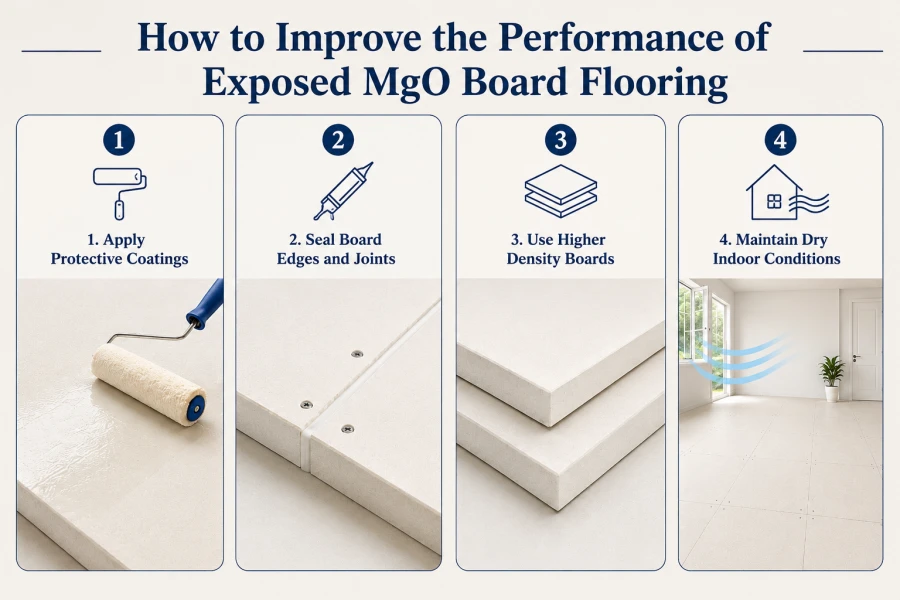
Apply Protective Coatings
A protective coating is one of the best ways to improve exposed MgO board flooring.
Possible options include:
- Epoxy coating
- PU coating
- Floor paint
- Acrylic sealer
- Waterproof coating
These coatings can help:
- Reduce surface dusting
- Improve cleanability
- Increase wear resistance
- Reduce moisture absorption
- Improve appearance
For best results, the board surface should be properly cleaned, sanded, and primed before coating.
Seal Board Edges and Joints
The edges and joints of MgO board are more vulnerable to moisture penetration than the main surface.
If the board is used as an exposed floor, the edges should be sealed carefully.
This can help reduce water absorption and improve durability.
Important areas to seal include:
- Cut edges
- Board joints
- Screw holes
- Perimeter edges
- Areas around penetrations
Proper joint treatment can also reduce dust accumulation and improve the overall appearance of the floor.
Use Higher Density Boards
For exposed flooring applications, higher-density MgO boards are usually preferred.
Higher-density boards generally provide:
- Better surface hardness
- Better impact resistance
- Better screw-holding strength
- Better wear resistance
- Improved overall durability
Lower-density boards may be more suitable for wall, ceiling, or lightweight applications, but they may not be ideal for direct floor exposure.
Maintain Dry Indoor Conditions
Even with coatings or sealers, MgO board should still be kept in a dry indoor environment.
To improve service life:
- Avoid standing water
- Avoid frequent wet cleaning
- Keep the room ventilated
- Repair water leaks quickly
- Avoid direct contact with damp ground
- Use proper vapor control when necessary
Good moisture management is essential for long-term performance.
7. MgO Board vs Traditional Flooring Materials
MgO board has several advantages, especially in fire resistance and stability. However, it performs differently from finished flooring materials.
| Feature | MgO Board | Vinyl Flooring | Tile | Epoxy Floor |
|---|---|---|---|---|
| Fire Resistance | Excellent | Moderate | Excellent | Good |
| Moisture Resistance | Moderate | High | Excellent | High |
| Decorative Appearance | Basic | Good | Excellent | Good |
| Wear Resistance | Moderate | Good | Excellent | Excellent |
| Installation Speed | Fast | Moderate | Slow | Moderate |
| Best Use | Subfloor or dry exposed areas | Residential and commercial interiors | Wet or high-wear areas | Industrial and commercial floors |
This comparison shows why MgO board is excellent as a substrate, but not always the best choice as a finished floor surface.
For many projects, the best solution is to use MgO board as the base layer and install a finished floor material above it.
8. Final Thoughts
Magnesium oxide board can be used directly as flooring in some limited indoor applications, especially in dry storage rooms, utility spaces, and temporary structures.
However, it is important to understand that MgO board is mainly designed as a substrate, not as a decorative finished floor surface.
If left exposed, it may face limitations in appearance, wear resistance, cleaning, and moisture protection.
For long-term performance, especially in areas with foot traffic, moisture, or higher appearance requirements, it is better to install a suitable floor covering or apply a protective coating.
In simple terms:
MgO board can be left exposed in dry, low-traffic spaces, but for most permanent flooring applications, it should be covered, sealed, or coated.
9. FAQ
Can MgO board be used as a finished floor?
Yes, MgO board can be used as a finished floor in some dry, low-traffic indoor spaces such as storage rooms or utility areas. However, it is generally designed as a subfloor or underlayment rather than a decorative floor surface.
Is MgO board waterproof enough for flooring?
MgO board is moisture resistant, but it is not completely waterproof. If exposed to water for a long time, especially without proper drying, its service life may be reduced.
Can exposed MgO board absorb moisture?
Yes. MgO board can absorb moisture through its surface, edges, joints, and screw holes. For exposed floor use, sealing the board is recommended.
Should MgO board be sealed before floor use?
Yes. If MgO board is left exposed, a protective coating or sealer can help improve durability, reduce moisture absorption, and make the surface easier to clean.
Is MgO board suitable for commercial flooring?
Bare MgO board is generally not recommended for high-traffic commercial flooring. For commercial spaces, it is better to use MgO board as a substrate and install vinyl, tile, epoxy, or another finished floor material on top.
Can MgO board be painted for floor use?
Yes, MgO board can be painted for floor use, but proper surface preparation is required. The board should be clean, dry, sanded, and primed before applying a suitable floor-grade coating.
Can MgO board be used in storage rooms without floor covering?
Yes, in many dry and low-traffic storage rooms, MgO board may be left exposed. However, sealing the surface and edges is recommended to improve durability and reduce moisture-related risks.
What is the best way to protect exposed MgO board flooring?
The best way is to apply a protective coating such as epoxy, PU coating, floor paint, or sealer. It is also important to seal the edges and maintain dry indoor conditions.
Latest Posts