Table of Contents

Ask Us Any Question

1. Introduction

When exporting magnesium oxide boards (MgO boards), one of the most common questions from customers is:

“How many boards can be loaded into a container?”

At first glance, many people try to calculate this based on volume. However, in real-world operations, this approach is almost always inaccurate. The actual loading capacity is influenced by multiple factors, and the final number is rarely as simple as a volume calculation suggests.

This guide doesn’t just give you a number—it helps you understand why that number makes sense.

After reading, you will clearly understand:

  • How different container types affect loading capacity
  • How MgO boards are actually loaded inside a container
  • How many magnesium oxide boards can realistically fit into a container

If you’ve ever been confused about container loading quantities, this guide will give you a clear and complete answer.


2. Common Container Types and Specifications

Before discussing loading methods, it is essential to understand the common container types and their basic specifications.

Different containers vary in dimensions and payload capacity, and these differences directly affect the final loading quantity.

2.1 Common Container Types

In the export of magnesium oxide boards (MgO boards), the following three types of dry containers are most commonly used:

20′ GP (20-foot General Purpose Container)

This is the most commonly used small container. Although its internal volume is limited, its payload capacity is not much lower than that of larger containers. Therefore, it is particularly suitable for high-density products, such as MgO flooring boards.

40′ GP (40-foot General Purpose Container)

With approximately double the volume of a 20′ container, it is suitable for products that require more space but have relatively lower density.

40′ HC (40-foot High Cube Container)

With the same length and width as a 40′ GP, but a greater height. The additional height can improve loading efficiency to some extent, especially when pallet height becomes a limiting factor.

Although these three container types may seem similar, in practice, choosing the right one can significantly impact both loading capacity and shipping cost.


2.2 Container Specification Comparison

Below is a comparison of the key specifications of these three commonly used container types:

Container Type Length (m) Width (m) Height (m) Door Width (m) Door Height (m) Max Payload (t) Volume (cbm)
20′ GP 5.90 2.35 2.39 2.34 2.28 28.20 33
40′ GP 12.03 2.35 2.39 2.34 2.28 28.80 67
40′ HC 12.03 2.35 2.70 2.34 2.58 28.62 76

👉 See more container types here


3. Why Container Loading Is Not a Simple Calculation

When asking about loading quantity, many customers use what seems like a logical method: they divide the container volume by the volume of a single board to get a theoretical number.

However, in real-world operations, this method rarely produces an accurate result.

The reason is simple: container loading is not purely a mathematical problem—it is a combination of dimensions, space utilization, and handling constraints.


3.1 Dimensions Do Not Fit Perfectly

The internal dimensions of a container are almost never exact multiples of the board size.

For example:

  • A common board size is 1220 × 2440 mm
  • The internal container width is approximately 2350 mm

This means that along the width, two boards cannot fit perfectly side by side, and some unused space is inevitable.

These “gaps” are often ignored in theoretical calculations, but in practice, they are unavoidable and directly affect the final loading quantity.


3.2 Pallets Occupy Space

In actual shipping, magnesium oxide boards are rarely loaded loose. Instead, they are typically packed on pallets.

Pallets themselves take up additional space. Therefore, when calculating loading capacity, you must consider the pallet as a whole unit, not just the volume of individual boards.


3.3 Container Door Limitations

Many people focus only on internal container dimensions but overlook a critical constraint:

👉 All cargo must pass through the container door.

For example:

  • Door width is typically around 2.34 m
  • Door height is typically around 2.28 m

This means:

  • Pallet dimensions must be able to pass through the door
  • Some loading arrangements that seem feasible “on paper” are simply impossible in practice

3.4 Loading Method Affects Space Utilization

Container loading is not about “filling every inch of space”—it must also consider operational realities such as:

  • How forklifts handle the pallets
  • How pallets are arranged inside the container

Different loading methods can lead to completely different space utilization rates.

For example, for the same 20′ GP container:

  • Different manufacturers may provide significantly different loading quantities
  • This difference is not due to calculation errors, but rather different loading strategies
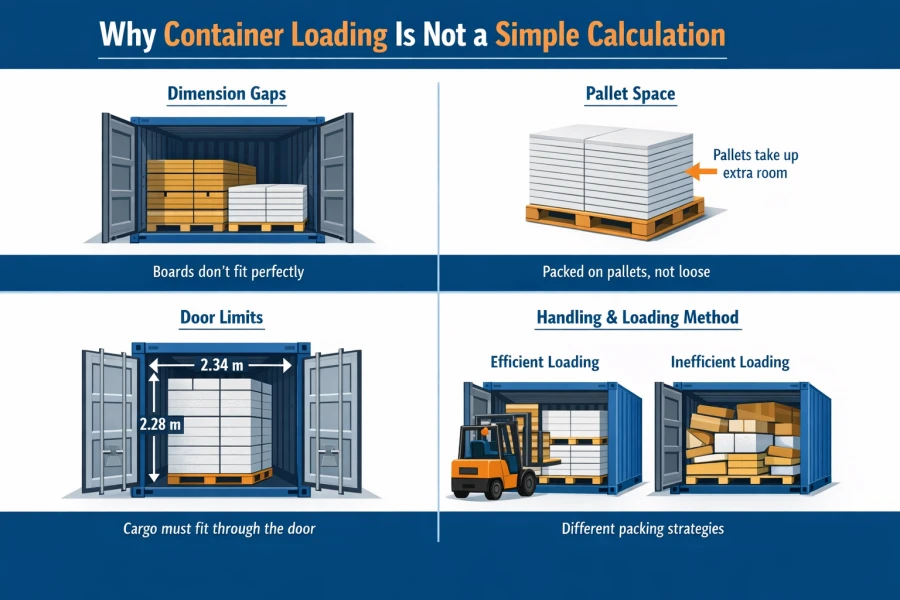
A clean, professional 2x2 grid infographic titled “Why Container Loading Is Not a Simple Calculation,” illustrating four factors affecting container loading: dimension gaps with partially filled pallets in an open container, pallet space with boards stacked on a wooden pallet and an arrow pointing to the pallet, door limits showing container door width (2.34 m) and height (2.28 m), and handling methods comparing efficient and inefficient loading, using a modern flat design in blue and orange with white MgO boards and clear industrial visuals.


4. Pallet Design and Requirements

In the container loading process of magnesium oxide boards (MgO boards), pallets are not just a simple packaging tool—they are a key factor that directly affects loading efficiency, safety, and actual loading capacity.


4.1 Pallet Dimensions

In most cases, pallet dimensions are designed to match the board size. For example:

  • Board size: 1220 × 2440 mm
  • Pallet size: 1220 × 2440 mm

This ensures better stability and simplifies the loading process.


4.2 Pallet Height

Pallets themselves have a certain height, typically ranging from 100 to 150 mm.

Although this may seem minimal, it has a direct impact on the overall stacking height of each pallet and occupies part of the available space inside the container. Therefore, pallet height must always be included in loading calculations.


4.3 Forklift Handling Requirements (Key Point)

Pallet design must meet forklift handling requirements—this is a critical aspect that is often overlooked.

The standard requirement is:
👉 The pallet must be accessible from both the length and width directions by a forklift.

If a pallet can only be handled from one side, it can create serious operational difficulties during loading and unloading, and may even affect the overall loading plan.


4.4 Load Capacity and Stability

Each pallet typically carries multiple boards, so it must have sufficient strength and stability.

In practice, we usually control:

  • Total pallet height: around 1 meter
  • Total pallet weight: no more than 3.5 tons

This is done to:

  • Avoid exceeding forklift load limits
  • Improve handling safety
  • Reduce the risk of pallet deformation or damage during transportation

5. Pallet Arrangement Strategies Inside the Container

In actual container loading, how pallets are arranged is often more important than simply asking “how much can be loaded.”

With the same container and the same boards, different loading methods can lead to significant differences in final loading quantity. This is one of the key reasons why different suppliers may provide different loading figures.


5.1 Horizontal vs. Vertical Pallet Placement

In practice, there are two common ways to position pallets inside a container:

  • Horizontal Pallets
    Pallets are placed flat on the floor.
    This is the most common and stable method.
  • Vertical Pallets
    Loaded horizontal pallets are rotated upright using a turning machine, so that the pallet stands on its side and contacts the floor along its edge.

5.2 Mixed Horizontal and Vertical Arrangement (Key Strategy)

Because container dimensions do not perfectly match pallet dimensions, using only horizontal placement often results in wasted space.

To improve space utilization, a mixed arrangement of horizontal and vertical pallets is commonly used.

For example, in a 20′ GP container, a typical configuration might be:

  • Total: 8 pallets
  • Arrangement: 4 horizontal pallets + 4 vertical pallets

This alternating layout allows for better use of internal space, minimizes gaps, and significantly improves overall loading efficiency.

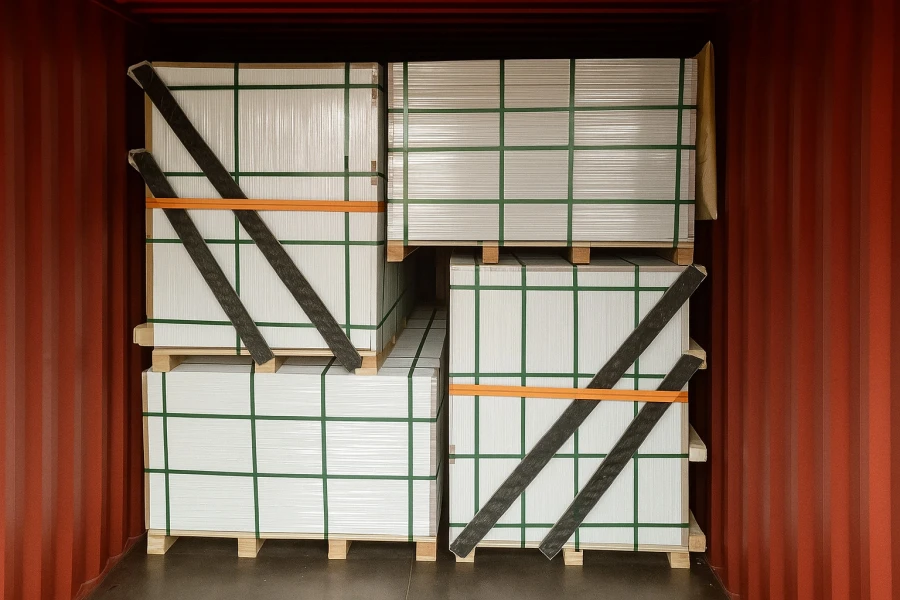
The horizontal pallets and vertical pallets loaded with magnesium oxide boards are arranged alternately inside the container


5.3 Important Notes for Vertical Pallets (Critical)

Since vertical pallets are created by rotating horizontal ones, their structural stability changes when positioned on their side.

Therefore, during unloading, it is strongly recommended to rotate vertical pallets back to the horizontal position using a turning machine before unpacking.

If the packaging straps are removed directly while the pallet is still vertical, it may lead to:

  • The entire pallet collapsing
  • Boards slipping or falling
  • Edge damage or even breakage

These issues are quite common in handling and on-site operations, but they can be completely avoided with proper procedures.


6. The Impact of Container Weight Limits on Loading Quantity

In the process of loading magnesium oxide boards (MgO boards), there is a critical factor that is often overlooked:

👉 The container’s maximum payload limit.

In many cases, what actually limits the loading quantity is not space, but weight.


6.1 Impact of Different Board Densities

MgO boards designed for different applications can vary significantly in density. For example:

  • Wall / ceiling boards: approximately 1000 kg/m³
  • Flooring boards: approximately 1300 kg/m³

The higher the density, the greater the weight for the same volume.

This means that even with the same container and the same loading method, fewer flooring boards can be loaded compared to wall boards due to weight restrictions.


6.2 Weight Restrictions at Different Ports

In addition to the container’s own payload limit, it is also important to consider:

👉 Weight restrictions imposed by different countries and ports.

For example:

  • Some ports have strict limits on the total container weight
  • Some countries impose additional restrictions on inland transportation

These factors can directly affect how much cargo can be loaded.


6.3 Why Weight Limits Must Be Confirmed in Advance

Before arranging production and container loading, it is essential to confirm the following with your freight forwarder:

  • The maximum allowable weight for the shipping route
  • Restrictions at the destination port
  • Any additional transportation requirements

Otherwise, you may encounter issues such as:

  • Goods already produced but unable to be loaded as planned
  • Forced reduction in loading quantity
  • Additional and unexpected logistics costs

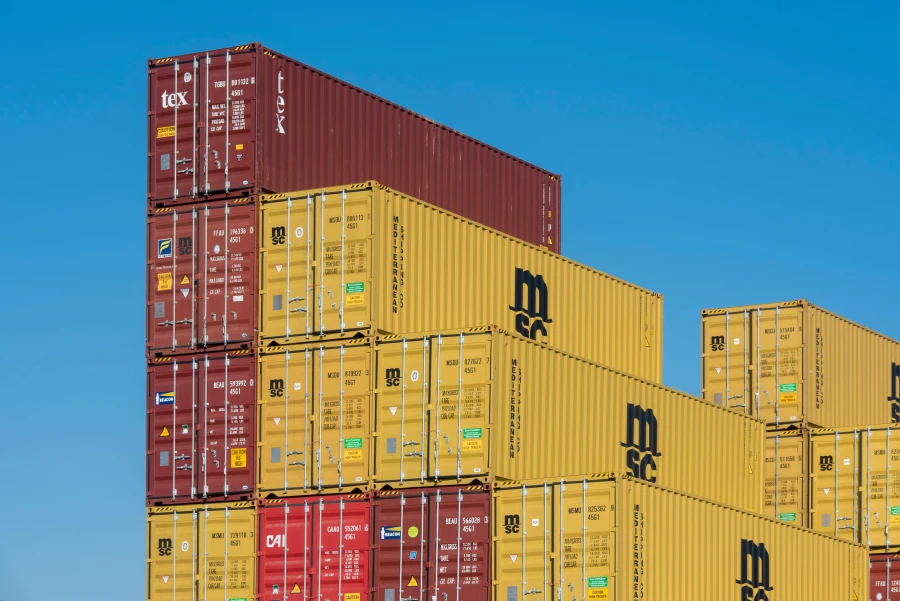
Yellow and red containers are stacked in the container yard.


7. Side Gaps and Anti-Tipping Measures

During container loading, even with optimized pallet dimensions and arrangement, some internal gaps (side gaps) are unavoidable.
If these gaps are not properly managed, they can pose significant risks during transportation.


7.1 Risks During Transportation

Without proper securing measures, the following issues may occur during transit—especially under sea freight conditions with vessel movement:

  • Pallets shifting forward and backward
  • Pallets tilting or even collapsing
  • Edge damage or board breakage

7.2 Common Securing Methods

To ensure cargo stability, the following measures are commonly used:

1) Dunnage Airbags

Placed between the pallets and the container walls, these airbags are inflated to fill the gaps, providing both cushioning and stabilization.

2) Optimized Pallet Arrangement

By carefully planning the loading layout, large empty spaces can be minimized, reducing the risk of movement during transport.

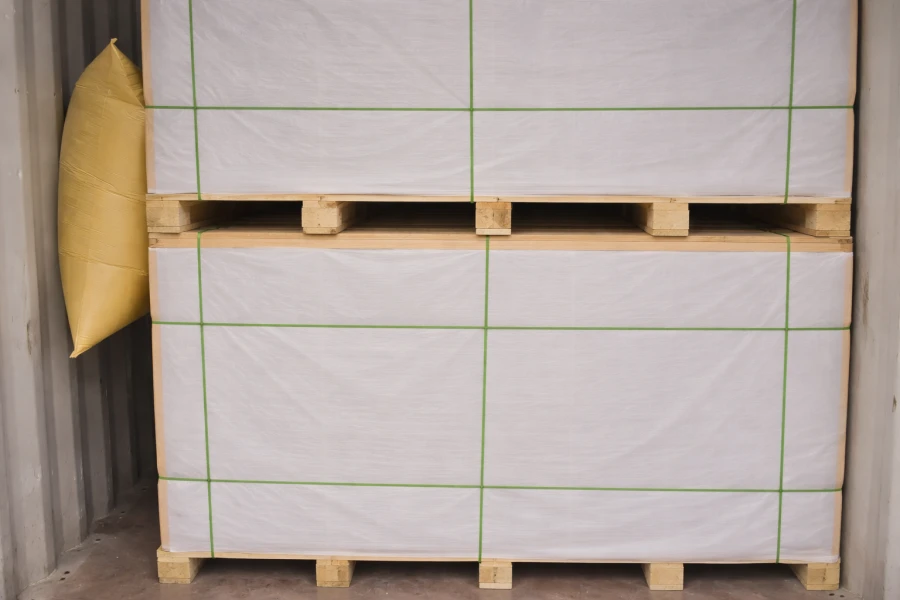
Two stacked pallets loaded with magnesium oxide boards are placed inside the container, with the adjacent gaps filled with airbags to protect the pallets from damage.


8. Actual Loading Quantity Explanation

After understanding all the influencing factors, one point must be clearly emphasized:
👉 The container loading quantity of magnesium oxide boards is not a fixed number.


8.1 Why Loading Quantities Vary Between Suppliers

Even for boards with the same specifications, different manufacturers may provide different loading quantities. The main reasons include:

  • Differences in pallet design
  • Different loading strategies
  • Varying safety margins
  • Whether operational convenience is prioritized

Therefore, variations in loading quantity do not necessarily mean one is right and another is wrong—it simply reflects different approaches and priorities.


8.2 Actual Loading Quantity

The table below shows standard loading data from Suparna for reference only.

1. Ceiling / Wall Boards

Thickness Size (mm) Weight/Board (kg) 20′ GP (pcs) 40′ GP (pcs)
6mm 1220×2440 18 1100 1440
8mm 1220×2440 24 820 1080
10mm 1220×2440 30 660 900
12mm 1220×2440 36 540 720

2. Subflooring Boards

Thickness Size (mm) Weight/Board (kg) 20′ GP (pcs) 40′ GP (pcs)
18mm 1220×2440 70 312 384
20mm 1220×2440 78 288 344


9. Conclusion

Container loading of magnesium oxide boards (MgO boards) is not a simple calculation—it is a systematic process influenced by multiple factors.

In addition to container dimensions, the following elements play a critical role:

  • Pallet design
  • Loading method
  • Board density
  • Container weight limits
  • Transportation safety requirements

Understanding these factors will help you to:

  • Estimate loading quantities more accurately
  • Avoid unnecessary costs and risks
  • Plan logistics more effectively in advance

A good loading solution is not about maximizing quantity at all costs, but about finding the optimal balance between safety, efficiency, and cost.

If you need further assistance, feel free to contact us by clicking the button below or emailing us at info@magnesium-oxide-board.com. We will get back to you as soon as possible.

Related Posts