
1. What Is Leachable Chloride Ion in MgO Board?
Leachable chloride ion refers to chloride ions that can dissolve into the extraction solution after a leaching test. In magnesium oxide (MgO) boards, these chloride ions mainly originate from magnesium chloride (MgCl₂), which is commonly used as a binder in traditional MgO board formulations.
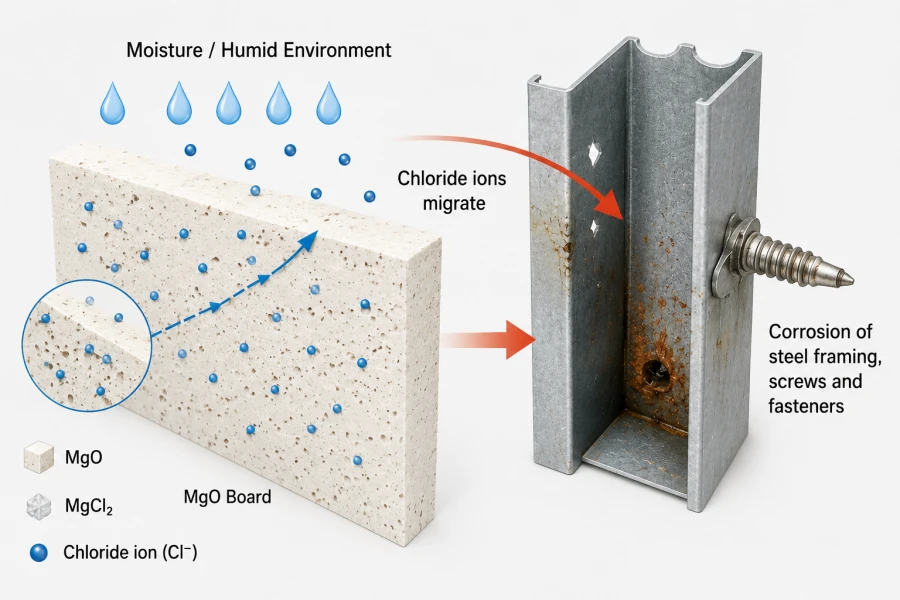
Unlike total chloride content, leachable chloride ion content reflects the amount of chloride ions that may migrate under humid or wet conditions. For this reason, it is considered one of the most important indicators for evaluating the long-term safety, durability, and corrosion risk of MgO boards.
Excessive leachable chloride ion content may increase the risk of:
- Corrosion of steel framing, screws, and fasteners
- Moisture-related durability problems
- Surface sweating or “crying board” phenomena
- Compatibility issues in humid environments
For this reason, chloride ion testing is widely used to assess the long-term performance of MgO boards in construction applications.
2. Test Method Reference
The following laboratory procedure is based on GB/T 33544—2017, the Chinese national standard for magnesium oxide boards.
According to the standard:
- Chloride ion content shall not exceed 10%
- Leachable chloride ion content shall not exceed 5%
This standard includes separate test methods for determining both total chloride ion content and leachable chloride ion content.
This article focuses on the determination of leachable chloride ion content and provides a step-by-step overview of the complete testing procedure. The detailed process below illustrates how MgO board samples are prepared, leached, titrated, and calculated to determine the final leachable chloride ion content.
3. Determination of Leachable Chloride Ion Content
3.1 Reagents
Reagents Requirements
The following reagents shall be used:
a) Nitric acid solution (1+1).
b) Silver nitrate solution (1.7 g/L):
Accurately weigh approximately 1.7 g of silver nitrate (AgNO₃), dissolve it in water, transfer to a 1 L brown volumetric flask, dilute to the mark with water, and mix thoroughly. Standardize the silver nitrate solution using a 0.0100 mol/L sodium chloride standard solution.
c) Silver nitrate solution (17 g/L):
Accurately weigh approximately 17 g of silver nitrate (AgNO₃), dissolve it in water, transfer to a 1 L brown volumetric flask, dilute to the mark with water, and mix thoroughly. Standardize the silver nitrate solution using a 0.1000 mol/L sodium chloride standard solution.
d) Sodium chloride standard solution (0.0100 mol/L):
Weigh approximately 5 g of sodium chloride (reference reagent) into a weighing bottle. Dry at 130 °C–150 °C for 2 h. After cooling in a desiccator, accurately weigh 0.5844 g, dissolve in water, dilute to 1 L, and mix thoroughly.
e) Sodium chloride standard solution (0.1000 mol/L):
Weigh approximately 10 g of sodium chloride (reference reagent) into a weighing bottle. Dry at 130 °C–150 °C for 2 h. After cooling in a desiccator, accurately weigh 5.8443 g, dissolve in water, dilute to 1 L, and mix thoroughly.
Standardization of Silver Nitrate Solution (1.7 g/L or 17 g/L)
Using a pipette, transfer 10 mL of 0.0100 mol/L or 0.1000 mol/L sodium chloride standard solution into a beaker. Dilute with water to 200 mL, then add 4 mL of nitric acid solution (1+1).
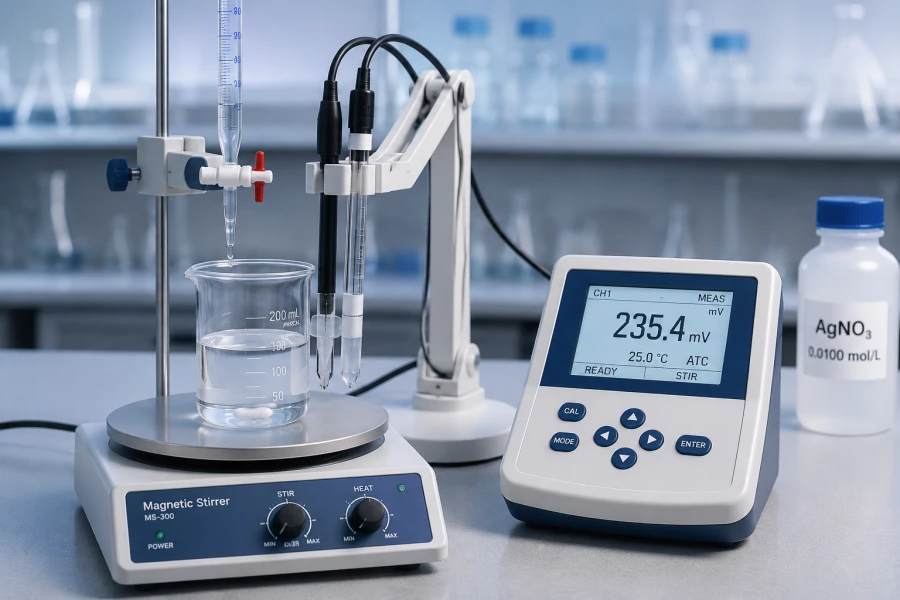
Under electromagnetic stirring, determine the endpoint by potentiometric titration using the silver nitrate solution.
After passing the equivalence point, add another 10 mL of the same sodium chloride standard solution into the same solution, and continue titration with silver nitrate solution until the second endpoint is reached.
The consumed volumes of silver nitrate solution, V₀₁ and V₀₂, shall be calculated using the second derivative method.
Calculation of V₀
V₀ = V₀₂ − V₀₁
Where:
- V₀ = volume of silver nitrate solution consumed by 10 mL of 0.0100 mol/L or 0.1000 mol/L sodium chloride standard solution, in milliliters (mL)
- V₀₂ = volume of silver nitrate solution consumed in the blank test containing 200 mL water, 4 mL nitric acid solution (1+1), and 20 mL sodium chloride standard solution, in milliliters (mL)
- V₀₁ = volume of silver nitrate solution consumed in the blank test containing 200 mL water, 4 mL nitric acid solution (1+1), and 10 mL sodium chloride standard solution, in milliliters (mL)
Calculation of Silver Nitrate Solution Concentration
Where:
- c = concentration of silver nitrate solution, in moles per liter (mol/L)
- c′ = concentration of sodium chloride standard solution, in moles per liter (mol/L)
- V′ = volume of sodium chloride standard solution, in milliliters (mL)
3.2 Equipment and Apparatus
- Square Hole Sieves: Two square hole sieves with apertures of 0.125 mm and 0.25 mm respectively.
- Balance: Analytical balance with a readability of 0.0001 g.
- Graduated Cylinders: 5 mL and 100 mL graduated cylinders.
- Beakers: 200 mL and 500 mL beakers.
- Volumetric Flask: 250 mL volumetric flask.
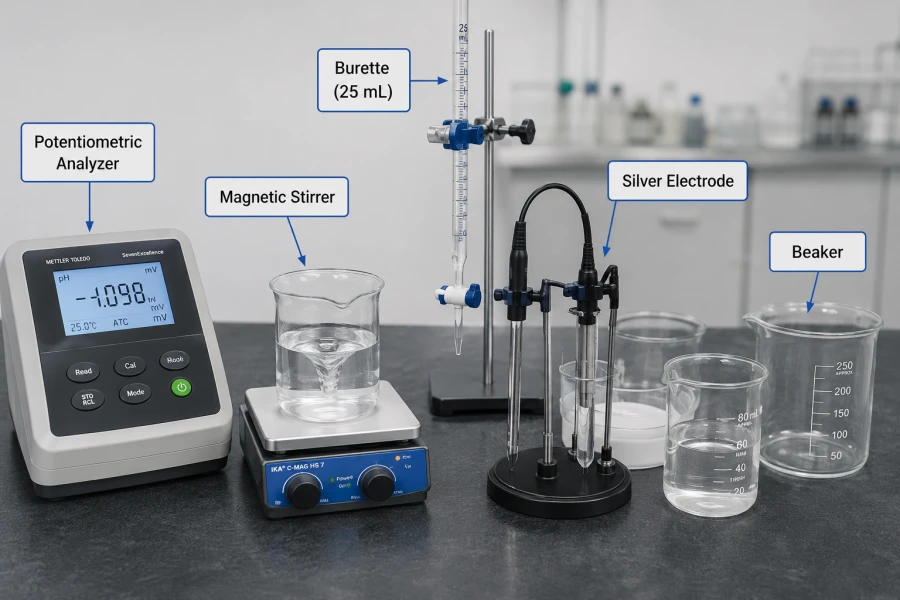
- Burette: 25 mL burette.
- Pipettes: 10 mL and 25 mL pipettes.
- Magnetic Stirrer: Magnetic stirring device.
- Potentiometric Analyzer: Potentiometric measuring instrument.
- Crusher: Grinding or crushing machine.
3.3 Sample Preparation
Approximately 40 g of specimen remaining after the impact resistance test shall be collected and crushed.
The sample shall then be ground using a crusher and sieved through square hole sieves to ensure that all particles fall within the size range of 0.125 mm to 0.25 mm.
Particles with a particle size between 0.125 mm and 0.25 mm shall be collected as the test sample.
The prepared sample shall be dried at 100 °C–105 °C until constant mass is achieved before testing.
3.4 Preparation of Sample Leachate
Laboratory Conditions
The laboratory used for preparation of the test solution shall maintain an environmental temperature of (20 ± 2) °C.
Extraction Procedure
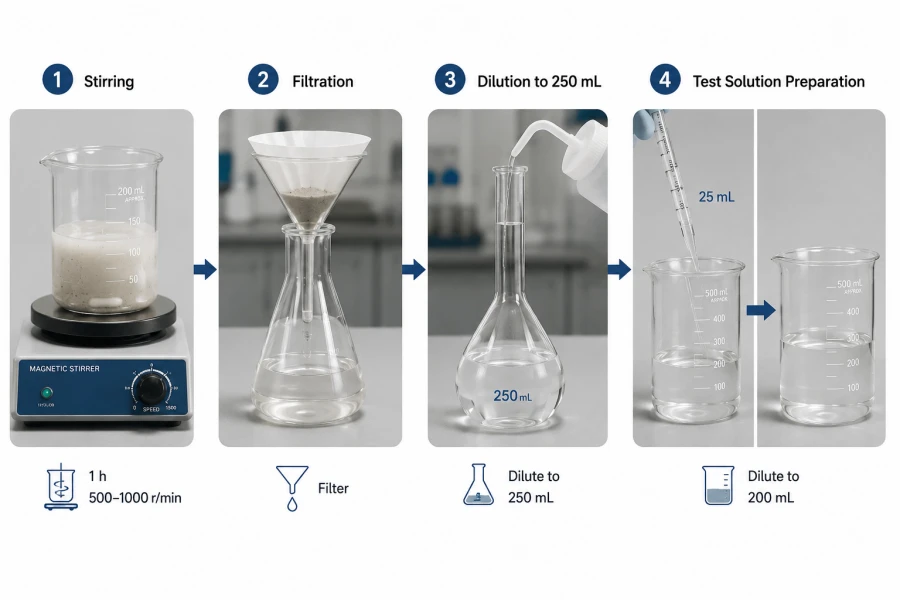
Weigh 2 g of the sample prepared according to Section B.3, accurate to 0.0001 g, and place it into a 200 mL beaker.
Add 100 mL of water and place the beaker on a magnetic stirrer.
Stir the mixture for 1 hour while keeping the sample in a semi-suspended state throughout the stirring process.
The stirring speed shall be maintained between 500 r/min and 1,000 r/min.
Filtration and Dilution
After stirring is completed, allow the mixture to stand for 10 minutes.
Filter the solution using medium-speed filter paper and collect the leachate into a 250 mL volumetric flask.
Wash the sample residue with water until the chloride ions are completely removed.
Dilute the filtrate to 250 mL with water and mix thoroughly.
Preparation of Test Solution
Using a pipette, transfer 25 mL of the solution into a 500 mL beaker.
Dilute with water to 200 mL.
The test solution is then ready for analysis.
3.5 Test Procedure
Sample Extraction
Weigh 0.5 g of the sample prepared according to Section 3, accurate to 0.0001 g, and place it into a 200 mL beaker.
Add 50 mL of water and 4 mL of nitric acid solution, then stir and heat to boiling for 5 minutes.
Filter the solution using fast qualitative filter paper, and wash the residue with distilled water until no chloride ions are detected.
Collect approximately 200 mL of filtrate.
Potentiometric Titration
Using a pipette, add 10 mL of 0.0100 mol/L or 0.1000 mol/L sodium chloride standard solution into the filtrate.
Place a magnetic stirring bar into the beaker and position the beaker on a magnetic stirrer.
Start stirring and insert the silver electrode (or chloride electrode) together with the calomel electrode. Connect both electrodes to the potentiometer or pH meter.
Slowly titrate with the silver nitrate solution while recording the electrode potential and the corresponding burette readings.
Determination of the First Endpoint
As the equivalence point approaches, add the silver nitrate solution slowly in increments of 0.10 mL each time.
When a sudden change in potential occurs, the equivalence point has been passed.
Continue adding silver nitrate solution until the potential change gradually becomes stable.
Record the volume of silver nitrate solution consumed at the first endpoint.
Determination of the Second Endpoint
In the same solution, use a pipette to add another 10 mL of 0.0100 mol/L or 0.1000 mol/L sodium chloride standard solution. At this stage, the solution potential will decrease.
Continue titrating with the silver nitrate solution until the second equivalence point appears.
Record the electrode potential and the corresponding volume of silver nitrate solution consumed.
Blank Test
For the blank test, add 200 mL of water and 4 mL of nitric acid solution (1+1) into a clean beaker.
Using a pipette, add 10 mL of 0.0100 mol/L or 0.1000 mol/L sodium chloride standard solution.
Without adding any sample, slowly titrate with the silver nitrate solution under magnetic stirring while recording the electrode potential and corresponding burette readings until the first endpoint appears.
After passing the equivalence point, add another 10 mL of 0.0100 mol/L or 0.1000 mol/L sodium chloride standard solution into the same solution.
Continue titration with silver nitrate solution until the second endpoint is reached.
The volumes of silver nitrate solution consumed, V₀₁ and V₀₂, shall be calculated using the second derivative method.
3.6 Calculation and Expression of Results
The test results shall be calculated using the second derivative method.
The titration endpoint is determined by identifying the point where the second derivative of voltage with respect to volume (ΔE² / ΔV²) becomes zero.
If equal volumes of silver nitrate solution are added near the equivalence point, the function (ΔE² / ΔV²) will become zero at a point between the positive and negative sign changes. The corresponding volume at this point is considered the endpoint volume and may be obtained by interpolation.
Calculation of Silver Nitrate Solution Volume Consumed by Chloride Ions
Where:
- V = volume of silver nitrate solution consumed by chloride ions in the sample, in milliliters (mL)
- V₁ = volume of silver nitrate solution consumed after adding 10 mL of 0.0100 mol/L or 0.1000 mol/L sodium chloride standard solution to the sample solution, in milliliters (mL)
- V₂ = volume of silver nitrate solution consumed after adding 20 mL of 0.0100 mol/L or 0.1000 mol/L sodium chloride standard solution to the sample solution, in milliliters (mL)
Calculation of Leachable Chloride Ion Content
The leachable chloride ion content shall be calculated according to the following formula:
Where:
- C′Cl⁻ = leachable chloride ion content in the sample (%)
- k = correction factor, with a value of 10
- c = concentration of silver nitrate solution, in moles per liter (mol/L)
- V = volume of silver nitrate solution consumed by chloride ions in the test solution, in milliliters (mL)
- m = mass of the sample, in grams (g)
Selection of Standard Solutions
When the chloride ion content is not greater than 0.500%, use:
- 0.0100 mol/L sodium chloride standard solution
- 1.7 g/L silver nitrate solution
When the chloride ion content is greater than 0.500%, use:
- 0.1000 mol/L sodium chloride standard solution
- 17 g/L silver nitrate solution
Latest Posts