Introduction: A Turning Point for the MgO Board Industry
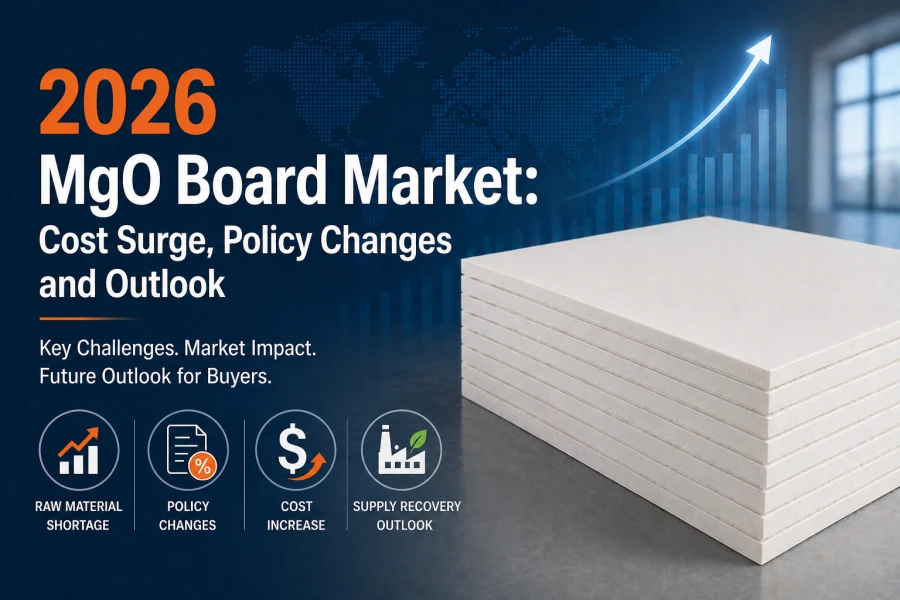
The year 2026 is shaping up to be one of the most challenging and transformative periods for the magnesium oxide board (MgO board) industry in the past decade. Buyers, contractors, and distributors around the world are experiencing a combination of rising prices, unstable supply, and shifting trade policies that are fundamentally altering how this material is sourced and priced.
For many years, MgO boards have been valued for their fire resistance, durability, and environmental advantages. However, in 2026, the conversation has shifted from performance to cost control, supply security, and risk management.
Two major factors are driving this disruption:
- A severe shortage of magnesium oxide (MgO), the core raw material
- The cancellation of China’s export tax rebate policy (9%)
These changes are not temporary fluctuations—they represent structural shifts that will influence pricing, supplier selection, and procurement strategies well beyond 2026.
This article provides a comprehensive analysis of the current market challenges, explains the underlying causes, and offers practical guidance for buyers navigating this new landscape.
1. Raw Material Crisis: Magnesium Oxide Supply Shock
Environmental Regulations Shut Down Production in Haicheng
Magnesium oxide is the single most important raw material in MgO board production. Its quality, purity, and activity level directly determine the strength, durability, and long-term performance of the final product.
Globally, one of the most critical supply hubs for MgO is Haicheng, located in Liaoning Province, China. This region has historically supplied a significant portion of the world’s light-burned magnesium oxide.
However, since the end of 2025, major changes have taken place.
In response to stricter environmental policies, the local government initiated a large-scale shutdown of outdated magnesium oxide kilns. These older production facilities, often characterized by high emissions and low efficiency, were completely phased out.
While this move supports long-term environmental sustainability, the short-term impact has been severe:
- A sharp reduction in MgO production capacity
- Disruption of established supply chains
- Heavy reliance on existing inventory rather than fresh production
As a result, the market entered 2026 with significantly constrained supply.
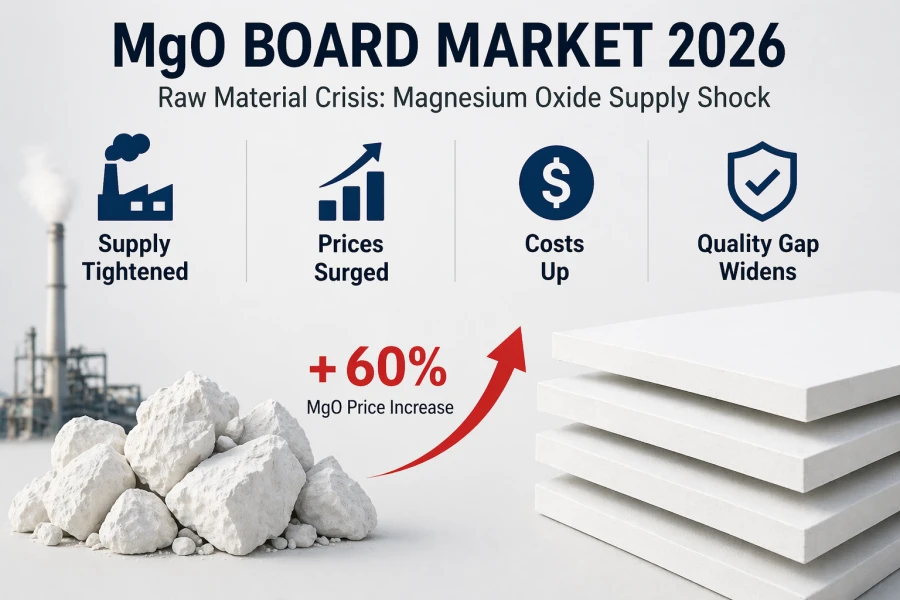
Magnesium Oxide Prices Increased by Over 60%
With supply tightening rapidly and demand remaining strong, magnesium oxide prices have surged dramatically.
As of April 2026:
- MgO prices have increased by more than 60% compared to early 2026 levels
This is not a marginal fluctuation—it is a structural price shock that has directly impacted all downstream industries, including MgO board manufacturing.
It is important to note that this price increase is especially relevant for high-quality magnesium oxide, typically defined as:
- Purity: above 85%
- Activity: above 65%
These specifications are essential for producing high-performance MgO boards with stable mechanical properties and long-term durability.
Manufacturers that rely on this grade of MgO—such as those committed to premium product quality—have experienced the full impact of this cost surge.
MgO Board Production Costs Increased by Over 18%
Given that magnesium oxide accounts for a substantial portion of total production cost, the effect on MgO board pricing has been significant.
Based on industry data:
- The increase in MgO prices has led to an overall production cost increase of more than 18% for MgO boards
This figure reflects manufacturers using high-quality raw materials. It highlights a critical reality: The price of MgO boards is no longer stable or predictable under current market conditions.
For buyers, this means that historical pricing benchmarks from 2025 are no longer applicable.
Growing Quality Gap Between Manufacturers
One of the most important—but often overlooked—consequences of this raw material crisis is the widening gap in product quality across suppliers.
Not all manufacturers respond to rising costs in the same way.
High-quality manufacturers
- Continue using high-purity, high-activity MgO
- Maintain strict quality standards
- Accept higher production costs
- Adjust pricing accordingly
Low-quality manufacturers
- Switch to lower-purity MgO
- Use materials with lower activity levels
- Increase fillers to reduce cost
- Maintain or only slightly increase prices
This creates a misleading situation in the market: Some suppliers may offer prices similar to 2025 levels, but at the expense of product quality.
For buyers, this presents a serious risk.
If a supplier’s price has not increased despite the 2026 cost environment, it is essential to verify:
- MgO purity and activity levels
- Board density and strength
- Resistance to moisture and deformation
- Long-term performance stability
Failing to do so can lead to hidden costs, including product failure, project delays, and reputational damage.
2. Policy Impact: Export Tax Rebate Cancellation (9%)
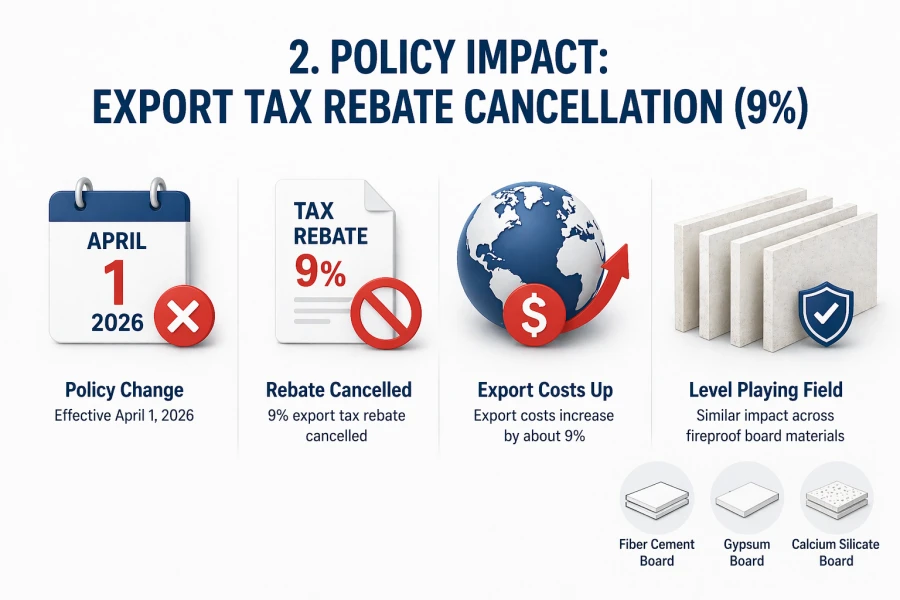
What Changed on April 1, 2026
In addition to raw material challenges, the MgO board industry is also affected by a major policy shift.
On January 18, 2026, China’s Ministry of Finance and State Taxation Administration issued an official announcement regarding export tax policies.
Effective April 1, 2026:
- The export tax rebate for certain products has been cancelled
- MgO boards (HS Code: 68080000) are included in the affected category
This means that exporters can no longer reclaim value-added tax (VAT) for these products, directly increasing export costs.
Why the Policy Was Introduced
Although MgO boards are included in the policy, it is important to understand that the primary target of this adjustment is the photovoltaic (solar) industry.
The government’s decision is based on several strategic considerations:
1. Industry Maturity
China’s photovoltaic industry has achieved global dominance in:
- Production capacity
- Cost efficiency
- Supply chain integration
As a result, continued policy support is no longer necessary.
2. Reducing “Price War” Competition
Export rebates were often used by companies to:
- Lower export prices
- Compete aggressively in international markets
This led to profit erosion and unsustainable competition.
3. Lowering Trade Friction Risks
Export rebates can be perceived as government subsidies, increasing the risk of:
- Anti-dumping investigations
- Countervailing duties
Removing rebates helps create a more neutral trade environment.
4. Optimizing Fiscal Resources
Funds previously used for rebates can now support:
- Advanced technologies
- Industry upgrades
- Sustainable development initiatives
While these reasons are primarily linked to the photovoltaic sector, MgO boards are affected due to their classification within the same export category.
Direct Impact on MgO Board Exporters
The cancellation of the 9% export tax rebate has an immediate financial impact:
- Export costs increase by approximately 9%
- Profit margins are significantly compressed
Unlike raw material costs, which may fluctuate, this policy change represents a permanent structural adjustment.
Competitive Impact Across Fireproof Board Materials
One important point for buyers is that MgO boards are not alone in this situation.
Other fire-resistant building materials are also affected, including:
- Fiber cement boards
- Gypsum boards
- Calcium silicate boards
This means:
The removal of export tax rebates does not fundamentally change the competitive relationship between these materials.
In other words, MgO boards are not at a disadvantage compared to alternative products in terms of policy impact.
3. Short-Term Pain vs Long-Term Industry Transformation
Short-Term Challenges
In the short term, the industry faces several pressures:
- Rapid price increases
- Supply instability
- Buyer hesitation and delayed procurement decisions
Some markets may also experience temporary behaviors such as:
- Early purchasing to avoid further price increases
- Increased negotiation pressure on suppliers
Industry Consolidation Is Accelerating
These challenges are accelerating a natural process of industry consolidation.
Stronger manufacturers will:
- Maintain quality standards
- Invest in technology and compliance
- Expand market share
Weaker manufacturers will:
- Struggle with rising costs
- Lose competitiveness
- Gradually exit the market
This process will lead to a more concentrated and professional industry structure.
Shift Toward Value-Based Competition
The era of competing purely on price is coming to an end.
In the future, success will depend on:
- Product quality
- Technical reliability
- Brand reputation
- Service capability
For buyers, this means supplier selection should focus less on price and more on overall value and long-term performance.
4. Supply Recovery Outlook: When Will Prices Stabilize?
New Kilns Expected by Mid-2026
According to leading MgO producers, efforts are underway to rebuild production capacity.
- Upgraded, environmentally compliant kilns are expected to begin operation by late June 2026
These facilities will:
- Improve production efficiency
- Meet environmental standards
- Gradually restore supply
Supply-Demand Balance Will Improve
As new capacity comes online:
- Supply constraints will ease
- Market availability will increase
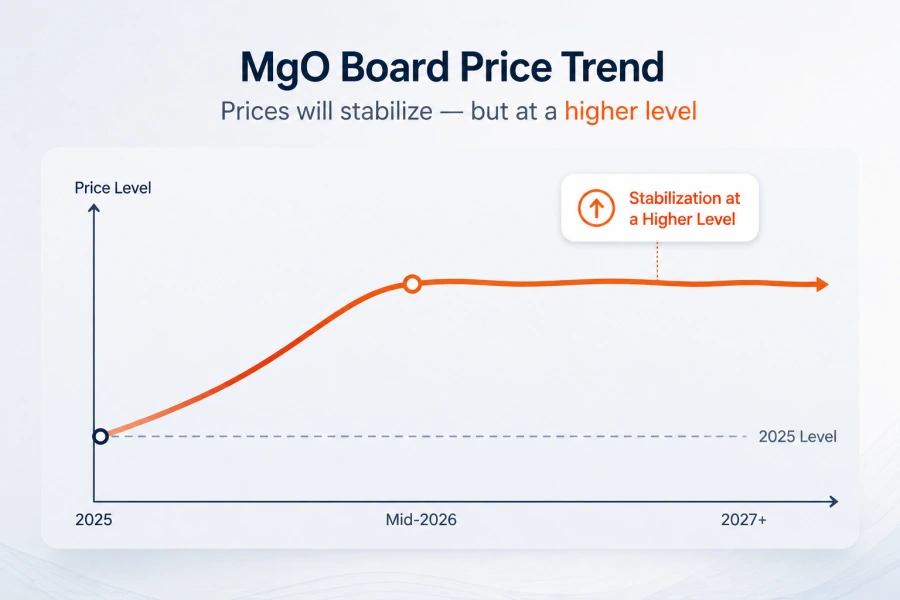
- Price pressure may begin to stabilize
However, this process will take time and will not result in an immediate return to previous conditions.
Why Prices Will Not Return to 2025 Levels
Even as supply improves, several factors will prevent prices from falling back to 2025 levels:
- Higher environmental compliance costs
- Capital investment in new equipment
- Reduced participation of small, low-cost producers
This leads to a new reality:
The cost structure of the MgO industry has permanently shifted upward.
5. Practical Advice for Buyers in 2026
In this complex market environment, buyers need to adopt a more strategic approach.
Verify Raw Material Quality
Always confirm:
- MgO purity (preferably above 85%)
- Activity level (above 65%)
Be Cautious of Unusually Low Prices
If a price appears too good to be true, it likely reflects:
- Lower material quality
- Compromised production standards
Confirm Price Validity Period
Due to volatility, quotations may only be valid for:
- 7–15 days
- Or even shorter in some cases
Plan Budgets with Flexibility
Include contingency allowances to account for:
- Price fluctuations
- Supply delays
Choose Reliable Suppliers
Work with manufacturers who:
- Maintain consistent quality
- Provide transparent information
- Have stable raw material sourcing
6. Conclusion: A More Rational but More Demanding Market
The MgO board market in 2026 is undergoing a fundamental transformation.
While the combination of raw material shortages and policy changes has created short-term challenges, it is also driving the industry toward:
- Greater transparency
- Higher quality standards
- More sustainable competition
For buyers, the key is to adapt:
- Move beyond price-focused decisions
- Prioritize quality and reliability
- Build long-term partnerships with trusted suppliers
In this new environment, those who understand the market dynamics and make informed decisions will be best positioned to succeed.
Ready to make smarter decisions in the 2026 MgO market?
Contact us to discuss reliable supply and consistent quality for your projects.
Latest Posts