Vietnam’s construction industry is evolving rapidly. With new residential complexes, hotels, factories, and commercial buildings rising across the country, choosing the right building materials has never been more critical. One major challenge that builders and developers face in Vietnam is finding materials that can withstand a tropical climate — high humidity, heavy rainfall, strong sunlight, and fluctuating temperatures.
Among modern construction materials, magnesium oxide board, also known as MgO board, has gained increasing attention. But one key question remains:
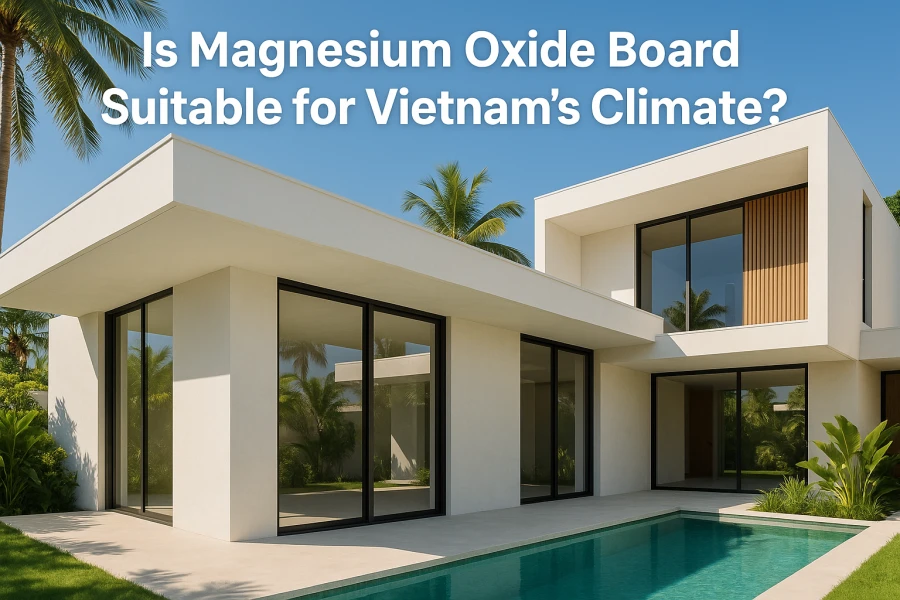
Is magnesium oxide board suitable for Vietnam’s climate?
The short answer is: Yes — and it may be one of the best choices available today.
In this in-depth guide, we’ll explore how MgO board performs in Vietnam’s unique climate conditions and why it is becoming a preferred fireproof and moisture-resistant building material in Southeast Asia.
Understanding Vietnam’s Climate Challenges for Construction
Vietnam is located in the tropical and subtropical zone of Southeast Asia. The country experiences:
High humidity (often 70–90%)
Long rainy and monsoon seasons
Frequent storms and typhoons
High temperatures throughout most of the year
Strong UV exposure
These conditions can cause serious damage to traditional materials such as gypsum board, plywood, MDF, and even some cement boards.
Some common problems in Vietnamese construction projects include:
Swelling and deformation caused by moisture absorption
Mold and mildew growth inside walls and ceilings
Cracking due to temperature changes
Structural weakening over time
Increased maintenance and replacement costs
This is where Magnesium Oxide (MgO) board shows its true value.
What Is Magnesium Oxide Board (MgO Board)?
Magnesium oxide board is an inorganic, non-combustible, high-performance building panel made primarily from:
Magnesium salts (commonly magnesium sulfate or magnesium chloride)
Perlite / mineral fillers
Fiberglass mesh for reinforcement
It is designed as a fire-resistant, moisture-resistant, and mold-proof alternative to traditional boards like gypsum board and fiber cement board.
MgO board is widely used for:
Wall sheathing and partitions
Ceilings and subfloors
Fire-rated walls and doors
Exterior sheathing systems (with correct finishing)
Modular and prefab buildings
Because of its composition, MgO board is particularly suitable for hot, humid, and harsh environments — such as Vietnam.
1. Moisture Resistance: Crucial for Vietnam’s High Humidity
One of the most important advantages of MgO board is its excellent resistance to moisture.
Unlike gypsum board, which softens, swells, and loses strength when exposed to water, MgO board does not dissolve or deform in high humidity environments. It can withstand prolonged exposure to moisture without significant damage.
This makes it ideal for applications in Vietnam such as:
Bathrooms and kitchens
Laundry rooms
Basements
Coastal buildings
Exterior wall systems (with proper coatings)
In tropical areas, materials that absorb water become heavy, weak, and unstable over time. MgO board remains stable and structurally reliable, even in extreme humidity.
2. Strong Mold and Mildew Resistance
Vietnam’s warm and wet climate creates perfect conditions for mold growth. Mold is not only ugly but also dangerous to human health, especially in homes, schools, and hospitals.
MgO board is inorganic and does not contain paper, wood, or organic fibers — which are the primary food sources for mold. As a result:
Mold cannot easily grow on its surface
Bacteria and fungi find it difficult to survive
Indoor air quality improves
Long-term maintenance costs are reduced
This is a significant advantage for:
Hotels & resorts
Apartments and condominiums
Hospitals & clinics
Educational buildings
For Vietnam’s fast-growing hospitality and housing markets, this feature alone makes magnesium oxide board an excellent choice.
3. Fire Resistance: A Rising Priority in Vietnam
Fire safety is becoming a critical concern in many developing countries, including Vietnam. With higher population density in cities like Ho Chi Minh City and Hanoi, the risk of fire in residential and commercial buildings has increased.
MgO board is non-combustible and can achieve Class A1 fire rating under European standards. This means:
It does not burn
It does not release toxic smoke
It does not spread flames
It can withstand extremely high temperatures
This makes it perfect for:
Fire-rated partitions
Stairwells and corridors
Fire doors and shafts
Industrial buildings and warehouses
Data centers and power rooms
Compared to gypsum board, MgO board can provide longer and more reliable fire protection, which is essential for modern urban construction in Vietnam.
4. Superior Performance in Temperature Fluctuations
Vietnam experiences differences between daytime and nighttime temperatures, especially in northern and central regions. Thermal expansion and contraction can cause inferior materials to crack.
MgO board has low thermal expansion, meaning:
Less cracking over time
Better structural stability
Longer service life
Improved performance for exterior systems
This is especially valuable for:
Facade panels
Prefabricated buildings
Modular houses
Temporary construction structures
Because Vietnam is increasing its use of prefab and modular construction, MgO board is an ideal material for this trend.
5. Lightweight & Easy Installation for Fast-Paced Projects
Modern Vietnamese construction is moving fast. Builders prefer materials that reduce labor, transportation costs, and installation time.
MgO board is:
Much lighter than concrete panels
Easier to cut, drill, and handle
Compatible with steel frame systems
Suitable for modular construction
For large-scale projects like apartments, malls, hotels, and industrial parks, MgO board helps speed up construction while lowering costs.
6. Why MgO Board Is Better Than Gypsum Board in Vietnam
| Feature | Gypsum Board | MgO Board |
|---|---|---|
| Moisture resistance | Poor | Excellent |
| Mold resistance | Weak | Strong |
| Fire resistance | Medium | Excellent |
| Durability | Low in humidity | High |
| Suitability for Vietnam | Limited | Ideal |
While gypsum board may be cheaper at the beginning, its short lifespan and maintenance problems make it more expensive in the long run, especially in Vietnam’s climate.
Real Applications of MgO Board in Vietnam
Magnesium oxide board is increasingly used in:
High-rise residential buildings
Resorts & hotels along the coast
Shopping malls and commercial centers
Industrial parks and factories
Schools & government buildings
Modular housing projects
As Vietnam continues to develop its infrastructure, demand for fireproof, moisture-resistant, and eco-friendly boards will continue to grow.
Final Verdict: Is MgO Board Suitable for Vietnam’s Climate?
Absolutely.
In fact, magnesium oxide board is one of the best building materials available for tropical and high-humidity regions like Vietnam. Its resistance to moisture, mold, fire, and temperature changes makes it a superior choice over traditional materials.
For architects, developers, importers, and contractors in Vietnam looking for a reliable modern building board, MgO board is a smart, safe, and future-proof investment.
Looking for a Reliable MgO Board Supplier?
Suparna is a professional manufacturer of high-quality Magnesium Oxide Boards with more than 20 years of production experience. We supply MgO boards to Europe, the Middle East, Southeast Asia, Australia, and the Americas.
If you are working on projects in Vietnam and need a trusted MgO board supplier, feel free to contact us.
Latest Posts