1. Introduction
Modern construction projects demand more from building materials than ever before. Builders, architects, developers, and homeowners are looking for solutions that not only meet structural requirements but also provide superior fire protection, moisture resistance, durability, and sustainability. Traditional wall materials such as gypsum drywall and cement board have long been industry standards, yet they often struggle to meet the performance expectations of modern buildings.
One of the most significant challenges facing construction today is balancing safety, longevity, and environmental responsibility. Buildings must comply with increasingly strict fire codes, withstand moisture exposure, provide healthy indoor environments, and remain cost-effective throughout their lifespan. At the same time, the industry is under growing pressure to reduce carbon emissions and adopt more sustainable building practices.
This is where magnesium oxide wallboard, commonly known as MgO wallboard, has emerged as a compelling alternative.
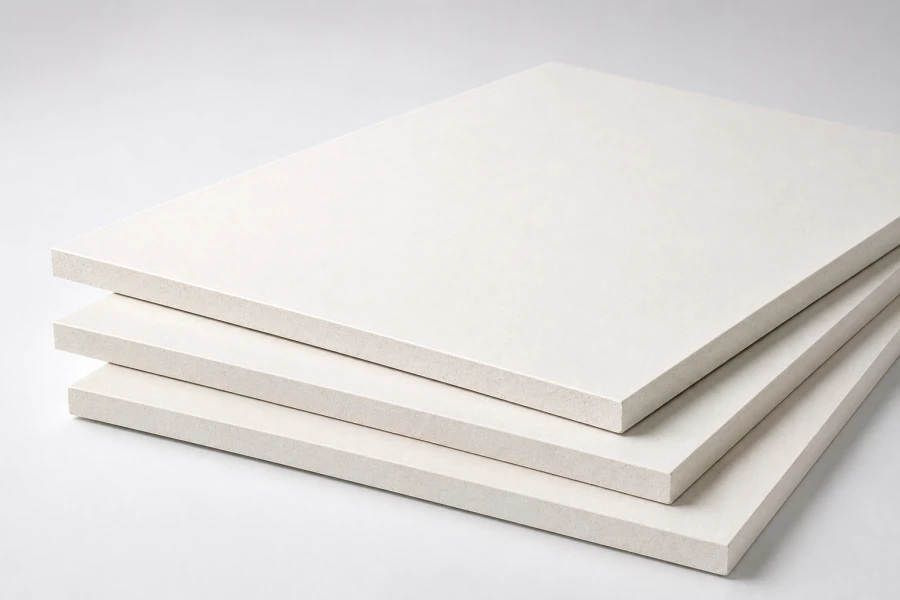
MgO wallboard is a high-performance building panel made primarily from magnesium oxide and other mineral-based materials. Unlike traditional drywall, it offers exceptional fire resistance, superior moisture protection, mold resistance, high strength, and environmental benefits. These advantages have led to its growing adoption in residential homes, commercial buildings, schools, hospitals, hotels, and industrial facilities worldwide.
Over the past decade, magnesium oxide wallboard has gained attention as one of the most versatile building materials available. Builders appreciate its ease of installation, long service life, and ability to perform in challenging environments. Homeowners value its contribution to safer and healthier living spaces. Architects increasingly specify MgO wallboard in projects where durability and sustainability are priorities.
This comprehensive guide explains everything you need to know about magnesium oxide wallboard, including its composition, manufacturing process, benefits, applications, and how it compares with traditional wall materials.
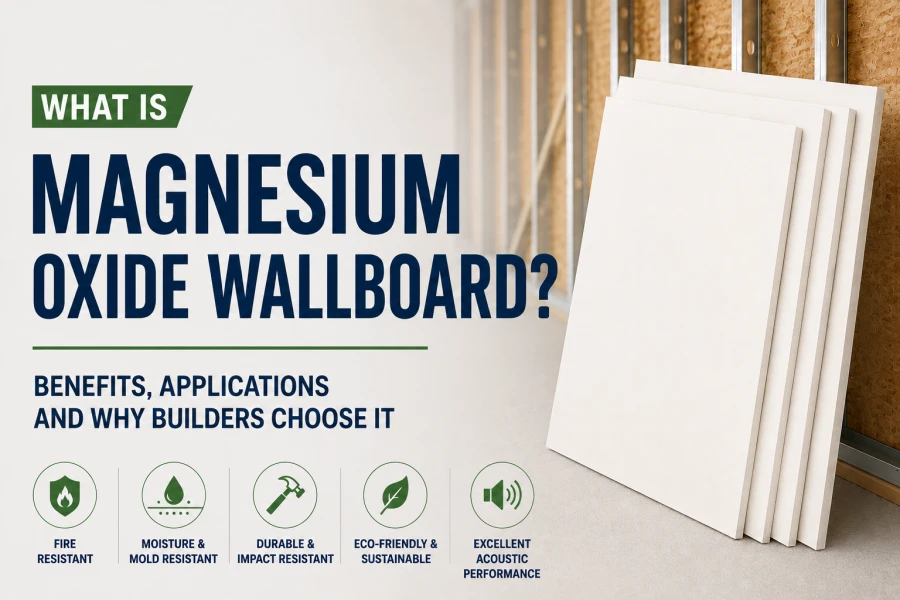
2. What Is Magnesium Oxide Wallboard?
Magnesium oxide wallboard is a construction panel manufactured from inorganic mineral-based materials, primarily magnesium oxide (MgO), magnesium sulfate, reinforcing fibers, and lightweight mineral fillers.
It is designed to serve as a high-performance alternative to traditional gypsum drywall, plywood, and cement board. Because it is made primarily from mineral components rather than paper or wood-based materials, magnesium oxide wallboard exhibits superior resistance to fire, moisture, mold, insects, and physical damage.
The material is commonly used for:
- Interior wall systems
- Exterior wall sheathing
- Ceiling applications
- Fire-rated assemblies
- Wet-area construction
- Commercial buildings
- Industrial facilities
- Modular construction
Unlike standard drywall, which consists of a gypsum core wrapped in paper, MgO wallboard uses inorganic reinforcement systems that significantly improve its durability and environmental resistance.
As a result, it maintains its structural integrity under conditions that often cause conventional wall materials to fail.
3. Main Components of Magnesium Oxide Wallboard
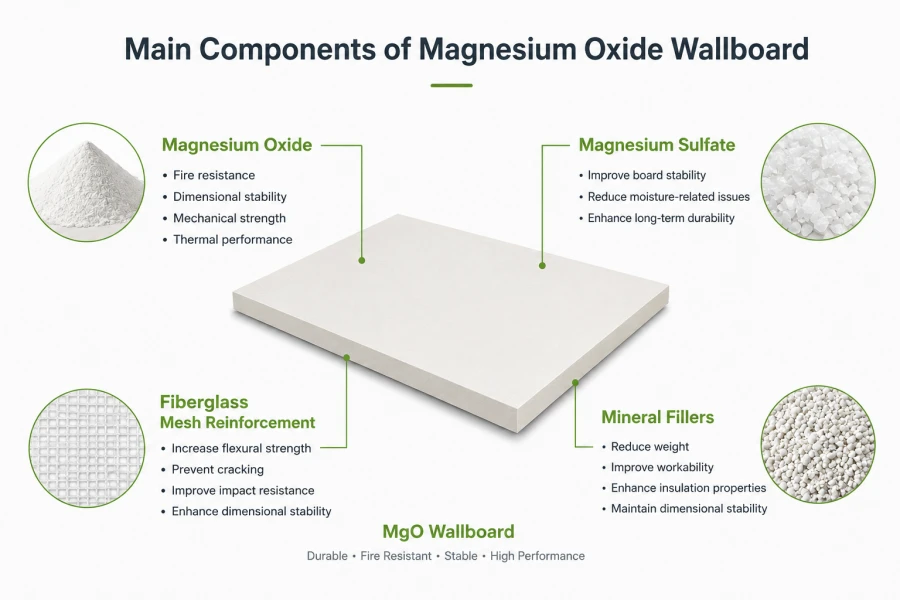
Understanding the composition of MgO wallboard helps explain its performance advantages.
3.1 Magnesium Oxide
Magnesium oxide serves as the primary structural component of the board.
It provides:
- Fire resistance
- Dimensional stability
- Mechanical strength
- Thermal performance
Because magnesium oxide is naturally non-combustible, it contributes significantly to the board’s fire-resistant properties.
3.2 Magnesium Sulfate
Modern high-quality MgO wallboards often use magnesium sulfate as a binding agent.
Magnesium sulfate helps:
- Improve board stability
- Reduce moisture-related issues
- Enhance long-term durability
Many builders prefer magnesium sulfate boards because they generally perform better in humid environments than older magnesium chloride formulations.
3.3 Fiberglass Mesh Reinforcement
Fiberglass mesh is embedded within the board during manufacturing.
Its primary functions include:
- Increasing flexural strength
- Preventing cracking
- Improving impact resistance
- Enhancing dimensional stability
This reinforcement system allows the board to remain strong while maintaining relatively low weight.
3.4 Mineral Fillers
Lightweight fillers such as perlite and other natural minerals may be incorporated into the board.
These materials help:
- Reduce weight
- Improve workability
- Enhance insulation properties
- Maintain dimensional stability
Together, these components create a durable, high-performance building panel suitable for demanding construction environments.
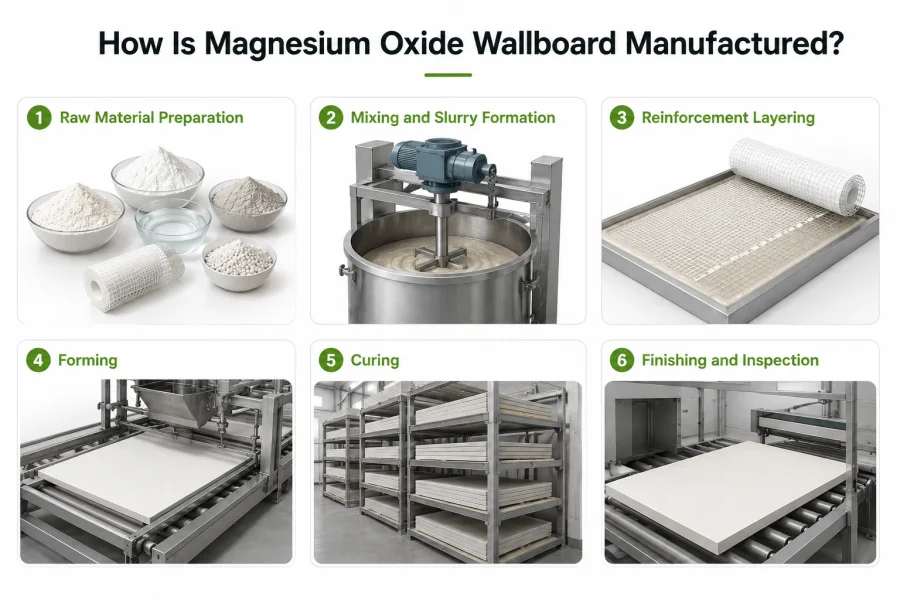
4. How Is Magnesium Oxide Wallboard Manufactured?
The manufacturing process of magnesium oxide wallboard plays a critical role in determining its quality, durability, and performance.
Although formulations vary among manufacturers, the basic production process follows several key stages.
Step 1: Raw Material Preparation
Production begins with carefully selected raw materials, including:
- Magnesium oxide powder
- Magnesium sulfate
- Water
- Fiberglass mesh
- Mineral fillers
- Performance additives
Each ingredient must meet strict quality standards to ensure consistent board performance.
The purity of magnesium oxide is particularly important because it directly affects strength, fire resistance, and dimensional stability.
Step 2: Mixing and Slurry Formation
The raw materials are blended together to form a uniform slurry.
This stage requires precise control of:
- Material ratios
- Mixing speed
- Temperature
- Moisture content
Proper mixing ensures that the finished board develops consistent physical and chemical properties throughout its structure.
Step 3: Reinforcement Layering
Fiberglass mesh reinforcement is incorporated into the board during production.
Multiple layers may be used depending on:
- Board thickness
- Intended application
- Structural requirements
The reinforcement helps improve impact resistance and prevents cracking during installation and long-term service.
Step 4: Forming
The slurry is poured onto templates and shaped into panels.
This stage has a significant impact on the final strength and durability of the product.
Step 5: Curing
After forming, the panels undergo curing.
During curing, chemical reactions occur that allow the board to develop:
- Strength
- Dimensional stability
- Moisture resistance
- Fire resistance
The curing process may take several days depending on the manufacturing method.
Proper curing is essential for achieving consistent product quality.
Step 6: Finishing and Inspection
Once cured, boards are:
- Trimmed to size
- Surface finished
- Quality inspected
- Performance tested
Manufacturers evaluate:
- Dimensions
- Surface quality
- Strength
- Moisture resistance
- Fire performance
Only boards meeting specification requirements proceed to packaging and shipment.
5. History and Development of MgO Wallboard
Although magnesium oxide wallboard has recently gained popularity in many markets, the technology itself is not new.
The use of magnesium-based building materials dates back several decades.
Early development occurred primarily in Asia, where manufacturers sought alternatives to traditional gypsum and cement products. As construction demands evolved, magnesium oxide technology improved significantly.
By the early 2000s, MgO wallboard began attracting attention in Europe and North America because of its combination of:
- Fire safety
- Durability
- Environmental performance
Growing concerns about mold, moisture damage, and indoor air quality further accelerated interest in MgO products.
Today, magnesium oxide wallboard is used globally in:
- Residential construction
- Commercial buildings
- Educational facilities
- Healthcare environments
- Industrial projects
- Modular construction systems
Advancements in manufacturing have also improved product consistency, helping establish MgO wallboard as a credible alternative to traditional wall systems.
6. Key Benefits of Magnesium Oxide Wallboard
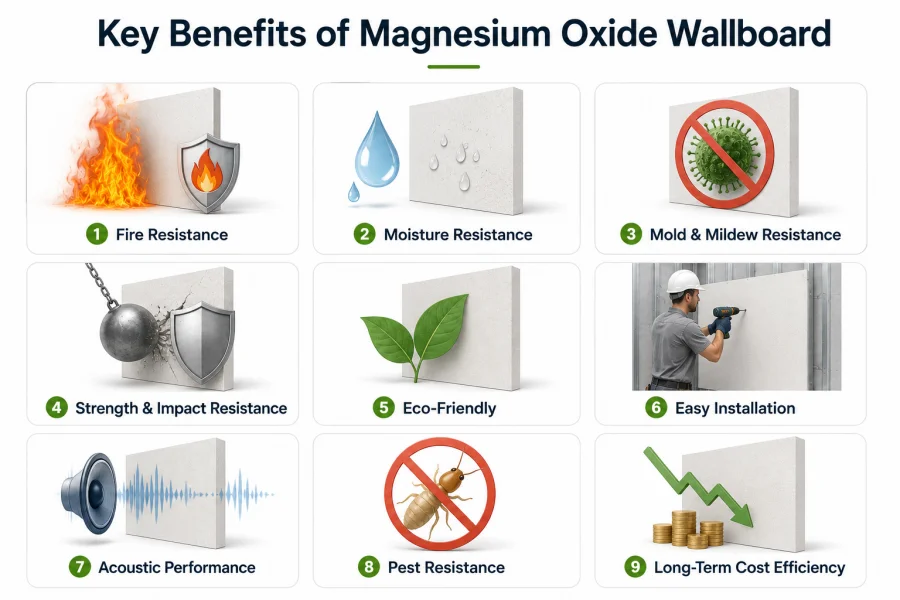
6.1 Exceptional Fire Resistance
Fire resistance remains one of the most important reasons builders choose magnesium oxide wallboard.
Unlike wood-based panels and conventional drywall systems, MgO wallboard is inherently non-combustible.
Because magnesium oxide is a mineral material, it does not burn, contribute fuel to a fire, or produce significant smoke.
Many MgO wallboards can withstand temperatures exceeding 1,000°C while maintaining structural stability.
This performance makes them suitable for:
- Fire-rated partitions
- Exit corridors
- Stairwells
- Mechanical rooms
- Schools
- Hospitals
- Hotels
In fire situations, maintaining wall integrity can help slow flame spread and provide occupants with valuable evacuation time.
For this reason, fire resistance is often considered the defining advantage of magnesium oxide wallboard.
6.2 Superior Moisture Resistance
Moisture is one of the most common causes of building deterioration.
Traditional drywall can absorb water, soften, and eventually lose structural integrity.
Magnesium oxide wallboard performs very differently.
Its inorganic composition helps resist:
- Water absorption
- Swelling
- Delamination
- Warping
This makes it particularly valuable in:
- Bathrooms
- Kitchens
- Basements
- Laundry rooms
- Coastal buildings
Builders working in humid climates often choose MgO wallboard specifically because of its ability to maintain performance under moisture exposure.
6.3 Resistance to Mold and Mildew
Mold growth is a serious concern in both residential and commercial buildings.
Many conventional building materials contain organic components that provide a food source for mold.
MgO wallboard does not.
Its inorganic composition makes it highly resistant to mold and mildew development.
Benefits include:
- Improved indoor air quality
- Reduced maintenance costs
- Healthier indoor environments
- Lower risk of microbial contamination
This advantage is particularly important in schools, healthcare facilities, and residential buildings.
6.4 Outstanding Strength and Impact Resistance
Durability is another area where magnesium oxide wallboard excels.
Compared with traditional drywall, MgO wallboard offers significantly greater resistance to:
- Impact damage
- Cracking
- Surface dents
- Structural deformation
Its reinforced structure allows it to withstand demanding conditions while maintaining its appearance and performance.
High-traffic environments such as schools, hospitals, hotels, and commercial facilities benefit particularly from this enhanced durability.
6.5 Environmentally Friendly Composition
Sustainability is becoming increasingly important in construction.
Magnesium oxide wallboard supports environmentally responsible building practices because it is manufactured primarily from abundant natural minerals.
Additional environmental benefits include:
- Low VOC emissions
- No formaldehyde
- No asbestos
- Recyclable components
- Reduced maintenance requirements
Its long lifespan also helps reduce construction waste by minimizing replacement frequency.
6.6 Easy Installation and Workability
Despite its impressive strength and durability, magnesium oxide wallboard remains relatively easy to install.
Builders appreciate that MgO wallboard can be:
- Cut using standard construction tools
- Drilled without specialized equipment
- Fastened with screws or adhesives
- Finished with paint, wallpaper, tiles, or decorative coatings
Compared with cement board, which is often heavy and difficult to handle, MgO wallboard offers a more installer-friendly solution.
The lightweight nature of the panels provides several practical benefits:
- Faster installation
- Lower labor costs
- Reduced worker fatigue
- Easier transportation
- Improved job-site efficiency
For contractors managing large projects, these advantages can significantly reduce construction timelines and overall project costs.
Another benefit is the board’s smooth and stable surface. Unlike some traditional wall materials that require extensive preparation before finishing, MgO wallboard provides an excellent substrate for various decorative treatments.
This combination of strength and workability makes magnesium oxide wallboard attractive to builders seeking efficiency without compromising performance.
6.7 Excellent Acoustic Performance
Modern buildings require more than structural performance alone.
Occupant comfort increasingly depends on effective sound control.
Magnesium oxide wallboard offers excellent acoustic insulation due to its dense mineral composition.
When installed as part of a complete wall assembly, it helps reduce sound transmission between adjacent spaces.
This makes it particularly suitable for:
- Apartment buildings
- Hotels
- Office buildings
- Conference rooms
- Educational facilities
- Healthcare environments
Noise reduction contributes directly to:
- Improved privacy
- Enhanced occupant comfort
- Better working environments
- Increased property value
In multifamily housing projects, acoustic performance is often a key design requirement.
Builders frequently choose MgO wallboard because it helps achieve sound-control goals while simultaneously providing fire resistance and durability.
By combining multiple performance benefits into a single material, MgO wallboard can simplify wall assembly design and reduce the need for additional specialized products.
6.8 Natural Resistance to Insects and Pests
One often overlooked advantage of magnesium oxide wallboard is its resistance to insects and pests.
Traditional wood-based building materials can attract:
- Termites
- Carpenter ants
- Beetles
- Other wood-destroying organisms
Over time, pest infestations can lead to significant structural damage and costly repairs.
Because MgO wallboard contains no organic cellulose materials, it offers no nutritional value to insects.
As a result:
- Termites cannot consume it.
- Mold-related pest problems are reduced.
- Structural damage risks are minimized.
- Pest-control costs may decrease.
This characteristic makes MgO wallboard especially valuable in tropical and humid regions where termite activity is common.
Property owners benefit from increased durability and lower maintenance requirements throughout the life of the building.
6.9 Long-Term Cost Efficiency
Some builders initially hesitate to use magnesium oxide wallboard because its upfront material cost can be higher than standard drywall.
However, evaluating wall materials solely on purchase price can be misleading.
The true cost of ownership includes:
- Installation costs
- Maintenance expenses
- Repair frequency
- Replacement requirements
- Building lifespan
When these factors are considered, MgO wallboard often proves highly cost-effective.
Its resistance to:
- Fire
- Moisture
- Mold
- Impact damage
- Insect attack
helps reduce maintenance and replacement costs over time.
In commercial buildings, fewer repairs can mean less disruption to occupants and lower operating expenses.
In residential properties, homeowners benefit from reduced maintenance requirements and improved long-term performance.
Many builders view magnesium oxide wallboard as an investment in building durability rather than simply another construction material.
7. Magnesium Oxide Wallboard vs Drywall
One of the most common questions builders ask is whether magnesium oxide wallboard is better than traditional drywall.
The answer depends on project requirements, but in many performance categories, MgO wallboard offers significant advantages.
7.1 Fire Resistance Comparison
Fire performance is one of the largest differences between the two materials.
Traditional drywall contains gypsum, which includes chemically bound water that helps slow fire spread.
However, prolonged exposure to high temperatures eventually causes drywall to weaken and lose structural integrity.
Magnesium oxide wallboard performs differently.
Its mineral composition is inherently non-combustible.
Advantages include:
- Higher temperature resistance
- Reduced flame spread
- Greater structural stability during fires
- Lower smoke generation
For projects requiring fire-rated assemblies, MgO wallboard often provides superior performance.
7.2 Moisture Resistance Comparison
Water exposure is a major weakness of traditional drywall.
When exposed to moisture, drywall can:
- Swell
- Soften
- Warp
- Deteriorate
These problems frequently lead to costly repairs.
Magnesium oxide wallboard resists moisture far more effectively.
It maintains dimensional stability even in humid environments.
As a result, MgO wallboard is often preferred for:
- Bathrooms
- Kitchens
- Basements
- Coastal properties
7.3 Mold Resistance Comparison
Drywall typically uses paper facing.
Unfortunately, paper can support mold growth when exposed to moisture.
MgO wallboard contains no paper and no organic material capable of supporting mold development.
This gives it a major advantage in maintaining healthy indoor environments.
7.4 Strength Comparison
Standard drywall is relatively fragile.
Common issues include:
- Dents
- Cracks
- Surface damage
Magnesium oxide wallboard offers significantly higher impact resistance.
It is particularly beneficial in:
- Schools
- Hospitals
- Hotels
- Commercial buildings
where walls experience frequent contact and wear.
7.5 Lifespan Comparison
Drywall may require repairs or replacement when exposed to:
- Water damage
- Mold growth
- Physical impacts
MgO wallboard’s superior durability often results in a longer service life.
Over decades of use, this can produce substantial maintenance savings.
7.6 Environmental Comparison
Environmental performance is becoming increasingly important.
MgO wallboard generally offers:
- Lower VOC emissions
- No formaldehyde
- No asbestos
- Longer service life
- Reduced replacement frequency
These characteristics support sustainable construction goals.
7.7 Which Is Better?
For basic residential applications with limited performance requirements, traditional drywall may remain an economical choice.
However, when projects prioritize:
- Fire safety
- Moisture resistance
- Durability
- Indoor air quality
- Long-term value
magnesium oxide wallboard often emerges as the superior solution.
| Feature | MgO Wallboard | Traditional Drywall |
|---|---|---|
| Fire Resistance | Excellent | Good |
| Moisture Resistance | Excellent | Poor |
| Mold Resistance | Excellent | Moderate |
| Strength & Impact Resistance | High | Low |
| Service Life | Long | Moderate |
| Environmental Performance | High | Moderate |
| Best For | High-Performance Buildings | Standard Interior Walls |
8. Magnesium Oxide Wallboard vs Cement Board
Another common comparison involves cement board.
Both materials offer better moisture resistance than drywall, but there are important differences.
8.1 Weight
Cement board is considerably heavier.
This can increase:
- Transportation costs
- Labor requirements
- Installation time
MgO wallboard is generally lighter and easier to handle.
8.2 Workability
Cutting cement board often generates dust and requires specialized blades.
MgO wallboard can usually be cut more easily with conventional construction tools.
This improves job-site productivity.
8.3 Fire Performance
Both materials provide excellent fire resistance.
However, MgO wallboard often offers a better combination of:
- Fire protection
- Weight reduction
- Ease of installation
8.4 Surface Finish
MgO wallboard typically features a smoother surface.
This makes it easier to:
- Paint
- Wallpaper
- Decorate
without extensive preparation.
8.5 Overall Value
While cement board remains useful for certain applications, many builders prefer MgO wallboard because it combines durability, moisture resistance, fire protection, and ease of installation in a single material.
| Feature | MgO Wallboard | Cement Board |
|---|---|---|
| Weight | Lightweight | Heavy |
| Workability | Easy to Cut & Drill | More Difficult to Cut |
| Fire Performance | Excellent | Excellent |
| Surface Finish | Smooth | Rough |
| Overall Value | High | Moderate |
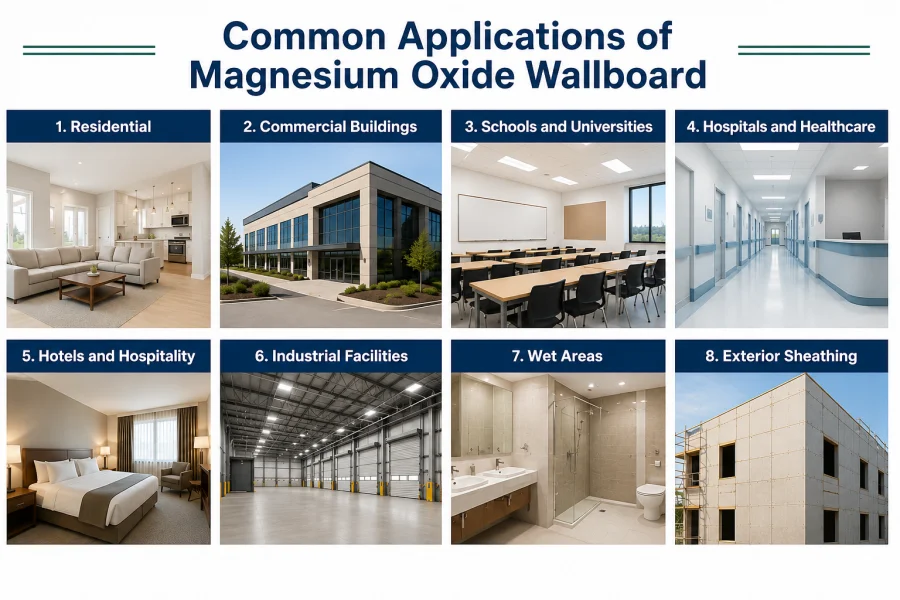
9. Common Applications of Magnesium Oxide Wallboard
The versatility of magnesium oxide wallboard is one of its strongest selling points.
Its performance characteristics make it suitable for a wide range of construction environments.
9.1 Residential Construction
Homeowners increasingly use MgO wallboard for:
- Interior walls
- Ceilings
- Kitchens
- Bathrooms
- Basements
- Garages
Its fire resistance and mold resistance help create safer and healthier homes.
9.2 Commercial Buildings
Commercial projects often require materials capable of withstanding heavy daily use.
MgO wallboard is commonly specified for:
- Office buildings
- Shopping centers
- Restaurants
- Retail facilities
Its durability helps reduce maintenance costs over time.
9.3 Schools and Universities
Educational facilities benefit from:
- Impact resistance
- Fire safety
- Long service life
Walls in schools often experience substantial wear, making durability especially important.
9.4 Hospitals and Healthcare Facilities
Healthcare environments require materials that support cleanliness and safety.
MgO wallboard helps by offering:
- Mold resistance
- Moisture resistance
- Fire protection
- Easy-to-clean surfaces
These characteristics contribute to healthier indoor environments.
9.5 Hotels and Hospitality Projects
Hotels prioritize:
- Fire safety
- Acoustic comfort
- Durability
- Aesthetic flexibility
MgO wallboard supports all of these objectives while helping reduce maintenance needs.
9.6 Industrial Facilities
Industrial buildings often expose materials to challenging conditions.
MgO wallboard performs well in facilities that require:
- Fire-rated construction
- Moisture protection
- Durable wall systems
9.7 Wet Areas
Bathrooms, locker rooms, spas, and laundry facilities represent ideal environments for magnesium oxide wallboard.
Its moisture-resistant properties help prevent the problems commonly associated with traditional drywall.
9.8 Exterior Sheathing Applications
Certain MgO wallboard products can be used as exterior sheathing when installed according to manufacturer recommendations.
Benefits include:
- Dimensional stability
- Moisture resistance
- Fire protection
- Long-term durability
10. How to Choose the Right Magnesium Oxide Wallboard
Not all MgO wallboards are identical. Product quality, formulation, thickness, and intended application can vary significantly between manufacturers. Selecting the right board for your project is essential for achieving optimal performance and long-term durability.
10.1 Choose the Appropriate Thickness
One of the first decisions is selecting the correct board thickness.
Typical thickness options include:
| Thickness | Common Applications |
|---|---|
| 6mm | Ceilings, decorative wall systems |
| 8mm | Interior partitions and residential walls |
| 10mm | Commercial wall systems |
| 12mm | Fire-rated assemblies and demanding environments |
Thicker boards generally provide:
- Better impact resistance
- Higher fire performance
- Increased structural stability
However, they may also increase material costs and weight.
The best choice depends on the specific requirements of the project.
10.2 Consider Environmental Conditions
Builders should evaluate the environment where the board will be installed.
Important considerations include:
- Dry Interior Spaces: Standard MgO wallboard is typically suitable for living rooms, bedrooms, and offices meeting rooms.
- High-Humidity Areas: For bathrooms, kitchens, spas, and laundry rooms, moisture-resistant products should be selected.
- Fire-Rated Assemblies: Projects requiring compliance with fire regulations may require certified fire-rated boards.
- Exterior Applications: If the board will be exposed to weather conditions, verify that the manufacturer specifically approves the product for exterior use.
10.3 Verify Product Certifications
Quality certification provides confidence that a product has been tested according to recognized standards.
Builders should look for documentation related to:
- Fire resistance
- Moisture resistance
- Structural performance
- Environmental safety
- Indoor air quality
Independent testing helps ensure that the board performs as advertised.
10.4 Evaluate Surface Requirements
Different projects require different finishing methods.
Consider whether the wallboard will be:
- Painted
- Wallpapered
- Tiled
- Laminated
- Coated with decorative finishes
Selecting the appropriate surface type can simplify installation and finishing work.
10.5 Work with Reputable Manufacturers
The performance of MgO wallboard depends heavily on manufacturing quality.
An experienced manufacturer can provide:
- Technical support
- Product certifications
- Installation guidance
- Consistent quality control
Choosing a reliable supplier helps minimize project risks and ensures long-term performance.
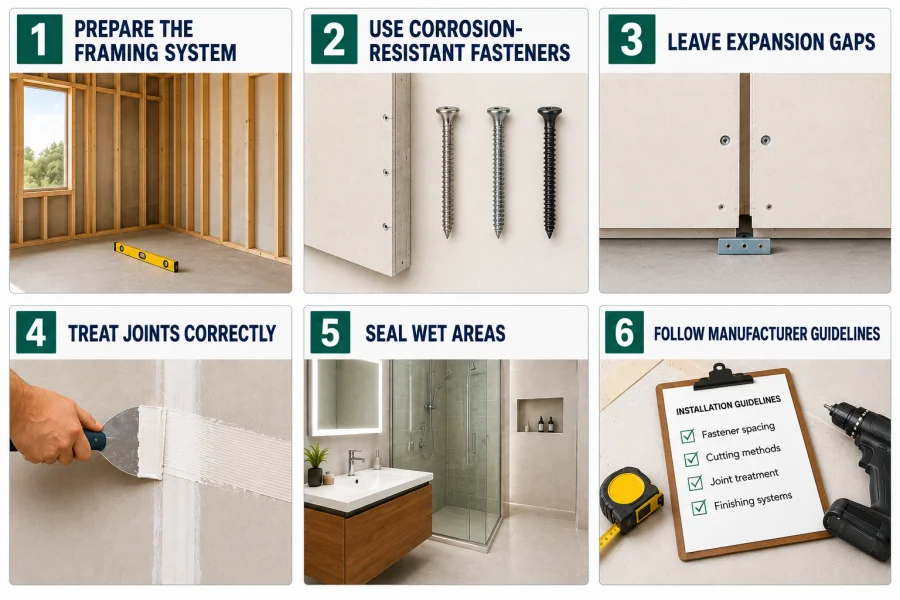
11. Installation Best Practices
Proper installation is essential for maximizing the performance and lifespan of magnesium oxide wallboard.
Although installation is similar to drywall, several best practices should be followed.
11.1 Prepare the Framing System
Before installation:
- Ensure framing is level
- Verify structural stability
- Remove any debris
- Check spacing requirements
A properly prepared substrate helps prevent alignment issues later.
11.2 Use Corrosion-Resistant Fasteners
Fasteners should be compatible with MgO wallboard and the surrounding environment.
Recommended options often include:
- Stainless steel screws
- Galvanized screws
- Corrosion-resistant fasteners
Using inappropriate fasteners may reduce long-term durability.
11.3 Leave Expansion Gaps
Small expansion gaps between panels can help accommodate natural movement caused by temperature and humidity changes.
Always follow manufacturer recommendations regarding:
- Panel spacing
- Joint treatment
- Expansion requirements
11.4 Treat Joints Correctly
For smooth finished walls:
- Apply joint tape.
- Use compatible joint compound.
- Sand as required.
- Apply primer before finishing.
Proper joint treatment helps create a professional appearance.
11.5 Seal Wet Areas
For bathrooms, kitchens, and other moisture-prone spaces:
- Seal joints appropriately.
- Protect exposed edges.
- Use suitable waterproofing systems when necessary.
Additional moisture protection can improve long-term performance.
11.6 Follow Manufacturer Guidelines
Every manufacturer may have specific recommendations regarding:
- Fastener spacing
- Cutting methods
- Joint treatment
- Finishing systems
Following these guidelines helps ensure warranty compliance and optimal results.
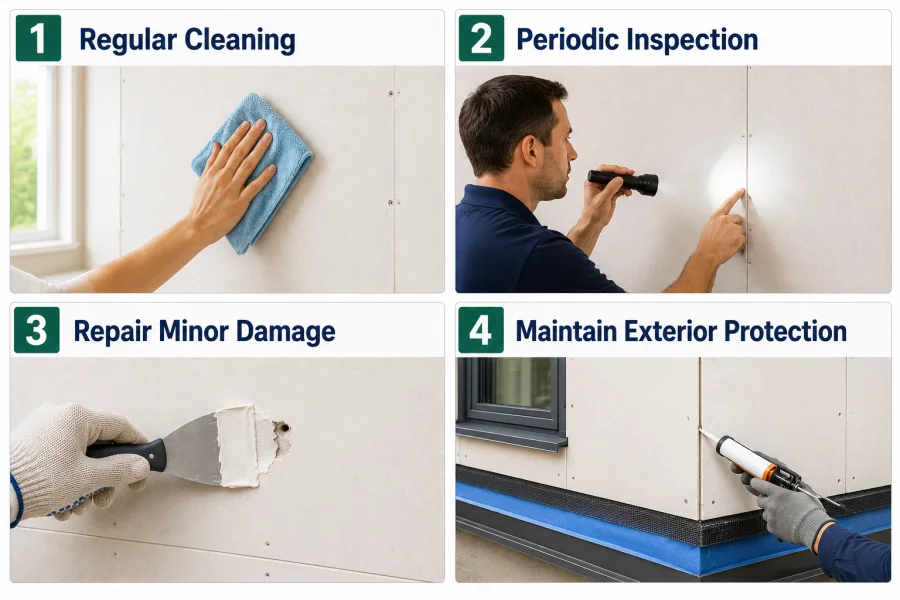
12. Maintenance Tips for MgO Wallboard
One of the advantages of magnesium oxide wallboard is its low maintenance requirements.
However, simple maintenance practices can help maximize its lifespan.
12.1 Regular Cleaning
Most surfaces can be cleaned using:
- A damp cloth
- Mild detergent
- Non-abrasive cleaning products
Avoid harsh chemicals that may damage decorative finishes.
12.2 Periodic Inspection
Inspect walls periodically for:
- Joint movement
- Surface damage
- Water intrusion
- Impact damage
Early detection of minor issues can prevent larger repairs.
12.3 Repair Minor Damage Promptly
Although MgO wallboard is highly durable, localized damage can occur.
Small imperfections should be repaired quickly using compatible patching materials.
12.4 Maintain Exterior Protection
For exterior applications:
- Inspect sealants
- Check flashing details
- Maintain weather barriers
Proper maintenance helps preserve long-term performance.
13. Frequently Asked Questions About Magnesium Oxide Wallboard
What is magnesium oxide wallboard made of?
MgO wallboard is typically made from magnesium oxide, magnesium sulfate, fiberglass mesh reinforcement, water, and mineral fillers.
Is MgO wallboard fireproof?
MgO wallboard is non-combustible and offers exceptional fire resistance. It is commonly used in fire-rated wall and ceiling assemblies.
How fire-resistant is magnesium oxide wallboard?
Many MgO wallboards can withstand temperatures exceeding 1,000°C while maintaining structural integrity.
Is magnesium oxide wallboard waterproof?
MgO wallboard is highly moisture-resistant but should not automatically be considered completely waterproof. Proper sealing may still be required in certain applications.
Does MgO wallboard support mold growth?
No. Because it is inorganic, magnesium oxide wallboard does not provide a food source for mold or mildew.
Can MgO wallboard be used in bathrooms?
Yes. Bathrooms are among the most common applications because of the board’s moisture resistance and mold resistance.
Can MgO wallboard be used outdoors?
Certain MgO wallboards are suitable for exterior applications. Always verify manufacturer recommendations before installation.
Is MgO wallboard stronger than drywall?
Yes. MgO wallboard generally offers significantly greater impact resistance, durability, and structural stability than conventional drywall.
Can magnesium oxide wallboard support tiles?
Yes. Its dimensional stability makes it an excellent substrate for ceramic and stone tile installations.
Is MgO wallboard environmentally friendly?
Yes. It is typically manufactured from natural mineral-based materials and contains no formaldehyde, asbestos, or VOC emissions.
Does MgO wallboard improve indoor air quality?
Because it contains no harmful VOCs and resists mold growth, MgO wallboard can contribute to healthier indoor environments.
Is magnesium oxide wallboard termite resistant?
Yes. Since it contains no organic cellulose materials, termites and other wood-destroying insects cannot consume it.
Can MgO wallboard be painted?
Yes. Most MgO wallboards can be painted using standard interior or exterior paint systems after appropriate surface preparation.
How long does MgO wallboard last?
When properly installed and maintained, magnesium oxide wallboard can provide decades of reliable service.
Is MgO wallboard worth the investment?
For projects requiring fire resistance, moisture protection, durability, and low maintenance, MgO wallboard often delivers excellent long-term value.
14. Conclusion
Magnesium oxide wallboard has emerged as one of the most advanced and versatile building materials available in modern construction. Combining exceptional fire resistance, moisture protection, mold resistance, impact strength, environmental sustainability, and long-term durability, it addresses many of the limitations associated with traditional drywall and cement board.
Whether used in residential homes, commercial buildings, healthcare facilities, schools, hotels, or industrial projects, MgO wallboard offers builders and property owners a high-performance solution capable of meeting today’s demanding construction standards.
Its ability to enhance fire safety, improve indoor air quality, reduce maintenance costs, and support sustainable building practices makes it an increasingly attractive choice for modern construction projects worldwide.
As building codes continue to evolve and expectations for performance continue to rise, magnesium oxide wallboard is well positioned to become a preferred wall system for the next generation of safe, durable, and environmentally responsible buildings.
Latest Posts