Introduction
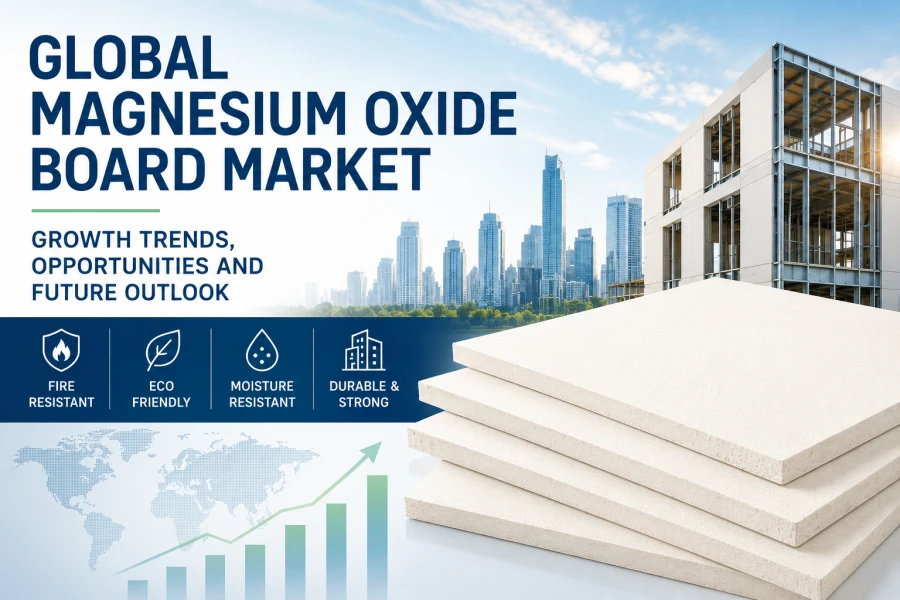
The global magnesium oxide board market has gained significant momentum over the past decade as the construction industry increasingly prioritizes fire safety, sustainability, and long-term durability. Once considered a niche alternative to traditional building materials, magnesium oxide (MgO) boards are now being specified in a growing range of residential, commercial, and industrial applications.
Driven by stricter building regulations, rising environmental awareness, and demand for healthier indoor environments, the market continues to expand across both developed and emerging economies. As architects, contractors, and developers seek materials that combine performance with sustainability, MgO boards are becoming an increasingly attractive solution.
This article explores the major growth drivers, emerging opportunities, regional developments, and long-term trends shaping the global magnesium oxide board market through 2030.
Global Magnesium Oxide Board Market Overview
Magnesium oxide board is a high-performance construction panel manufactured primarily from magnesium oxide and reinforcing materials. Known for its fire resistance, moisture resistance, mold resistance, and dimensional stability, it is widely used for wall sheathing, flooring underlayment, ceiling systems, partition walls, and fire-rated assemblies.
The market has experienced consistent growth due to several factors:
- Increasing demand for non-combustible building materials
- Expansion of green building initiatives
- Growing adoption of prefabricated construction methods
- Rising awareness of indoor air quality
- Development of stricter fire safety regulations
Although adoption rates vary by region, the long-term outlook remains positive as governments and developers place greater emphasis on resilient and sustainable construction.
What Is Driving the Growth of the MgO Board Market?
Fire Safety Requirements
One of the strongest growth drivers for MgO boards is fire protection. Around the world, governments continue to strengthen fire performance requirements for residential and commercial buildings.
Unlike many wood-based panels, MgO boards are non-combustible and can achieve high fire-resistance ratings when incorporated into certified wall, ceiling, and floor systems. As a result, they are increasingly specified in schools, hospitals, hotels, apartment buildings, and public infrastructure projects.
Sustainable Construction
The construction industry is under increasing pressure to reduce environmental impact. Builders and developers are actively searching for materials that contribute to sustainable construction goals.
MgO boards align with this trend because they offer:
- Long service life
- Low VOC emissions
- Resistance to biological degradation
- Compatibility with green building systems
As sustainability standards become more widespread, demand for environmentally responsible construction materials is expected to continue rising.
Moisture and Mold Resistance
Compared with many traditional interior panels, MgO boards perform exceptionally well in humid environments. Their resistance to mold growth and moisture damage makes them suitable for bathrooms, basements, kitchens, and coastal construction projects.
This performance advantage has become increasingly important as builders seek to reduce maintenance costs and improve building durability.
Long-Term Durability
Modern construction projects increasingly focus on lifecycle performance rather than initial material costs alone. MgO boards offer excellent dimensional stability, impact resistance, and durability, making them attractive for projects where long-term performance is a priority.
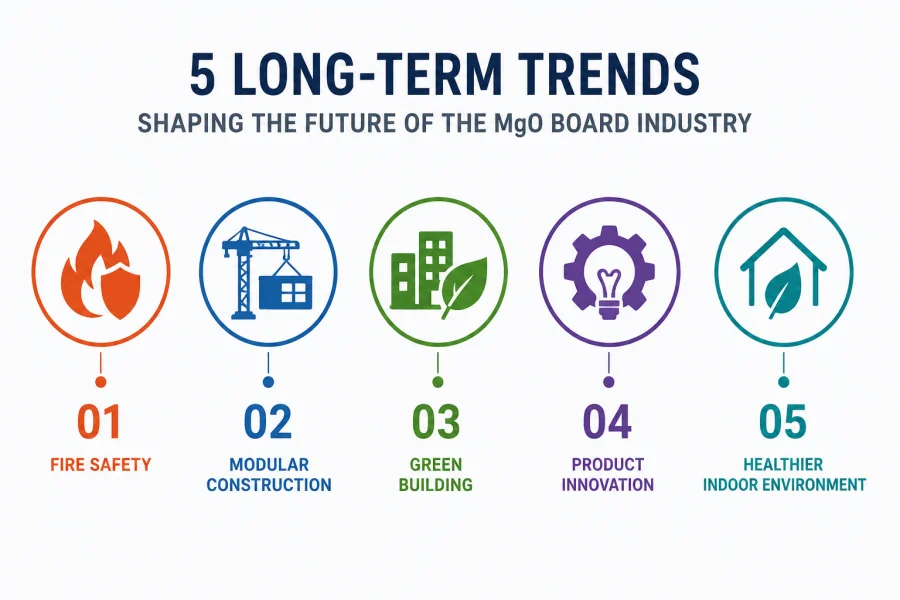
Five Long-Term Trends Shaping the Industry
Trend 1: Stricter Fire Regulations Worldwide
Fire safety remains a global concern, particularly in high-density residential and commercial developments. Building codes in many countries are becoming more demanding regarding fire-rated assemblies and non-combustible construction materials.
This regulatory environment is expected to continue supporting demand for magnesium oxide boards throughout the next decade.
Trend 2: Growth of Modular and Prefabricated Construction
The rapid expansion of modular and prefabricated construction is creating new opportunities for MgO board manufacturers.
Factory-built construction methods require materials that are:
- Lightweight
- Durable
- Easy to handle
- Dimensionally stable
- Fire resistant
These requirements align closely with the strengths of MgO boards, making them increasingly popular in modular housing, prefabricated wall panels, and off-site construction systems.
Trend 3: Expansion of Green Building Standards
Programs such as LEED and other sustainability certification systems continue to influence material selection worldwide.
Developers are paying greater attention to:
- Material durability
- Indoor environmental quality
- Resource efficiency
- Building lifecycle performance
As a result, MgO boards are increasingly being incorporated into green building projects.
Trend 4: Innovation in MgSO4 and Specialty MgO Boards
Product innovation remains an important area of market development.
Manufacturers are introducing:
- Magnesium sulfate boards (MgSO4 boards)
- Sanded boards for flooring applications
- Decorative laminated boards
- High-density structural boards
- Specialty fire door core panels
These innovations expand the potential applications of magnesium oxide technology and create opportunities in new market segments.
Trend 5: Demand for Healthier Indoor Environments
Indoor air quality has become an important consideration in modern construction.
MgO boards are often selected because they:
- Do not support mold growth
- Contain no asbestos
- Produce minimal VOC emissions
- Contribute to healthier indoor environments
This trend is particularly relevant in healthcare facilities, schools, senior living communities, and residential developments.
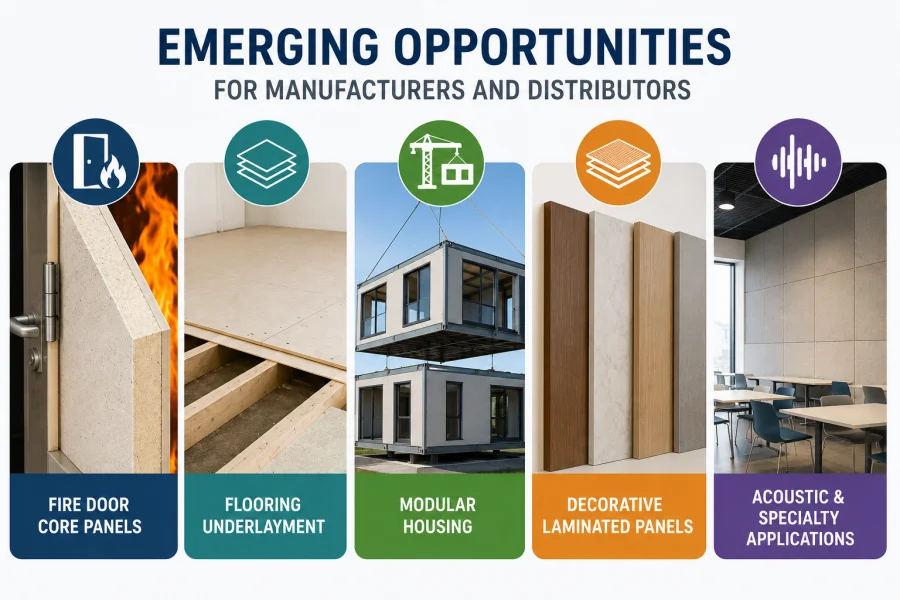
Emerging Opportunities for Manufacturers and Distributors
Several high-growth opportunities are expected to drive industry expansion over the coming years.
Fire Door Core Panels
The increasing adoption of fire-rated doors in commercial and residential construction creates substantial demand for specialized MgO core materials.
Flooring Underlayment
As builders seek alternatives to plywood and cement-based products, MgO flooring panels are gaining attention for their combination of strength, fire resistance, and moisture resistance.
Modular Housing
Rapid urbanization and housing demand continue to support modular construction projects, creating new opportunities for manufacturers capable of supplying factory-ready panels.
Decorative Laminated Panels
The combination of MgO substrates with PVC films, HPL surfaces, and decorative finishes allows manufacturers to enter higher-value interior markets.
Acoustic and Specialty Applications
Schools, offices, hotels, and public buildings increasingly require acoustic performance alongside fire protection, opening additional opportunities for specialty MgO products.
Challenges Facing the Industry
Despite its strong growth potential, the magnesium oxide board industry faces several challenges.
Competition from Alternative Materials
MgO boards compete with gypsum boards, fiber cement boards, calcium silicate boards, and plywood. Continued market education is necessary to communicate the unique advantages of MgO technology.
Installation Awareness
In some regions, contractors remain unfamiliar with proper MgO board installation practices. Increased training and technical support will help accelerate adoption.
Supply Chain Complexity
Raw material sourcing, quality consistency, and logistics management remain important considerations for manufacturers serving international markets.
For a detailed analysis of recent raw material shortages, rising production costs, export policy changes, and their impact on pricing, readers can explore our dedicated 2026 MgO Board Market Report.
Regional Outlook Through 2030
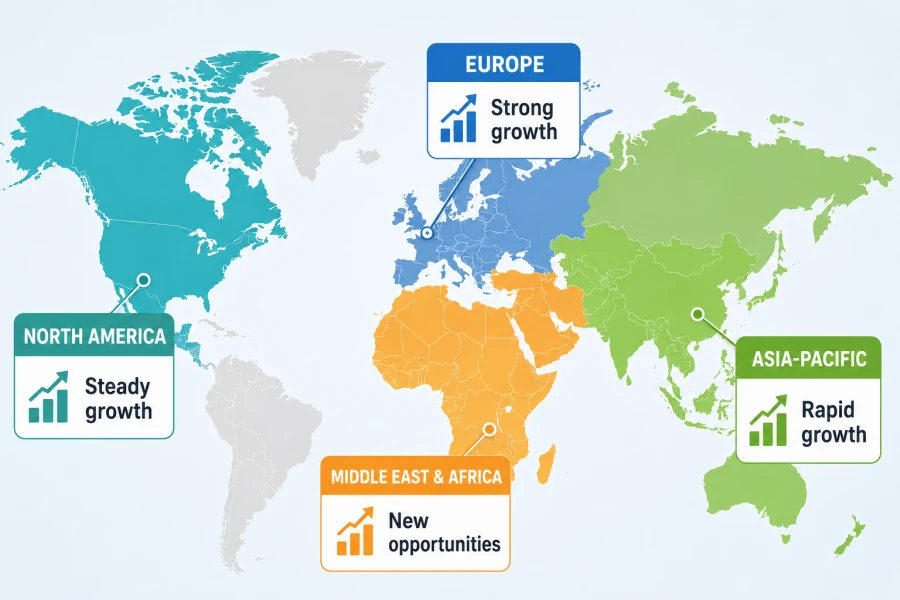
North America
Demand is expected to grow steadily due to stricter fire safety requirements, increased adoption of prefabricated construction, and growing interest in sustainable building materials.
Europe
Europe remains one of the most promising markets due to strong environmental regulations and widespread support for green construction initiatives.
Asia-Pacific
Rapid urbanization, infrastructure development, and expanding manufacturing capacity will continue to make Asia-Pacific a key growth region.
Middle East and Africa
Large-scale infrastructure projects, commercial developments, and increasing focus on fire safety standards are expected to create new opportunities in emerging markets.
Future Outlook
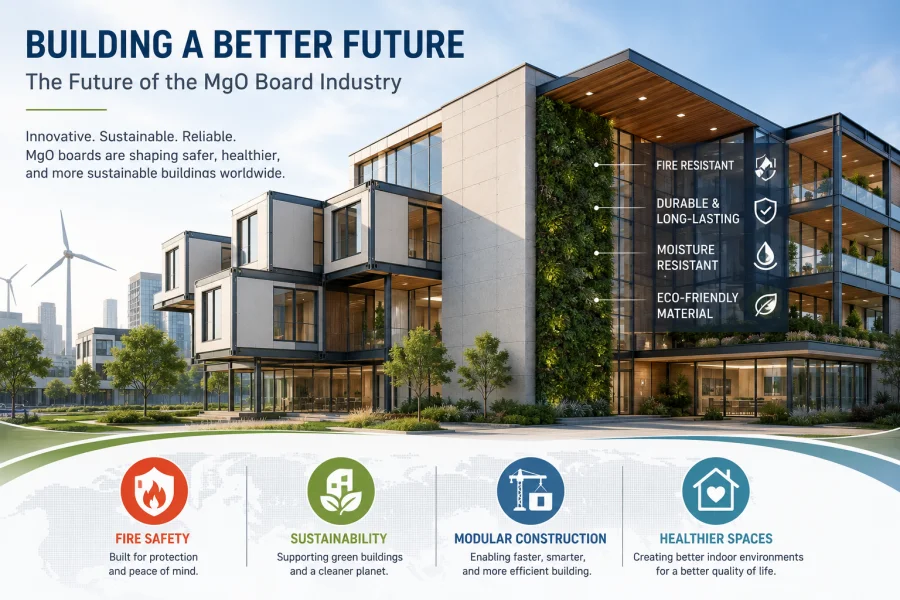
The future of the global magnesium oxide board market appears highly promising. Growing demand for fire-resistant, environmentally responsible, and durable construction materials is expected to support continued market expansion through 2030 and beyond.
Manufacturers that focus on innovation, quality control, sustainability, and technical support will be best positioned to capture market share in an increasingly competitive environment.
As construction practices continue to evolve, magnesium oxide boards are likely to play an increasingly important role in shaping safer, healthier, and more sustainable buildings worldwide.
Conclusion
The magnesium oxide board market is transitioning from a specialized niche into a mainstream construction material category. Driven by fire safety regulations, sustainability initiatives, modular construction growth, and demand for healthier indoor environments, the industry is positioned for long-term expansion.
For manufacturers, distributors, and construction professionals, understanding these market trends is essential for identifying new opportunities and preparing for future growth. While challenges remain, the long-term outlook for magnesium oxide boards remains positive as global demand for high-performance building materials continues to rise.
Have questions about magnesium oxide boards or their applications? Contact our team to discuss solutions tailored to your project requirements.
Latest Posts