Introduction
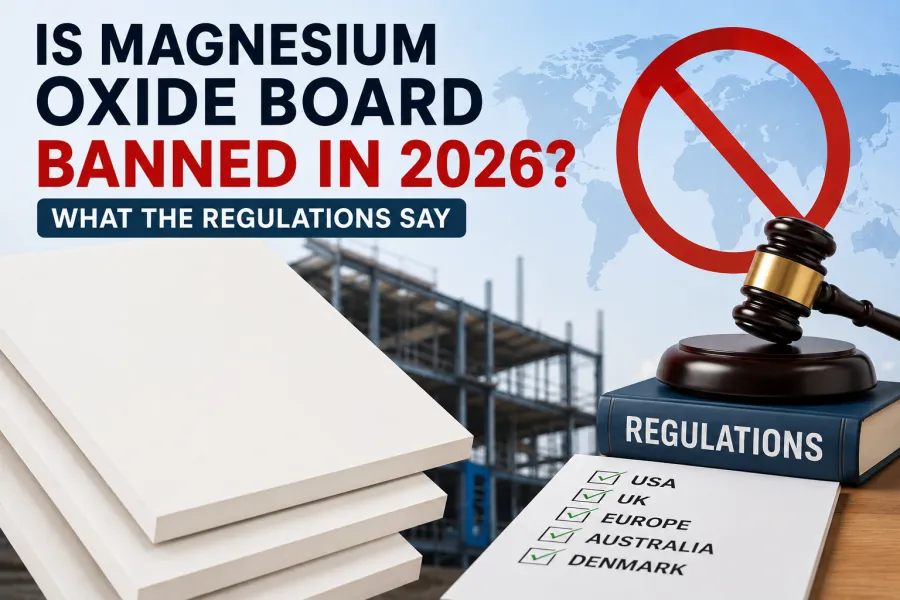
No, magnesium oxide (MgO) board is not globally banned in 2026. However, certain MgO products have faced restrictions, warnings, or serious concerns in specific applications—most notably chloride-based boards used in humid environments.
Much of the confusion comes from the well-documented moisture and corrosion problems associated with some MgO boards used in Denmark during the 2010s. These problems led to restrictions on their use and created the impression that MgO board itself had been banned worldwide.
The reality is more nuanced. MgO boards are still used in many construction markets, but their suitability depends on the product formulation, performance testing, intended application, climate, and local building requirements.
In this article, we explain where the “MgO board ban” claims came from, what happened in Denmark, how major markets treat MgO boards, and what buyers should check before choosing a product.
What Is MgO Board?
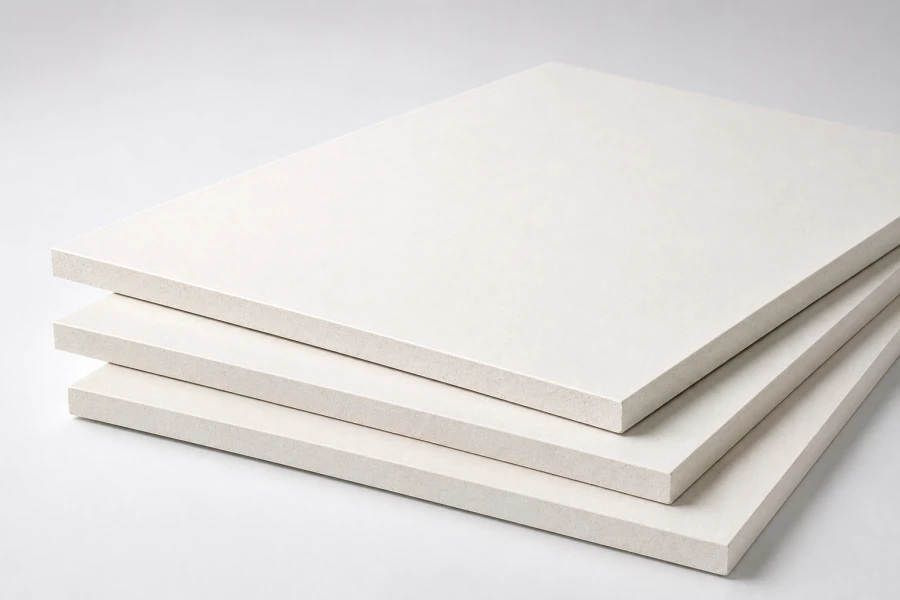
MgO board is a mineral-based construction board used for applications such as wall sheathing, ceilings, flooring, fire-rated assemblies, and decorative panels. Depending on the formulation, MgO boards may use magnesium chloride (MgCl₂) or magnesium sulfate (MgSO₄) as a binder.
For a detailed explanation of MgO board composition, properties, applications, and manufacturing, see our guide: [What Is MgO Board?]
Is MgO Board Banned in 2026?
The short answer is no—not globally.
| Question | Answer |
|---|---|
| Is MgO board globally banned? | No |
| Have some MgO boards caused serious moisture problems? | Yes |
| Did Denmark restrict the use of MgO boards following documented failures? | Yes |
| Are all MgO boards affected by the Danish case? | No |
| Is MgO board still used internationally? | Yes |
| Does every MgO board comply with every building code? | No |
The important distinction is between a ban on a material category and restrictions on particular products or applications.
A building material can remain commercially available while certain formulations, applications, or construction systems are rejected because they do not meet local performance requirements.
Why Do People Think MgO Board Is Banned?
The main reason is the well-known Danish MgO board problem.
MgO boards became widely used in Denmark as wind barrier/sheathing boards in ventilated facade constructions. During the winter of 2014–2015, significant moisture problems were discovered in a number of buildings.
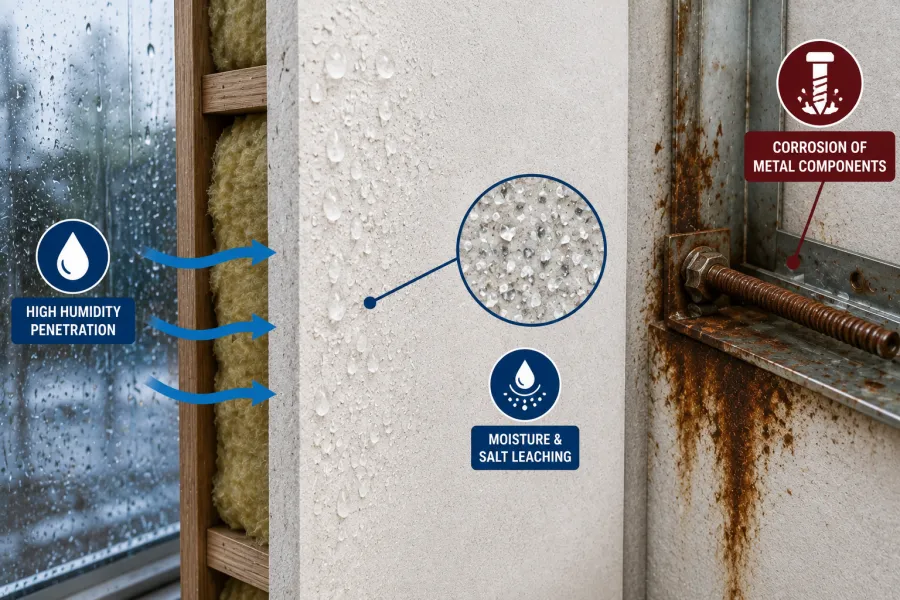
Researchers at the Technical University of Denmark found that some of these boards could absorb large amounts of moisture from humid outdoor air. Under high relative humidity, salty liquid could appear on the board surface and run onto adjacent building components. The liquid contained soluble chloride ions and could cause severe corrosion of metal fasteners and other components. Moisture and mold problems were also reported in surrounding materials.
This became one of the most important reasons behind the modern debate about MgO board safety.
What Happened to MgO Boards in Denmark?
The Danish case was not simply a problem with the word “magnesium oxide.” It was closely related to the properties of specific boards and the way they were used in exterior wall constructions.
Many of the problematic products investigated in Denmark were magnesium oxychloride (MgCl₂-based) boards. Their salt content could contribute to significant moisture uptake under high-humidity conditions. Researchers documented “weeping” or salty water leakage from some boards, followed by corrosion of metal components and moisture-related damage.
Research comparing chloride- and sulfate-based MgO boards has also found significant differences in moisture-related behavior between products. This is one reason why the binder system and complete product formulation should be considered when evaluating an MgO board.
The Danish experience therefore provides an important lesson:
Do not judge an MgO board only by its name or its fire performance. Moisture behavior, durability, corrosion resistance, and intended application are equally important.
Does the Denmark Case Mean All MgO Boards Are Banned?
No.
The Danish problems should not be interpreted as evidence that every MgO board has the same performance.
MgO boards can differ substantially in:
- Binder system
- Raw material quality
- Chloride content and chemical composition
- Density
- Reinforcement
- Moisture absorption
- Moisture movement
- Corrosion behavior
- Manufacturing and curing processes
- Intended application
Magnesium sulfate (MgSO₄)-based boards use a different binder system from traditional magnesium oxychloride boards. Some research has found lower moisture uptake in sulfate-based products compared with the problematic chloride-based boards studied in Denmark.
However, binder type alone should not be treated as a guarantee of product quality. Independent testing and application-specific performance data remain important.
Is MgO Board Banned in the USA?
No, MgO board is not generally banned in the United States.
MgO products can be evaluated and used as components of construction assemblies when they meet the applicable requirements for the intended application. UL, for example, provides databases for locating and verifying fire-rated assemblies and certified products.
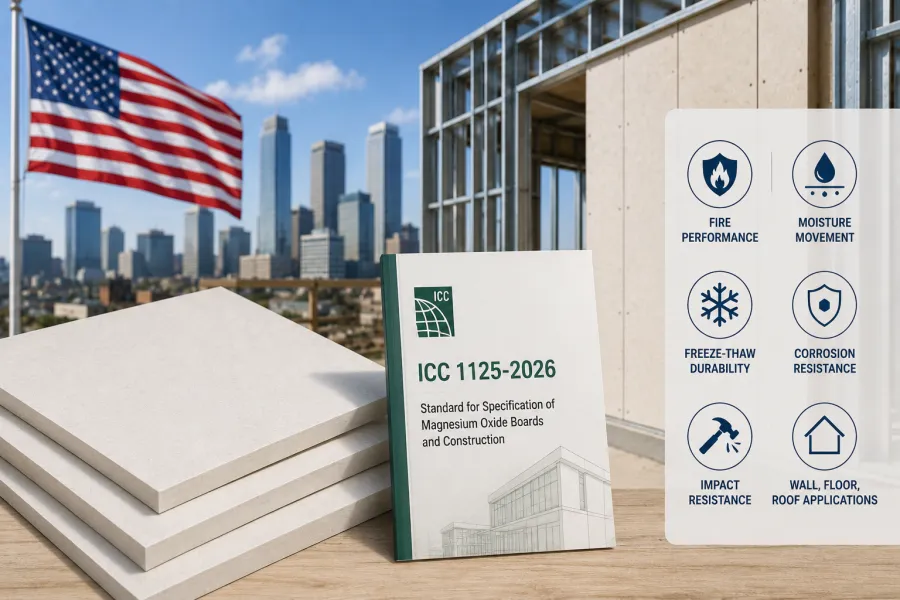
An important development for the U.S. market is the publication of ICC 1125-2026, Standard for Specification of Magnesium Oxide Boards and Construction.
The standard establishes performance requirements and testing approaches for MgO boards, including physical properties, durability, moisture movement, freeze-thaw performance, corrosion resistance, impact resistance, surface-burning characteristics, and application-specific requirements for wall, floor, roof, and tile backer applications.
This is important because it shows the direction of the North American market: clearer performance requirements rather than a blanket ban on MgO board.
For U.S. projects, however, a manufacturer should not simply state that an MgO board is “code compliant.” The specific product, assembly, testing, and project requirements must be evaluated.
Is MgO Board Banned in the UK?
There is no simple nationwide ban on all MgO boards in the UK.
MgO boards have been specified and used in UK construction projects. UK technical documents also recognize magnesium oxide board as a non-combustible board that can provide fire resistance depending on the product and the complete construction system.
However, this does not mean that every MgO board is acceptable for every UK application.
For example, some UK project specifications have specifically prohibited the use of magnesium oxide/magnesium oxychloride sheathing boards in certain wall and SIP applications.
Therefore, the correct question for a UK project is not simply:
“Is MgO board banned in the UK?”
It is:
“Is this specific MgO board approved for this specific construction system and application?”
This distinction is particularly important for external walls, SIPs, timber-frame construction, and projects with strict fire or warranty requirements.
Is MgO Board Banned in Australia?
MgO board is not generally banned in Australia.
Australian technical evaluations have included MgO boards for applications such as wall systems, external boards, fire protection, and other construction uses. MgO products can achieve non-combustible results when appropriately tested, including under AS 1530.1, while fire-resistance performance depends on the complete tested system.
As in other markets, compliance should be based on the specific product, test report, installation method, and applicable requirements of the project.
For projects in bushfire-prone areas or applications requiring a specific fire resistance level, buyers should request the relevant Australian test reports and system documentation rather than relying only on a general “fireproof” claim.
Is MgO Board Banned in Europe?
There is no general EU-wide ban on MgO board.
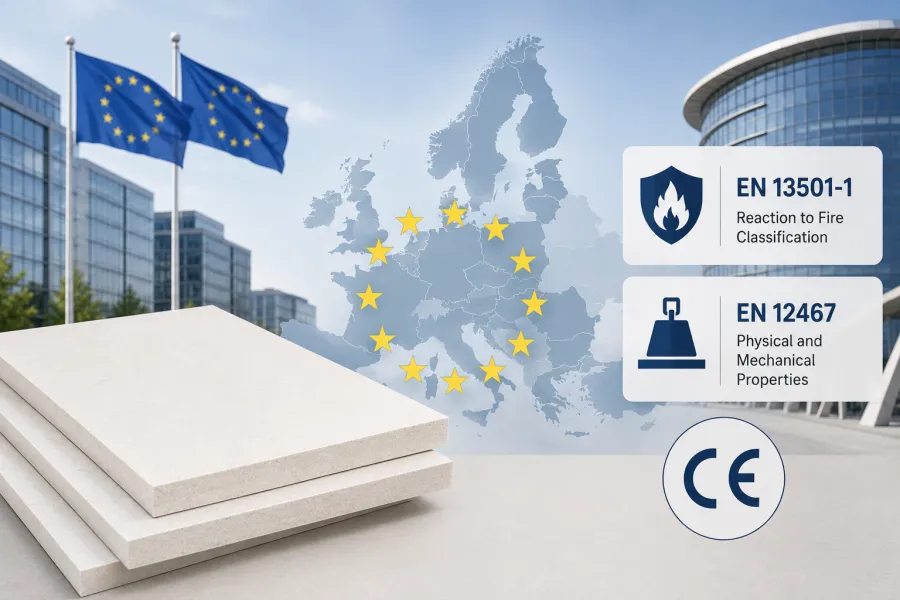
European projects may use EN-based testing and other technical assessment routes depending on the product, application, and regulatory pathway.
For example, EN 13501-1 can be used for reaction-to-fire classification, while EN 12467 is often referenced when evaluating physical and mechanical properties of MgO boards.
However, testing to an EN standard does not automatically mean that a product is CE marked for every application. The applicable compliance route depends on the product’s intended use, the relevant European regulatory framework, and the technical assessment route available for that product.
In other words:
EN test results, CE marking, and suitability for a particular building application are related but not identical concepts.
Does Magnesium Sulfate MgO Board Avoid the Denmark Problem?
Magnesium sulfate (MgSO₄)-based MgO board is often considered when moisture and chloride-related corrosion are major concerns.
Unlike magnesium oxychloride boards, MgSO₄-based boards use a different binder chemistry. Research comparing sulfate- and chloride-based MgO boards has identified differences in moisture uptake and related performance.
However, choosing a sulfate-based board should not replace proper product testing.
A high-quality MgO board should still be evaluated for:
- Moisture resistance
- Moisture movement
- Corrosion resistance
- Freeze-thaw durability where applicable
- Mechanical strength
- Fire performance
- Long-term durability
- Compatibility with the intended construction system
For projects in cold, humid, or moisture-sensitive environments, these factors are particularly important.
What Should You Check Before Buying MgO Board?
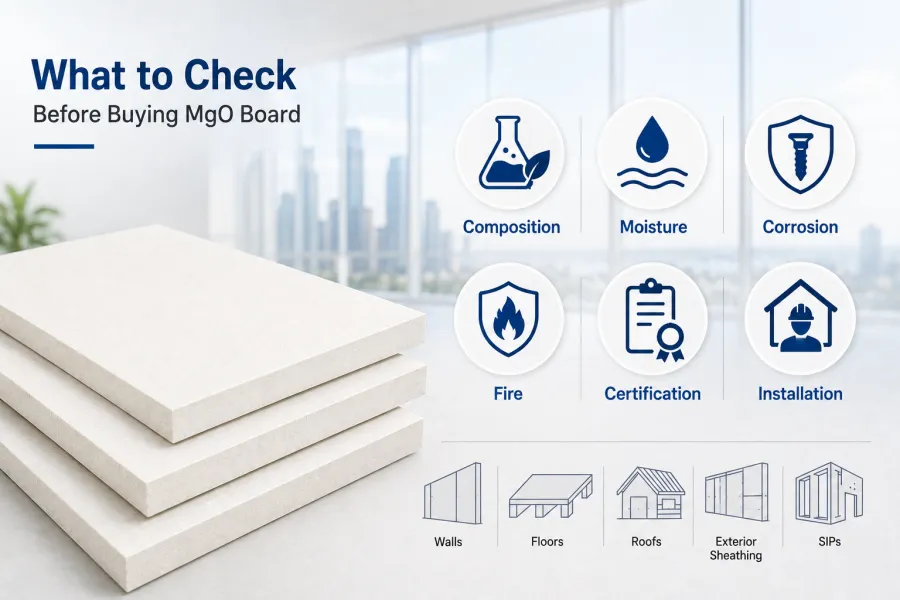
Instead of asking only whether an MgO board is “banned,” buyers should ask whether the specific product is suitable for the intended application.
Before placing an order, request:
1. Product Composition
Ask whether the board is MgSO₄-based or MgCl₂-based and request clear information about the binder system and major raw materials.
2. Moisture and Durability Data
Request test data covering moisture absorption, moisture movement, water resistance, freeze-thaw performance, or other durability properties relevant to the project.
3. Corrosion-Related Testing
For applications involving metal framing, fasteners, or exterior wall systems, corrosion resistance can be an important consideration.
4. Fire Test Reports
Do not rely only on statements such as “Class A” or “fireproof.” Ask for the actual test report and verify the applicable test standard.
5. Application-Specific Certification
A board suitable for interior wall lining may not automatically be suitable for exterior sheathing, flooring, roofing, or SIP construction.
6. Installation Requirements
Even a well-performing board can fail if it is installed in an unsuitable environment or without the required moisture-control measures.
How Suparna Approaches MgO Board Quality
At Suparna MgO Board, we manufacture both magnesium sulfate (MgSO₄)-based and magnesium chloride (MgCl₂)-based MgO boards for different applications and market requirements.
For chloride-based products, our manufacturing process includes controlled soaking and water-curing procedures designed to reduce soluble chloride and improve product stability.
For projects where chloride-related moisture and corrosion concerns are particularly important, we can also provide magnesium sulfate-based MgO boards.
Rather than relying on a single chemical indicator, we recommend evaluating the complete product specification, test reports, intended application, and installation conditions.
Final Answer: Is Magnesium Oxide Board Banned in 2026?
No, magnesium oxide board is not globally banned in 2026.
The confusion mainly comes from serious moisture and corrosion problems associated with certain MgO boards used in Denmark, particularly in exterior wall applications under high-humidity conditions. Those failures led to restrictions and raised legitimate concerns about product quality and application suitability.
Today, MgO boards continue to be evaluated and used in different construction markets. At the same time, regulations and standards are becoming more focused on measurable product performance, as demonstrated by the introduction of ICC 1125-2026 in North America.
So the better question is not:
“Is MgO board banned?”
It is:
“Does this specific MgO board meet the performance and regulatory requirements for my application?”
If you are sourcing MgO board for fire-rated walls, flooring, SIPs, exterior sheathing, or other construction applications, ask your supplier for complete technical documentation, independent test reports, and clear installation guidance.
Latest Posts