
Introduction
As construction trends move toward sustainable and fire-resistant materials, magnesium oxide (MgO) boards are becoming a global favorite for subflooring, wall panels, ceilings, and modular building systems. But with so many suppliers and formulas available, how do you ensure you’re sourcing the right MgO board for your project?
This comprehensive buyer’s guide explains everything contractors, builders, and importers need to know about selecting high-performance magnesium oxide mgo boards—whether you’re working on a residential build or managing a commercial procurement project.
1. Understanding the Two Types of Magnesium Oxide MgO Board
Not all magnesium oxide MgO boards are made the same. One of the most important distinctions lies in the type of binder used:
🔹 Chloride-Based MgO Board (MgCl₂)
- Made with magnesium chloride as a binder
- Economical and widely available
- Can absorb moisture if not properly treated, leading to “crying boards” or corrosion in cold climates
🔹 Sulfate-Based MgO Board (MgSO₄)
- Uses magnesium sulfate, with better moisture stability
- Ideal for humid or cold environments
- Slightly higher cost but more durable in exposed conditions
Tip: Always ask your supplier which type they provide—and in which applications each is suitable.
2. Key Performance Indicators You Should Check
When comparing magnesium oxide MgO boards, look for these essential performance metrics:
| Property | Recommended Value | Notes |
|---|---|---|
| Fire Rating | Class A | Non-combustible is a must |
| Moisture Resistance | <20% water absorption | Critical for long-term performance |
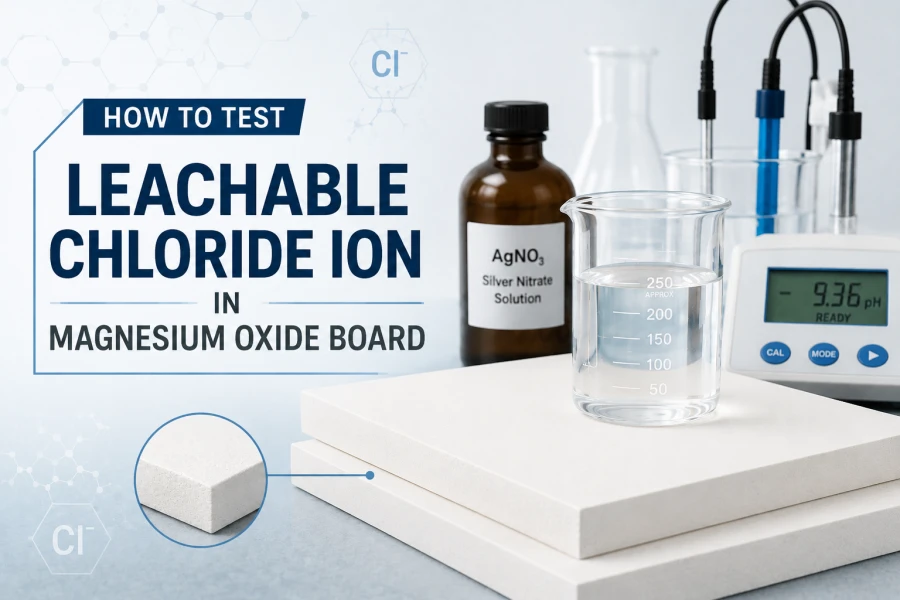
| Chloride Ion Content | <10% (if chloride-based) | Avoids corrosion and leaching |
| Flexural Strength | >10 MPa | Ensures load-bearing ability |
| Freeze-Thaw Resistance | Passed 25–50 cycles | For exterior or cold regions |
| Density | 0.95–1.25 g/cm³ | Affects strength and handling |
3. How to Identify High-Quality Magnesium Oxide MgO Board
Here are signs you’re working with a premium board:
✅ Clean, smooth surface with no powdering or crumbling
✅ Even thickness across the panel
✅ Fiberglass mesh embedded in both faces
✅ No odor or sticky residue
✅ Clear edge markings (batch number, thickness, brand)
Red Flags:
- Boards that absorb moisture in open air
- No certifications or test reports
- Hollow or “drummy” sound when tapped
- Visible salt leaching (white powder on surface)
4. Common Pitfalls When Importing MgO Board
Whether you’re sourcing from China, Vietnam, or India, be cautious of the following:
- Unsealed boards for exterior use
- No vapor barrier instructions provided
- Density lower than stated (boards may deform under load)
- Container damage due to poor export packaging
- No chloride-soaking process (if using MgCl₂ type)
Work only with suppliers who can issue full quality control documents, including test reports, material safety data sheets (MSDS), and packaging specs.
5. Applications and Thickness Recommendations
| Application | Suggested Thickness |
|---|---|
| Interior Wall Panel | 6mm–12mm |
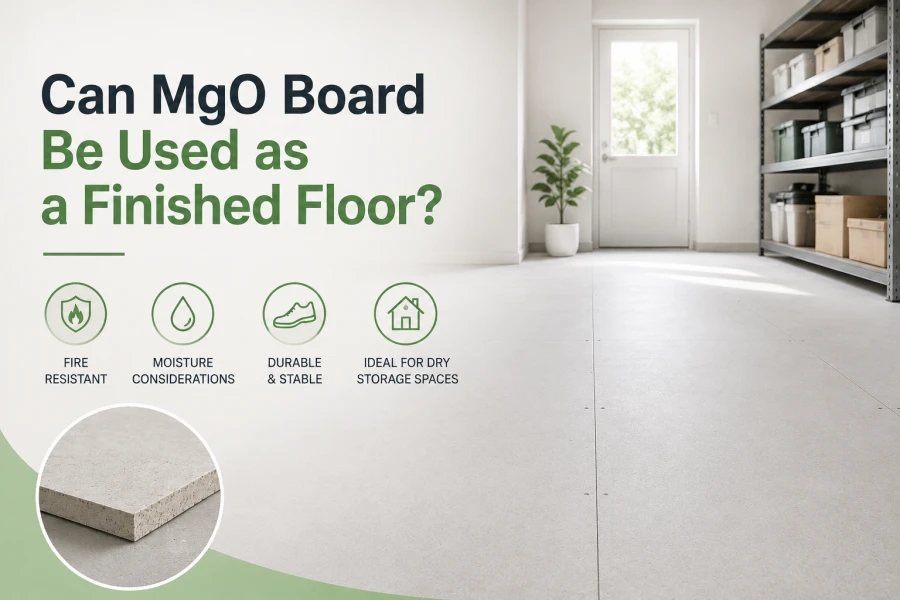
| Subflooring | 18mm–20mm |
| Ceiling / Soffit | 5mm–8mm |
| Tile Backer | 10mm–12mm |
| Fire-Rated Partition | 12mm+ |
6. Why Choose Suparna MgO Board?
At Suparna, we specialize in high-quality magnesium oxide MGO boards designed for international projects. Whether you need a structural-grade floor panel or a fireproof ceiling board, we deliver consistency, certification, and support.
✅ What Sets Us Apart:
- We offer both chloride-based and sulfate-based magnesium oxide MGO Boards, with guidance on where to use
- Chloride-based products go through an advanced soaking and curing process to eliminate free chloride ions
- Edge sealing and waterproof coatings available upon request
- Custom sizes, densities, and edge profiles (Square, T&G) are supported
- Export-ready packaging with protection
7. FAQ: Choosing and Using Magnesium Oxide MgO Board
Q1: Can MgO board be used outdoors?
Yes, if it’s properly sealed and/or sulfate-based. Always use vapor barriers and weather protection in exposed environments.
Q2: Is MgO board better than cement board?
MgO board is typically lighter, easier to cut, more fire-resistant, and has no silica dust. However, quality varies, so always compare specs.
Q3: How do I know if the MgO board will return salts (crying)?
Ask your supplier for chloride ion content and test reports. Boards with chloride >10% and no curing process are more likely to leach salts.
Final Thoughts
Choosing the right magnesium oxide MgO board is not just about price—it’s about ensuring safety, longevity, and performance. With the right specs, certifications, and supplier support, MgO board can transform the way you build.
If you’re a builder, contractor, or distributor looking for high-quality MgO board at competitive pricing, Suparna is ready to help.
📩 Ready to Source MgO Boards?
Get in touch with our technical team to:
- Request test reports and samples
- Learn the difference between chloride and sulfate magnesium oxide MgO Boards
- Get a customized export quote for your project
Latest Posts