What is HS Code & Why It Matters
The Harmonized System (HS) Code is an internationally standardized system of names and numbers used to classify traded products. Every product imported or exported is assigned a unique HS code, which helps customs authorities determine tariffs, taxes, and regulatory requirements.
For building materials like magnesium oxide boards (MgO boards), knowing the correct HS code is crucial. It ensures smooth customs clearance, avoids misclassification penalties, and helps importers accurately calculate duty and VAT.
This guide provides a detailed overview of the HS code for MgO boards, related customs regulations, and the recent policy changes affecting export tax rebates in China.
HS Code for Magnesium Oxide Board
Magnesium oxide boards (MgO boards) are classified under HS Code 680800. This code covers “Panels, boards, tiles and similar articles, agglomerated with cement, plaster, or other mineral binders.”
By using this code, customs authorities recognize MgO boards as mineral-bonded construction panels. Proper classification under 680800 is essential for importers and exporters to comply with international trade regulations and to determine applicable tariffs and VAT rates.
It is important to note that although MgO boards are sometimes compared with fiber cement boards or gypsum boards, their composition and mineral binder make them distinctly eligible for HS 680800. Misclassifying the product can lead to delays, fines, or unexpected duties at the destination port.
Why MgO Board = 680800
Magnesium oxide boards are classified under HS Code 680800 primarily because of their composition and manufacturing method. These boards are made by combining magnesium oxide with mineral binders, resulting in a rigid, fire-resistant panel.
Customs classification depends on the material type, binder used, and component:
- Mineral-bonded panels → HS 6808
- Gypsum boards → HS 6809
- Fiber cement boards → HS 6811
MgO boards do not contain significant cellulose fibers like fiber cement boards, nor are they primarily composed of gypsum. Their mineral binder structure and usage in construction panels make HS 680800 the correct classification.
Understanding this distinction is crucial for importers to avoid misclassification, which could result in unexpected tariffs, shipment delays, or even rejection by customs. Proper documentation should always reflect the material type and HS code.
HS Code of Common Building Boards
When importing or classifying building boards, it is important to understand the differences between common types of boards. Below is a comparison of widely used construction boards, including magnesium oxide boards, fiber cement boards, gypsum boards, OSB, plywood, and calcium silicate boards:
| Product | HS Code (Most Common) | Composition |
|---|---|---|
| Magnesium Oxide Board (MgO) | 680800 | Mineral binder + magnesium oxide |
| Fiber Cement Board | 681182 | Cement + cellulose fiber |
| Gypsum Board | 680911 | Gypsum + paper backing |
| OSB (Oriented Strand Board) | 441012 | Wood strands + adhesives |
| Plywood | 441233 | Wood veneers + glue |
| Calcium Silicate Board | 680690 | Calcium silicate + mineral binder |
Note: HS codes listed above are the most commonly used for these products. Actual codes may vary depending on country, product composition, or manufacturing method. Always confirm the correct HS code with your supplier or local customs before import.
This comparison helps importers and exporters choose the correct HS code, avoid misclassification, and ensure smooth customs clearance.
Import Duty and Documents
Importing magnesium oxide boards under HS Code 680800 requires careful attention to customs duties, VAT, and required documentation. While the exact duty rate varies by country, understanding the general requirements can help avoid delays or unexpected costs.
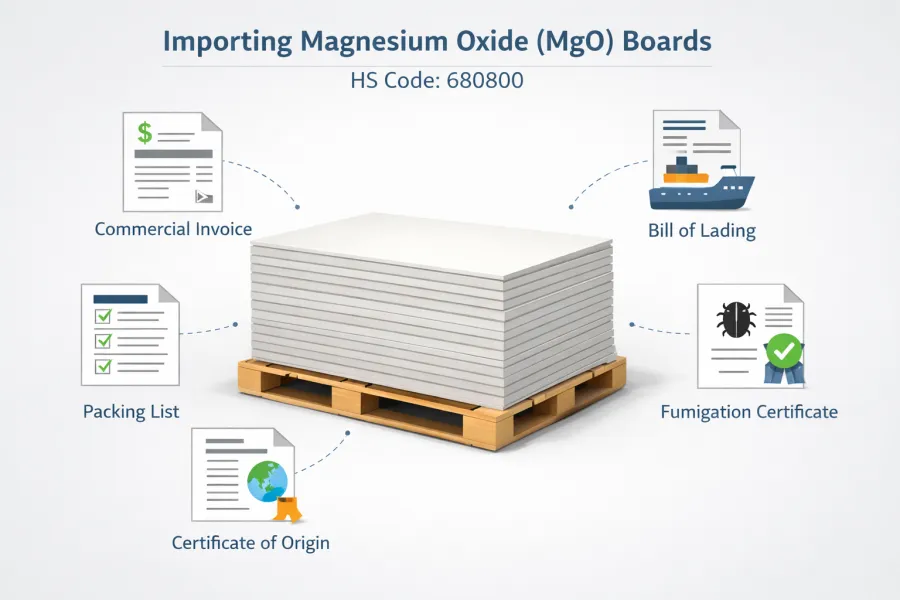
Common import requirements for MgO boards include:
- Commercial Invoice – Clearly stating product description, quantity, unit price, and total value.
- Packing List – Detailing the number of pallets, boards per pallet, and dimensions.
- Bill of Lading / Airway Bill – Proof of shipment and transportation details.
- Certificate of Origin – Required for certain countries to apply preferential tariffs or trade agreements.
- Fumigation Certificate – If wooden pallets are used, some countries require fumigation to prevent pests.
Duty and VAT Considerations:
- The customs duty is calculated based on HS code, declared value, and country-specific tariffs.
- VAT is generally applied at the destination country and may be refundable for certain business imports.
Proper documentation and accurate HS code declaration are essential to ensure smooth customs clearance and avoid penalties.
China Export VAT Rebate Policy Update (2026)
According to the Ministry of Finance and State Taxation Administration of China (Announcement No. 2, 2026), starting from April 1, 2026, the export VAT rebate for certain products, including magnesium oxide boards under HS Code 680800, will be cancelled.
Previously, Chinese exporters could claim a refund of the value-added tax (VAT) paid during production when exporting MgO boards. This rebate helped reduce the overall export cost and made Chinese MgO boards more competitive in the international market.
After this policy change, exporters will no longer receive the VAT refund, which may result in higher export costs. Buyers importing MgO boards from China should be aware that international prices may increase, depending on how individual manufacturers adjust their pricing.
While this change does not directly affect customs duties or HS codes at the destination, it increases the cost burden on Chinese exporters, and some of this additional cost may be reflected in the CIF or FOB price offered to importers.
Impact on MgO Board Export Prices
The cancellation of the export VAT rebate is expected to have a noticeable effect on the export pricing of magnesium oxide boards. Although the HS code and customs duty remain unchanged, the production cost for Chinese manufacturers will effectively increase, since the VAT paid during production is no longer refundable.
Potential impacts on pricing and orders include:
- Higher CIF/FOB Prices: Manufacturers may adjust their export quotations to reflect the lost rebate.
- Minimum Order Quantity Considerations: Smaller orders or sample shipments may become proportionally more expensive.
- Profit Margin Pressure: Exporters may prioritize larger orders to maintain profitability.
- Strategic Pricing: Some suppliers may absorb part of the additional cost to remain competitive, while others may pass it entirely to buyers.
Importers should communicate with suppliers for updated quotations after April 2026 and plan budgets accordingly. Being aware of this policy change allows buyers to anticipate price adjustments and make informed purchasing decisions.
Tips for Importers & Common Mistakes
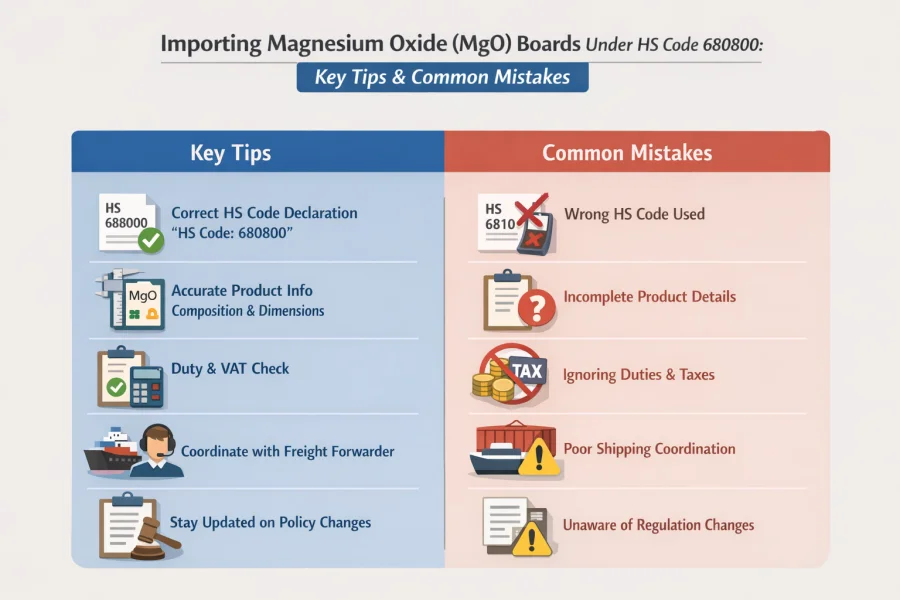
Importing magnesium oxide boards requires careful attention to classification, documentation, and local regulations. The following tips can help importers avoid common mistakes:
1. Always Declare the Correct HS Code
- Use 680800 for MgO boards.
- Do not misclassify as fiber cement, gypsum, OSB, or plywood. Misclassification can lead to fines or shipment delays.
2. Provide Accurate Product Information
- Clearly state the material composition, dimensions, thickness, and quantity on invoices and packing lists.
- Include test reports for fire resistance or structural use if required.
3. Understand Local Duty and VAT Requirements
- Duties vary by country; always check the latest tariff schedules.
- VAT may be refundable for business imports but must be calculated correctly.
4. Coordinate with Reliable Freight Forwarders
- Ensure that shipping, port handling, and customs clearance are handled professionally.
- Avoid delays caused by incomplete documentation or incorrect labeling.
5. Be Aware of Policy Changes
- Policy changes like the 2026 export VAT rebate cancellation means higher export prices may apply.
- Confirm current quotations and terms with your supplier before placing an order.
Following these tips will help importers minimize risks, reduce costs, and ensure smooth clearance for magnesium oxide boards.
Conclusion
Magnesium oxide boards (MgO boards) are classified under HS Code 680800, reflecting their mineral-bonded composition. Correct HS code declaration is crucial for smooth customs clearance, accurate duty calculation, and compliance with import regulations.
The recent 2026 policy update in China, which cancels the export VAT rebate for MgO boards, may lead to higher export costs and affect international pricing. Importers should be aware of these changes and coordinate closely with suppliers and freight forwarders to ensure accurate documentation and timely shipments.
Want to ensure your magnesium oxide board imports are smooth and compliant? Contact us today for expert guidance on HS codes, duties, and documentation.
Latest Posts