Introduction
Magnesium Oxide (MgO) board has become an increasingly popular building material in global construction markets due to its excellent fire resistance, moisture resistance, durability, and environmental performance. It is widely used in modular housing, SIP panels, interior partitions, subflooring systems, and passive fire protection applications.
As demand continues to grow, many distributors, contractors, and building material importers are looking beyond local suppliers and considering direct sourcing from China. With large-scale production capacity, competitive pricing, and flexible customization options, China has become one of the primary global manufacturing bases for MgO boards.
However, importing construction materials is not as simple as placing an order online. Factors such as technical specifications, minimum order quantity (MOQ), quality control, packaging standards, shipping arrangements, customs clearance, and payment terms all require careful planning. Without proper understanding, buyers may face risks such as inconsistent density, shipping damage, unexpected duties, or delays.
This step-by-step guide will walk you through the entire process of importing magnesium oxide board from China — from defining product requirements and evaluating manufacturers to managing logistics and avoiding common mistakes. Whether you are an experienced distributor or exploring bulk purchasing for the first time, understanding these key steps can help you reduce costs, minimize risks, and build a stable long-term supply chain.
Step 1: Define Your Technical Requirements Clearly
Before contacting any manufacturer, the most important step is to clearly define your technical requirements. Many importing problems occur not because of shipping or payment issues, but because the product specifications were not properly confirmed in advance.
Magnesium oxide board is not a single standardized product. Its performance can vary significantly depending on raw materials, formulation, density, and surface treatment. Therefore, providing detailed specifications at the beginning will save time, reduce misunderstandings, and ensure consistent quality.
Below are the key factors you should define:
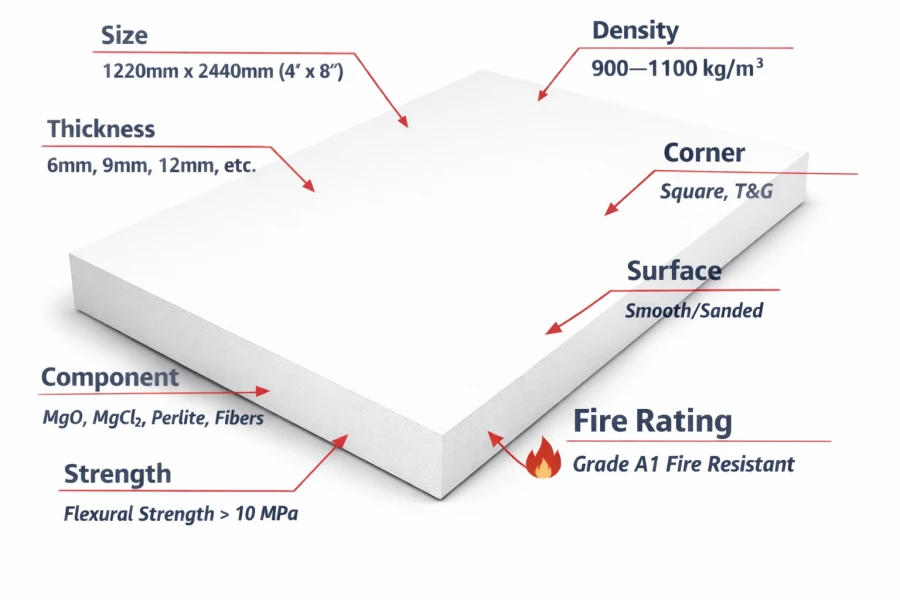
1.1 Thickness and Dimensions
Common thicknesses include:
6mm
8mm
10mm
12mm
15mm
18mm
Standard sheet sizes are often:
1220 × 2440 mm (or 1200 × 2400 mm)
1200 × 3000 mm
However, many Chinese manufacturers can produce customized sizes for container optimization or project requirements.
You should confirm:
Required thickness tolerance
Length and width tolerance
Whether square edge or tapered edge is needed
1.2 Density and Strength
Density directly affects strength, weight, and application suitability.
Typical density ranges:
900–1100 kg/m³ (lighter, interior wall)
1100–1300 kg/m³ (subflooring systems)
1300–1400+ kg/m³ (higher strength applications)
Higher density usually means:
Better impact resistance
Higher screw holding capacity
Improved fire performance
But it also increases weight and shipping cost.
Always request:
Density test report
Bending strength data
Compressive strength data (if for flooring or structural use)
1.3 Fire Rating Requirements
One of the main reasons buyers choose MgO board is fire resistance.
You should clarify:
Required fire resistance duration (e.g., 1-hour, 2-hour system)
Whether the board is used as part of a tested wall assembly
Remember:
Fire rating often depends on the full wall system, not just the board alone.
Request official test reports issued by recognized laboratories.
1.4 Moisture Resistance and Climate Conditions
If the board will be used in:
Humid climates
Coastal regions
Prefabricated housing
Exterior sheathing
You must confirm moisture performance.
Important checks:
Water absorption rate
Dimensional stability after water exposure
Anti-corrosion performance (especially for chloride-based boards)
Some manufacturers use improved formulations or special treatments to enhance moisture stability. Clarify this before ordering.
1.5 Chloride-Based vs Sulfate-Based MgO Board
There are two main formulations:
Magnesium chloride board
Magnesium sulfate board
Each has advantages and limitations in terms of cost, corrosion risk, and compatibility with other materials.
If your project involves:
Steel framing
Humid environment
PVC lamination
Long-term durability requirements
You should discuss formulation details with the manufacturer to ensure suitability.
👉️ More differences between magnesium chloride board and magnesium sulfate board
1.6 Surface Treatment and Finishing
MgO boards can be supplied as:
Sanded surface
Smooth surface
PVC laminated
Coated or primed
For interior decorative applications, surface flatness and smoothness are important. For flooring baseboards, impact resistance may be more critical. Clearly state your final application when requesting a quotation.
1.7 Edge Type and Machining Requirements
Depending on installation method, you may need:
Square edge
Shiplap edge
Tongue & groove
Pre-cut holes or CNC machining
If further processing (cutting, routing, drilling) will be done, confirm tolerances and corner finishing requirements.
1.8 Final Advice for Step 1
The more detailed your technical specification sheet is, the easier it will be to compare suppliers fairly. Avoid simply asking for “best price per sheet” without confirming density, formulation, and performance standards.
A professional manufacturer should be able to:
Provide full technical data sheet (TDS)
Provide fire test reports
Explain formulation differences
Recommend suitable density for your application
Taking time to define requirements at this stage will significantly reduce quality disputes, shipment delays, and unexpected performance issues later in the process.
Step 2: Find and Verify Reliable MgO Board Manufacturers in China
After defining your technical requirements, the next step is finding a reliable manufacturer. This stage determines whether your import process will be smooth and profitable—or filled with quality disputes and delays.
China has hundreds of suppliers offering magnesium oxide boards. However, not all of them are real manufacturers. Some are trading companies, some outsource production, and some lack stable quality control systems.
A structured verification process is essential.
2.1 Where to Search for Suppliers
You can start from the following channels:
Industry exhibitions
Google search
Referrals from industry contacts
However, online presence alone does not prove manufacturing capability. Many suppliers display similar photos, identical product descriptions, and copied technical data. Therefore, initial screening should focus on identifying real factories.
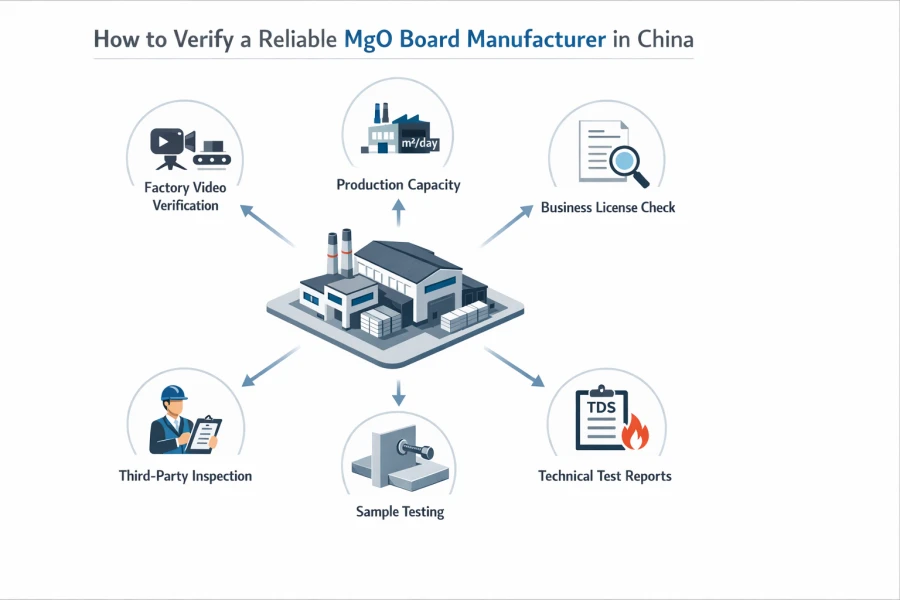
2.2 How to Identify a Real Manufacturer
Here are practical ways to evaluate whether a supplier is a genuine producer:
✔ Ask for Factory Videos
Request:
Production line video
Raw material mixing process
Board forming and curing area
Cutting and sanding section
Warehouse loading area
A real factory can provide updated videos with today’s date upon request.
✔ Check Production Capacity
Ask:
Daily production capacity (square meters per day)
Number of production lines
Number of workers
Lead time for a full container
Be cautious if:
Lead time is extremely short but factory size appears small
Capacity claims are unrealistic
Consistency between claimed capacity and visible facilities is important.
✔ Request Business License
Check:
Company registration name
Business scope
Years in operation
Manufacturers usually have “building materials manufacturing” or similar listed in their business scope.
2.3 Request Technical Documentation
Professional suppliers should provide:
Technical Data Sheet (TDS)
Fire test reports
Density test reports
Bending strength reports
Moisture resistance test reports
Important:
Verify whether the test reports:
Match the product density you are ordering
Come from recognized laboratories
Are recent (not outdated by many years)
If fire rating is critical for your market, confirm that the report standard matches your country’s requirements.
2.4 Ask About Raw Materials and Formulation
Magnesium oxide board quality depends heavily on:
Active MgO content
Type of magnesium salt (chloride or sulfate)
Fillers used
Fiberglass mesh reinforcement
Ask direct questions such as:
What grade of MgO powder do you use?
What is the active MgO percentage?
Do you use double-layer fiberglass mesh?
A knowledgeable manufacturer should answer clearly and confidently.
If answers are vague, it may indicate limited technical control.
2.5 Evaluate Communication Quality
This is often overlooked but extremely important.
Good signs:
Clear and professional replies
Fast response time
Willingness to explain technical details
Transparent discussion of limitations
Warning signs:
Avoiding specific technical questions
Changing density after quoting
Refusing to provide test reports
Over-promising unrealistic performance
Remember:
If communication is unclear before payment, it will be worse after payment.
2.6 Sample Evaluation Before Bulk Order
Never skip sample testing.
Before placing a container order:
Request samples with the exact density you will order
Test bending strength
Test screw holding strength
Check surface flatness
Check edge finishing
If your project is large or long-term, consider third-party inspection before shipment.
The cost of inspection is small compared to the cost of a defective container.
2.7 Visit the Factory (If Possible)
For long-term cooperation or exclusive distribution, factory visits are highly recommended.
On-site verification allows you to:
Confirm actual production scale
Observe curing conditions
Evaluate storage environment
Meet technical team
If visiting is not possible, consider:
Third-party audit services
Video factory tours with live interaction
2.8 Final Advice for Step 2
The cheapest supplier is rarely the safest choice.
Focus on:
Stable formulation
Consistent density
Verified fire performance
Transparent communication
Clear documentation
A reliable manufacturer should behave like a long-term partner, not just a short-term seller.
Choosing the right factory at this stage will determine:
Product consistency
Customer satisfaction
Your reputation in your local market
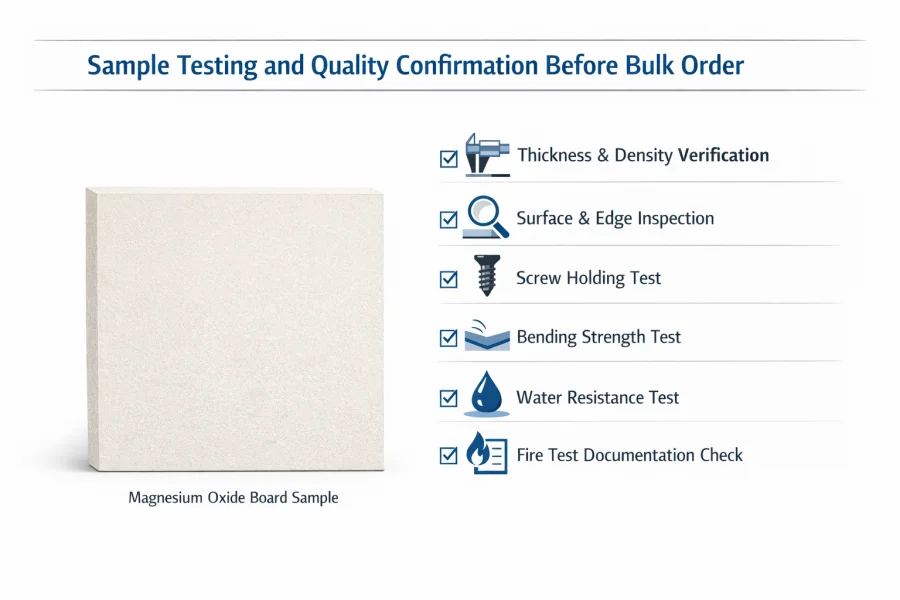
Step 3: Sample Testing and Quality Confirmation Before Bulk Order
Even if a manufacturer looks professional and provides complete documentation, you should never place a bulk order without testing samples.
Magnesium oxide board performance can vary significantly depending on formulation, density, curing conditions, and reinforcement materials. Two boards with the same thickness may perform very differently in strength, stability, and moisture resistance.
A proper sample evaluation process protects you from costly container-level mistakes.
3.1 Request Samples With Exact Order Specifications
When requesting samples, clearly confirm:
Thickness
Density
Surface treatment (raw / sanded / laminated)
Edge type (square edge / tongue & groove / CNC cut)
Reinforcement structure
Do not accept “standard sample” if it does not match your intended order density.
For example: A 10mm board at 1000kg/m³ performs very differently from 10mm at 1200kg/m³.
Always test the exact specification you plan to import.
3.2 Perform Basic Physical Inspection
Once you receive the samples, check:
✔ Surface Quality
Is the surface smooth and even?
Are there cracks or surface dusting?
Is fiberglass mesh visible?
✔ Edge Quality
Are edges straight?
Any corner breakage?
Any delamination?
✔ Flatness
Lay the board on a flat surface and check warping.
Warped boards may indicate:
Improper curing
High internal stress
Unbalanced moisture content
3.3 Test Mechanical Performance
If possible, conduct simple practical tests:
✔ Screw Holding Strength
Insert screws near edge and center
Check cracking or splitting
✔ Bending Strength
Support both ends and apply pressure in the middle
Observe cracking or deformation
✔ Impact Resistance
Light impact test can reveal brittleness.
For professional importers, third-party lab testing is recommended, especially for large orders.
3.4 Check Moisture Resistance
Moisture performance is critical for MgO boards.
You may perform:
Short-term water immersion test
Observe edge swelling
Check surface softening
Check for structural separation
Excessive expansion indicates poor formulation or improper magnesium salt balance.
For humid or coastal markets, this step is essential.
3.5 Confirm Fire Performance Documentation Matches Sample
Fire rating is a major selling point of MgO boards. However:
Test reports must match your density and thickness.
Some suppliers show reports for higher-density boards but ship lower-density material.
Always confirm:
Test standard (EN, ASTM, etc.)
Board thickness tested
Board density tested
If fire compliance is legally required in your country, consider sending sample to a local certified laboratory.
3.6 Compare Multiple Suppliers
If possible, order samples from 2–3 suppliers.
Evaluate:
Weight consistency
Surface quality
Packaging condition
Communication efficiency
Technical transparency
The small cost of extra samples can prevent thousands of dollars in loss.
3.7 Confirm Production Consistency Before Container Order
Before placing the bulk order, reconfirm:
The sample batch formula will be used for mass production.
Density tolerance range.
Thickness tolerance range.
Moisture content control.
Ask the supplier to confirm in written form.
Consistency is more important than perfection.
3.8 Consider Pre-Shipment Inspection
For container-level orders, especially first cooperation:
Hire third-party inspection before loading.
Check random boards for thickness and density.
Confirm packaging integrity.
Inspection cost is minimal compared to freight + customs + damage risk.
3.9 Why Step 3 Is Critical
Skipping sample validation often leads to:
Density inconsistency
Poor screw holding strength
Surface delamination
Moisture expansion problems
Customer complaints
Once goods are shipped overseas, quality disputes become complex and expensive.
A systematic sample approval process gives you control before committing to full payment and international freight.
Step 4: Pricing Structure, MOQ, and Total Import Cost Breakdown
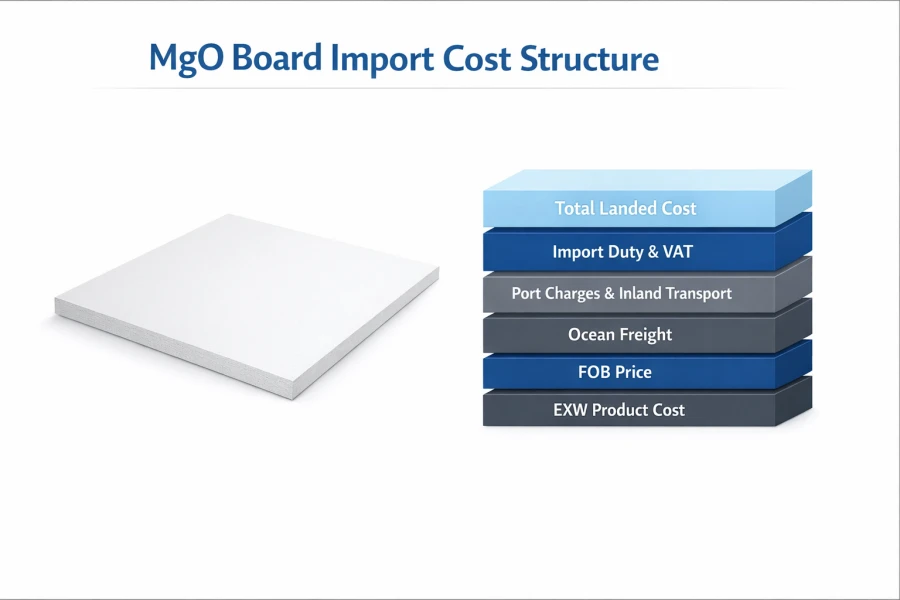
Understanding the full cost structure is essential before importing magnesium oxide board from China. Many buyers only compare the unit price per board, but the real import cost includes multiple components beyond factory pricing.
A clear cost breakdown helps you evaluate profitability, avoid hidden expenses, and negotiate more effectively.
4.1 Ex-Factory Price vs FOB Price
When requesting a quotation, you will usually receive either:
EXW (Ex-Works) price
FOB (Free on Board) price
EXW price includes only the product cost at the factory.
You are responsible for:
Inland transportation
Export customs clearance
Port handling fees
Loading charges
FOB price includes:
Product cost
Inland transport to port
Export documentation
Customs clearance
Loading onto vessel
For first-time importers, FOB is generally simpler and more predictable.
Always confirm:
Which port? (e.g., Qingdao, Shanghai, Tianjin)
Whether pallet packaging is included
Whether fumigation (if wooden pallets) is included
4.2 What Determines MgO Board Price?
MgO board pricing depends on several technical factors:
✔ Thickness
Thicker boards cost more due to raw material consumption.
✔ Density
Higher density = more material = higher cost.
For example:
1000kg/m³ board is cheaper than 1200kg/m³ board.
✔ Surface Treatment
Raw board
Sanded board
PVC laminated board
HPL laminated board
Lamination increases cost due to additional materials and processing.
✔ Reinforcement Structure
Multiple-layer fiberglass mesh or special additives may increase price.
✔ Customization
Special sizes
CNC cutting
Edge profiling
Logo printing
Customization typically increases MOQ and cost.
4.3 Typical Minimum Order Quantity (MOQ)
MgO board is heavy and bulky, so manufacturers usually prefer:
1 × 20GP container minimum
Why?
Because:
Inland transport cost is high.
Export documentation cost is fixed.
Small orders increase damage risk.
A 20GP container typically loads:
400–600 boards (depending on thickness)
Some suppliers may accept smaller orders, but unit price will increase significantly.
4.4 Ocean Freight Cost Considerations
Ocean freight depends on:
Destination country
Port congestion
Season
Container type (20GP vs 40HQ)
MgO board is heavy, so shipments are usually weight-limited before volume-limited.
For example:
A 20GP container may reach maximum weight limit before fully filling space.
Always calculate:
Total weight per container × freight rate
Freight fluctuations can significantly impact landed cost.
4.5 Total Landed Cost Calculation
Your final import cost includes:
FOB product cost
Ocean freight
Marine insurance
Import duty
VAT or local taxes
Port handling charges
Inland transport in destination country
Many buyers underestimate local port charges and customs broker fees.
Before placing an order, ask your freight forwarder for a full landed cost estimate.
4.6 Payment Terms
Common payment terms when importing from China:
30% T/T deposit + 70% balance before shipment
100% L/C at sight (for larger orders)
For first cooperation:
Smaller trial order is recommended.
Avoid 100% advance payment.
Always confirm:
Payment currency (USD usually)
Bank charges responsibility
4.7 Hidden Cost Risks to Watch
Be careful about:
✔ Extremely low price offers may indicate:
Lower density
Reduced magnesium content
Inconsistent curing
✔ Unclear density specification
Some suppliers quote by thickness only.
✔ Damage due to poor packaging
Boards must be tightly strapped and corner-protected.
✔ Moisture issues during shipping
Proper wrapping and container protection are necessary.
4.8 Profitability Perspective
Importing directly from China can reduce purchasing cost by 20–40% compared to local distributors in many markets.
However, successful importing depends on:
Clear technical specification
Proper supplier selection
Accurate freight calculation
Risk control before shipment
Price advantage only becomes real profit when quality is stable and logistics are well managed.
Step 5: Logistics, Shipping, and Documentation (B/L, Packing List, CO, etc.)
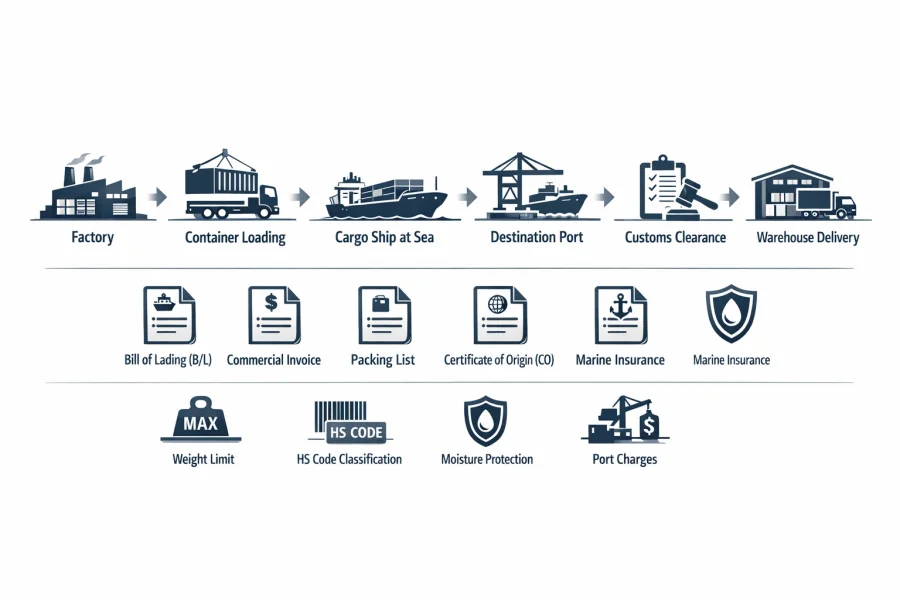
Once production is completed and quality is confirmed, the next critical stage is arranging shipment and preparing export documentation.
For many first-time importers, this is where confusion and unexpected costs may occur. Understanding the shipping process and required documents will help ensure smooth customs clearance and avoid delays.
5.1 Choosing the Right Shipping Method
Magnesium oxide board is heavy and large, so ocean freight is the most common shipping method.
✔ FCL (Full Container Load)
For bulk orders, FCL is recommended.
Advantages:
Lower cost per unit
Reduced handling damage
Faster customs clearance
Better moisture protection
Most MgO board shipments use:
20GP container (weight-limited)
40HQ for large specifications (such as 3000mm in length)
Because MgO boards are dense, shipments usually reach maximum weight before filling container volume.
✔ LCL (Less than Container Load)
LCL is possible for small orders, but not ideal.
Disadvantages:
Higher per-unit shipping cost
Increased handling damage risk
More complicated consolidation process
Longer transit time
For construction materials like MgO boards, LCL is generally not recommended unless the quantity is very small.
5.2 Container Loading and Packaging
Proper packaging is critical to prevent:
Edge breakage
Surface damage
Moisture exposure
Warping during transit
Standard export packaging usually includes:
Wooden pallets (fumigated if required)
Plastic wrapping
Corner protectors
Strong strapping
Before shipment, confirm:
Total gross weight
Number of pallets
Container loading photos
Request loading photos as proof before final payment.
5.3 Key Export Documents Explained
When importing MgO boards from China, you will typically receive the following documents:
✔ Bill of Lading (B/L)
The Bill of Lading is the most important shipping document.
It serves as:
Proof of shipment
Receipt of goods
Document of title
Key information on B/L includes:
Shipper
Consignee
Notify party
Port of loading
Port of discharge
Container number
Gross weight
Description of goods
Always carefully check:
Company names (must match business registration)
HS code
Weight accuracy
Product description
Any mistake can delay customs clearance.
✔ Commercial Invoice
The Commercial Invoice includes:
Seller and buyer information
Product description
Unit price
Total amount
Trade term (FOB, CIF, etc.)
Payment terms
Customs will use this document to calculate import duties.
✔ Packing List
The Packing List details:
Number of pallets
Number of boards per pallet
Net weight
Gross weight
Dimensions
Customs and warehouse staff rely on this for inspection.
✔ Certificate of Origin (CO)
Some countries require a Certificate of Origin to determine:
Applicable import duties
Trade agreement benefits
Confirm with your customs broker whether CO is required in your country.
✔ Other Possible Documents
Depending on your market, you may also need:
Fumigation certificate (for wooden pallets)
Inspection certificate
Fire test reports
CE or other compliance documentation
Always confirm import requirements before shipment.
5.4 Shipping Timeline Overview
Typical export timeline:
Production: 15–25 days
Inland transport to port: 2–5 days
Vessel departure waiting time: 3–7 days
Ocean transit: 15–60 days (depending on destination)
Plan inventory accordingly.
Delays may occur due to:
Port congestion
Customs inspection
Peak shipping seasons
Never schedule project delivery too close to estimated arrival date.
5.5 Customs Clearance Preparation
Before vessel arrival:
Send all documents to your customs broker in advance
Confirm HS code classification
Prepare import duty payment
Incorrect HS code classification may result in higher duty or inspection delay.
Work with an experienced customs agent if this is your first import.
5.6 Marine Insurance
Although not mandatory under FOB terms, marine insurance is strongly recommended.
Shipping risks include:
Container water leakage
Rough sea conditions
Loading damage
Insurance cost is relatively low compared to cargo value.
5.7 Common Logistics Mistakes to Avoid
✔ Not checking B/L details before release
✔ Ignoring container weight limits
✔ Underestimating port charges
✔ Choosing cheapest freight without reliability
✔ Skipping insurance
Logistics is not just transportation — it is risk management.
5.8 Why Step 5 Matters
Even if product quality is excellent, poor logistics management can lead to:
Delayed delivery
Additional port charges
Customs penalties
Customer dissatisfaction
A clear shipping and documentation process ensures that your imported MgO boards arrive safely, legally, and on time.
Step 6: Customs Duties and Import Compliance by Region
Importing magnesium oxide board from China is not only about price and logistics — it also requires compliance with local import regulations, customs duties, and building standards.
Each country has different rules regarding construction materials. Before placing a bulk order, you must clearly understand your local import requirements to avoid delays, penalties, or unexpected costs.
6.1 HS Code Classification
MgO board is typically classified under a building materials HS code.
However, classification may vary depending on:
Board composition
Surface treatment (raw or laminated)
Intended use
Incorrect HS code declaration may result in:
Higher duty rates
Customs inspection
Clearance delays
Fines
Always confirm the correct HS code with your customs broker before shipment.
6.2 Import Duties and Taxes
Import cost depends on:
Your country’s tariff policy
Trade agreements with China
Anti-dumping duties (if applicable)
VAT or GST rates
Typical charges include:
Import duty (percentage of invoice value)
VAT / GST
Port handling fees
Customs clearance service fees
Some countries offer reduced duties if a valid Certificate of Origin (CO) is provided.
Always calculate your landed cost before confirming order quantity.
6.3 Regional Compliance Requirements
✔ European Union (EU)
For construction materials entering the EU market:
CE marking may be required depending on application
Fire performance classification must comply with EN standards
Documentation must match tested product specifications
Importers are legally responsible for ensuring compliance with EU regulations.
Before importing, verify:
Which EN fire standard applies
Whether third-party testing is required
Labeling requirements
✔ United States
In the U.S., compliance may involve:
ASTM fire performance standards
Local building code approval (IBC compliance)
State-level requirements
Customs clearance is usually straightforward, but local building inspectors may require proof of fire rating for commercial projects.
Importers should confirm:
Whether project specification requires certified test reports
Whether additional local testing is needed
✔ Australia and New Zealand
Fire compliance is particularly strict.
Requirements may include:
AS/NZS fire testing standards
Compliance with National Construction Code (NCC)
Documentation for non-combustible classification
Always confirm compliance before promoting the product for fire-rated applications.
✔ Middle East & Southeast Asia
In many developing markets:
Customs procedures are simpler
Fire certification may not always be mandatory
Local distributor approval may be sufficient
However, import documentation must still be complete and accurate.
6.4 Anti-Dumping and Trade Restrictions
Before importing large quantities, check whether your country has:
Anti-dumping duties on building boards from China
Special tariffs on magnesium-based products
Temporary trade restrictions
These policies change over time.
Consult:
Customs broker
Freight forwarder
Official customs website
Do not rely solely on supplier information.
6.5 Product Labeling and Documentation Requirements
Some countries require:
Country of origin marking
Batch number traceability
Fire classification label
Safety data documentation
Failure to comply may result in goods being held at port.
6.6 Pre-Import Checklist
Before confirming shipment:
✔ Confirm HS code
✔ Confirm import duty rate
✔ Confirm required certifications
✔ Confirm documentation format
✔ Confirm labeling requirements
✔ Confirm customs broker arrangement
Import compliance is the buyer’s responsibility in most cases.
6.7 Why Compliance Planning Matters
Many importers focus only on product cost, but unexpected compliance issues can:
Delay delivery by weeks
Increase storage fees
Trigger additional inspections
Damage business reputation
Proper planning ensures your MgO board shipment enters your country smoothly and legally.
6.8 Strategic Advice
If you are importing MgO boards for resale or large construction projects, it is recommended to:
Conduct a small trial shipment first
Verify documentation acceptance
Confirm customs clearance process
Establish long-term cooperation with experienced suppliers
A stable supply chain depends not only on price but also on regulatory reliability.
Conclusion: Simplifying Your MgO Board Import Process
Importing magnesium oxide board from China can significantly reduce procurement costs and improve supply chain flexibility. However, successful importing requires more than simply comparing prices.
From defining technical specifications and verifying samples to managing logistics and ensuring customs compliance, each step plays a critical role in protecting your investment.
Many import challenges — such as density inconsistency, shipping damage, delayed clearance, or documentation errors — can be avoided when working with an experienced and transparent manufacturer.
If you are considering importing MgO boards for distribution, modular construction, SIP panels, subflooring, or fire-rated applications, partnering with a supplier who understands international standards and export procedures can greatly simplify the process.
Suparna has over 20 years of manufacturing and export experience in magnesium oxide boards. We support international buyers with:
Clear specification confirmation before production
Stable density control and quality consistency
Custom sizing and surface treatment options
Professional export packaging
Complete shipping documentation
Responsive technical support
Whether you are planning a trial shipment or a full container order, our team can guide you through each step — from technical consultation to final delivery.
If you would like to discuss your project requirements or request samples, feel free to contact our sales team. We are happy to provide detailed specifications, pricing structure, and shipping guidance tailored to your market.
Importing from China does not have to be complicated — with the right partner, it becomes a structured and manageable process.
Latest Posts