

When you install a new building material indoors, one of the first things you may notice is the smell. This often leads to a common concern:
Does magnesium oxide board (MgO board) have an odor—and if it does, is it safe?
The short answer is:
Yes, MgO board may have a very mild natural odor, but it is not harmful.
In this article, we’ll explain where that smell comes from, what MgO boards are made of, and why it’s considered a safe and environmentally friendly building material.
1. Does Magnesium Oxide Board Have an Odor?
High-quality magnesium oxide boards can have a slight, natural smell, especially when newly produced.
However, this odor is:
- Very mild
- Non-irritating
- Not chemical or pungent
Most people describe it as a subtle, natural material scent, rather than anything artificial or unpleasant.
Importantly, this smell is not associated with harmful emissions, which is a key difference compared to many traditional construction materials.
2. What Is Magnesium Oxide Board Made Of?
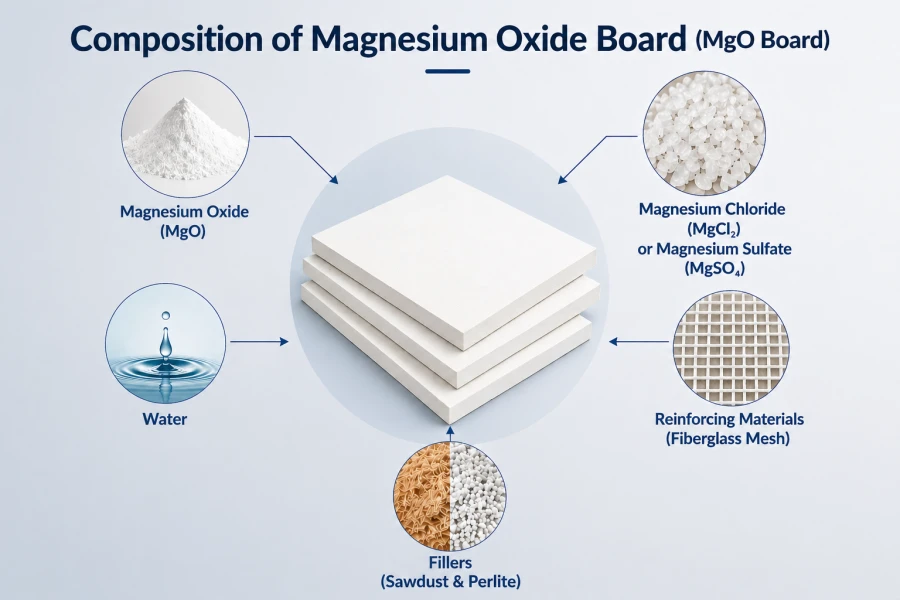
To understand the source of the odor, it helps to look at the composition of MgO boards.
Typical MgO boards are made from:
- Magnesium oxide (MgO)
- Magnesium chloride (MgCl₂) or magnesium sulfate (MgSO₄)
- Water
- Reinforcing materials (such as fiberglass mesh)
- Fillers (such as sawdust and perlite)
These raw materials are inorganic or naturally derived, and on their own:
- They do not have a strong odor
- They do not release harmful gases
Unlike some engineered boards that rely heavily on synthetic resins, MgO boards are formed through a mineral-based reaction process, which contributes to their low-emission profile.
👉 See full components of mgo board
3. Where Does the Smell Come From?
If the raw materials are largely odorless, why does MgO board sometimes have a smell?
The answer lies in the production process, not in harmful chemicals.
Heat Generated During Reaction
During manufacturing, magnesium oxide reacts with magnesium salts in a process that naturally generates heat.
This heat is part of the curing process that gives MgO board its strength and durability. However, it can also slightly affect other components inside the board.
Natural Scent from Organic Fillers
Some MgO boards include small amounts of organic fillers, such as wood fibers or sawdust, to improve structure and performance.
When exposed to heat during production, these materials may release a very light natural scent, similar to:
- Warm wood
- Dry timber
- Natural fiber materials
This is why the smell is often described as: A natural material scent rather than a chemical odor.
It’s important to note that this scent is typically very subtle and not noticeable to everyone.
4. Is the Smell Harmful?
This is the most important question—and the answer is reassuring.
The mild odor from MgO board is not harmful.
High-quality MgO boards are known for being:
- VOC-free (no volatile organic compounds)
- Formaldehyde-free
- Asbestos-free
- Free from radioactive substances
These characteristics make MgO board a safe choice for indoor applications, including:
- Residential housing
- Schools and educational buildings
- Hospitals and healthcare facilities
- Commercial interiors
Many manufacturers also provide independent test reports to verify these properties.
As an experienced and recognized magnesium oxide board manufacturer in China, Suparna provides complete safety documentation for its products. You can view the test reports below (click to open).
- Safety Data Sheet (SDS)
- VOC Test Report
- Asbestos-Free Test Report
- Formaldehyde & Radioactivity Test Report
5. MgO Board vs Traditional Drywall: Odor Comparison
Many users naturally compare MgO board with traditional drywall (gypsum board), especially when it comes to indoor air quality.
Here’s a simple comparison:
| Feature | Gypsum Drywall | MgO Board |
|---|---|---|
| Odor source | Adhesives, coatings, joint compounds | Natural material scent |
| VOC emissions | May contain VOCs | Low to no VOC |
| Smell intensity | Can be noticeable | Very mild |
| Indoor air quality | Acceptable | Improved |
Unlike traditional drywall, which often involves joint compounds, paints, and additives that may release odors, MgO board maintains a more stable and mineral-based composition.
This is one of the reasons why MgO board is increasingly chosen for projects that prioritize health, sustainability, and indoor air quality.
6. Where Is MgO Board Commonly Used Indoors?
Because of its low emissions and safety profile, MgO board is widely used in indoor environments where air quality matters.
Common applications include:
- Interior wall systems
- Ceiling panels
- Subfloor and underlayment systems
- Fire-rated partitions
It is especially popular in:
- Residential buildings
- Schools and universities
- Hospitals and clinics
- Office and commercial spaces
In these environments, minimizing harmful emissions is critical—making MgO board a reliable alternative to traditional materials.

7. When Should You Be Concerned About Odor?
While a mild smell is normal, there are situations where you should pay closer attention.
You may need to investigate further if the odor is:
- Strong or irritating
- Clearly chemical in nature
- Lasting more than 1–2 weeks
- Becoming stronger in humid conditions
These signs could indicate:
- Low-quality raw materials
- Improper manufacturing processes
- Issues with other installation materials (such as adhesives, coatings, or sealants)
In many cases, the source of a strong odor is not the MgO board itself, but other materials used during installation.
8. How to Reduce Any Odor After Installation
If you notice a slight smell after installation, it can usually be reduced quickly with simple steps:
- Improve ventilation (open windows, use fans, increase airflow)
- Control indoor humidity, especially in enclosed spaces
- Allow time for the material to stabilize in the environment
In most cases, any mild odor will fade naturally within a short period.
9. Conclusion: Should You Worry About MgO Board Odor?
In short:
- A slight odor is normal
- The smell comes from natural materials and production processes
- It is not harmful and does not indicate toxic emissions
If indoor air quality is important to your project, magnesium oxide board is often a better alternative to traditional drywall, offering both excellent fire resistance and a cleaner environmental profile.
Choosing a high-quality MgO board from a reliable manufacturer is key to ensuring both performance and safety.
10. FAQ
Does MgO board smell stronger than drywall?
No. In most cases, MgO board has a milder and more natural smell, while drywall odors often come from added chemicals such as joint compounds or coatings.
How long does the odor last?
Typically, any mild odor fades within a few days to a couple of weeks, depending on ventilation and environmental conditions.
Is MgO board safe for indoor use?
Yes. High-quality MgO boards are widely used in indoor environments due to their low emissions and absence of harmful substances.
Can MgO board be used in bedrooms or hospitals?
Yes. Because it does not release VOCs or formaldehyde, MgO board is suitable for sensitive environments where air quality is important.
Why do some boards smell stronger than others?
This is usually related to differences in manufacturing quality, raw materials, or the presence of other installation materials—not the core MgO formulation itself.
Latest Posts