
1. Introduction
When exporting magnesium oxide boards (MgO boards), one of the most common questions from customers is:
“How many boards can be loaded into a container?”
At first glance, many people try to calculate this based on volume. However, in real-world operations, this approach is almost always inaccurate. The actual loading capacity is influenced by multiple factors, and the final number is rarely as simple as a volume calculation suggests.
This guide doesn’t just give you a number—it helps you understand why that number makes sense.
After reading, you will clearly understand:
- How different container types affect loading capacity
- How MgO boards are actually loaded inside a container
- How many magnesium oxide boards can realistically fit into a container
If you’ve ever been confused about container loading quantities, this guide will give you a clear and complete answer.
2. Common Container Types and Specifications
Before discussing loading methods, it is essential to understand the common container types and their basic specifications.
Different containers vary in dimensions and payload capacity, and these differences directly affect the final loading quantity.
2.1 Common Container Types
In the export of magnesium oxide boards (MgO boards), the following three types of dry containers are most commonly used:
20′ GP (20-foot General Purpose Container)
This is the most commonly used small container. Although its internal volume is limited, its payload capacity is not much lower than that of larger containers. Therefore, it is particularly suitable for high-density products, such as MgO flooring boards.
40′ GP (40-foot General Purpose Container)
With approximately double the volume of a 20′ container, it is suitable for products that require more space but have relatively lower density.
40′ HC (40-foot High Cube Container)
With the same length and width as a 40′ GP, but a greater height. The additional height can improve loading efficiency to some extent, especially when pallet height becomes a limiting factor.
Although these three container types may seem similar, in practice, choosing the right one can significantly impact both loading capacity and shipping cost.
2.2 Container Specification Comparison
Below is a comparison of the key specifications of these three commonly used container types:
| Container Type | Length (m) | Width (m) | Height (m) | Door Width (m) | Door Height (m) | Max Payload (t) | Volume (cbm) |
|---|---|---|---|---|---|---|---|
| 20′ GP | 5.90 | 2.35 | 2.39 | 2.34 | 2.28 | 28.20 | 33 |
| 40′ GP | 12.03 | 2.35 | 2.39 | 2.34 | 2.28 | 28.80 | 67 |
| 40′ HC | 12.03 | 2.35 | 2.70 | 2.34 | 2.58 | 28.62 | 76 |
👉 See more container types here
3. Why Container Loading Is Not a Simple Calculation
When asking about loading quantity, many customers use what seems like a logical method: they divide the container volume by the volume of a single board to get a theoretical number.
However, in real-world operations, this method rarely produces an accurate result.
The reason is simple: container loading is not purely a mathematical problem—it is a combination of dimensions, space utilization, and handling constraints.
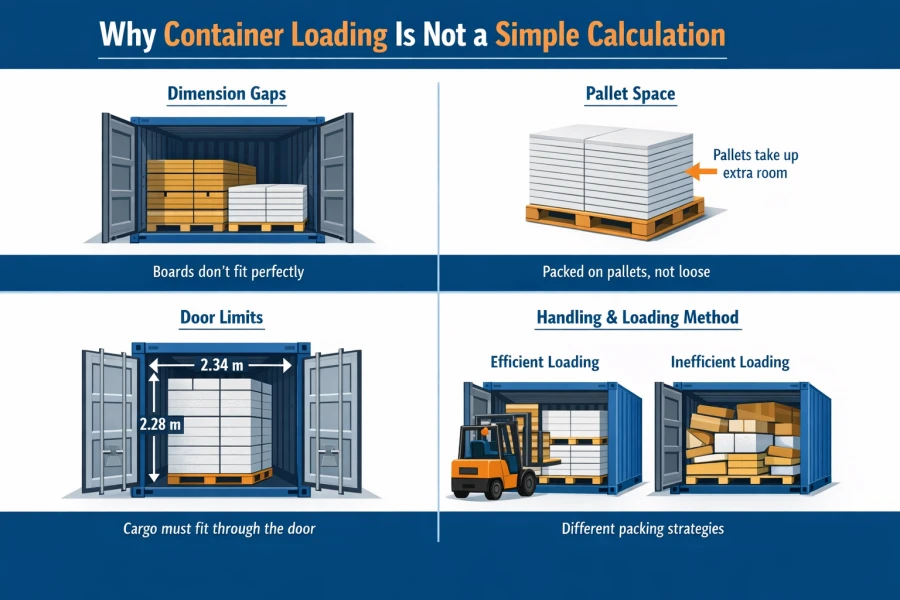
3.1 Dimensions Do Not Fit Perfectly
The internal dimensions of a container are almost never exact multiples of the board size.
For example:
- A common board size is 1220 × 2440 mm
- The internal container width is approximately 2350 mm
This means that along the width, two boards cannot fit perfectly side by side, and some unused space is inevitable.
These “gaps” are often ignored in theoretical calculations, but in practice, they are unavoidable and directly affect the final loading quantity.
3.2 Pallets Occupy Space
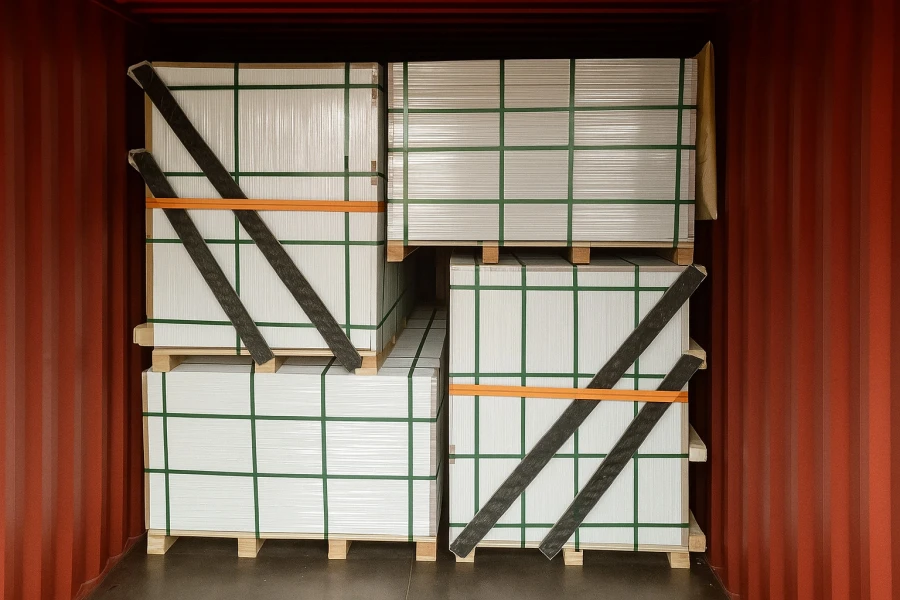
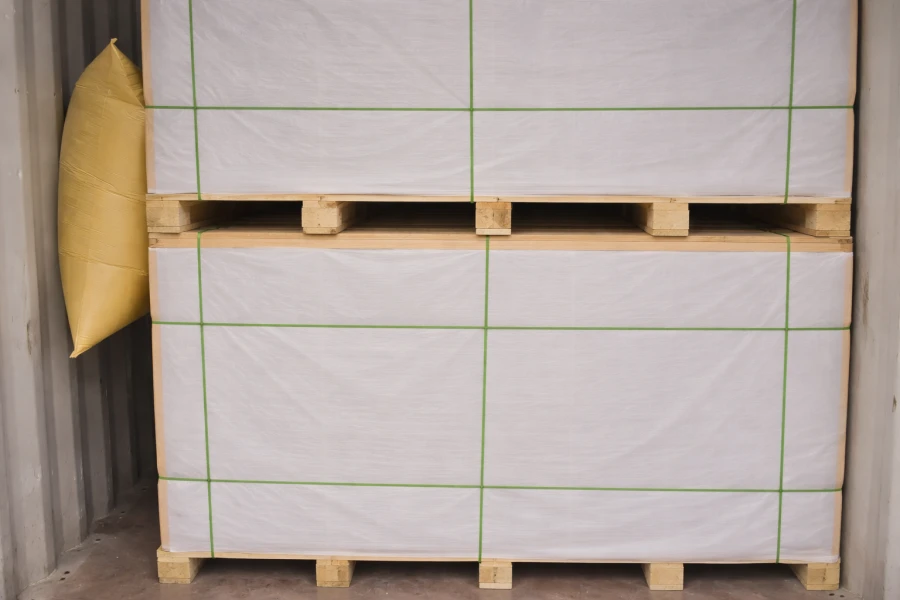
In actual shipping, magnesium oxide boards are rarely loaded loose. Instead, they are typically packed on pallets.
Pallets themselves take up additional space. Therefore, when calculating loading capacity, you must consider the pallet as a whole unit, not just the volume of individual boards.
3.3 Container Door Limitations
Many people focus only on internal container dimensions but overlook a critical constraint:
👉 All cargo must pass through the container door.
For example:
- Door width is typically around 2.34 m
- Door height is typically around 2.28 m
This means:
- Pallet dimensions must be able to pass through the door
- Some loading arrangements that seem feasible “on paper” are simply impossible in practice
3.4 Loading Method Affects Space Utilization
Container loading is not about “filling every inch of space”—it must also consider operational realities such as:
- How forklifts handle the pallets
- How pallets are arranged inside the container
Different loading methods can lead to completely different space utilization rates.
For example, for the same 20′ GP container:
- Different manufacturers may provide significantly different loading quantities
- This difference is not due to calculation errors, but rather different loading strategies
Latest Posts